
Mensuration - Perimeter and Area of 2D Shapes (including Trapeziums and Circles)
Review the key concepts, formulae, and examples before starting your quiz.
🔑Concepts
The perimeter is the total distance around the outside of a 2D shape. For a circle, this distance is called the circumference. For rectilinear shapes, add all side lengths together.
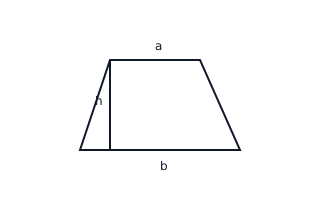
The area of a trapezium is calculated using the average of the two parallel sides multiplied by the perpendicular height: . The height must be perpendicular to the parallel bases.
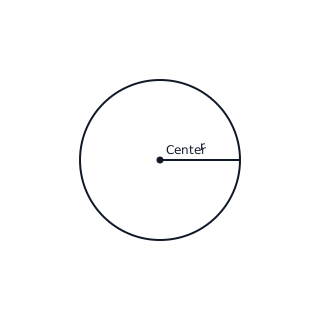
Circles are defined by their radius () or diameter (). The circumference and the area . A diameter is twice the radius: .
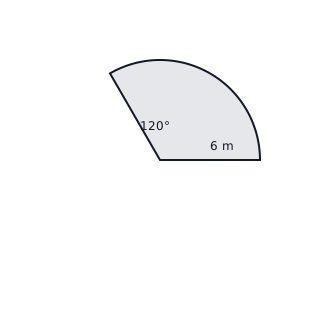
Sectors are fractions of a circle. The arc length and sector area are proportional to the central angle out of .
📐Formulae
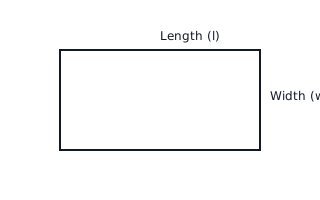
Rectangle: ,
Triangle:
Parallelogram:
Trapezium: (where and are parallel sides)
Circle Circumference: or
Circle Area:
Arc Length:
Sector Area:
💡Examples
Problem 1:
Calculate the area of a trapezium where the parallel sides are 8 cm and 12 cm, and the perpendicular height is 5 cm.
Solution:
Explanation:
Identify the parallel sides and , and height . Plug these into the trapezium area formula .
Problem 2:
Find the circumference and area of a circle with a radius of 7 cm. (Use )
Solution:
;
Explanation:
Use the formulas for circumference and for area. Substituting and allows for easy cancellation.
Problem 3:
A semi-circle has a diameter of 10 cm. Find its total perimeter.
Solution:
. .
Explanation:
The perimeter of a semi-circle consists of the curved arc (half the circumference) PLUS the straight diameter. Failing to add the diameter is a common mistake.
Problem 4:
A flower bed is in the shape of a sector of a circle with a radius of and a central angle of . Calculate the area of the flower bed. (Give your answer in terms of )
Solution:
Explanation:
Substitute the given radius and angle into the sector area formula. Simplify the fraction to and calculate to find the final area.
Problem 5:
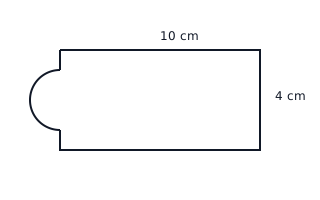
Calculate the area of the composite shape consisting of a rectangle of by with a semi-circle removed from one of the shorter sides.
Solution:
Explanation:
Find the area of the full rectangle first. The diameter of the semi-circle is equal to the width of the rectangle (), so the radius is . Calculate the area of the semi-circle and subtract it from the rectangle's area.