krit.club logo

Mensuration - Converting Units of Area and Volume

Grade 8Cambridge (IGCSE)

Review the key concepts, formulae, and examples before starting your quiz.

🔑Concepts

•

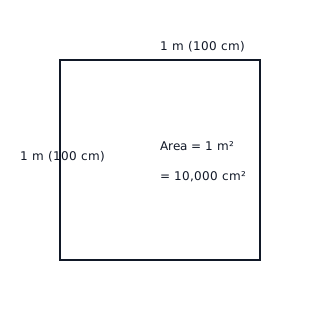
The fundamental principle of converting units of area is that the conversion factor is squared. For example, since 1 m=100 cm1 \text{ m} = 100 \text{ cm}, then 1 m2=(100)2 cm2=10,000 cm21 \text{ m}^2 = (100)^2 \text{ cm}^2 = 10,000 \text{ cm}^2. This can be visualized as a square of side length 1 m1 \text{ m} (or 100 cm100 \text{ cm}) composed of 10,00010,000 tiny 1 cm21 \text{ cm}^2 squares.

A square illustrating the conversion of 1 square meter to 10,000 square centimeters.
•

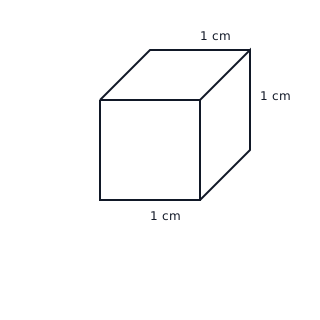
For volume conversions, the linear conversion factor is cubed. Because 1 cm=10 mm1 \text{ cm} = 10 \text{ mm}, it follows that 1 cm3=(10)3 mm3=1,000 mm31 \text{ cm}^3 = (10)^3 \text{ mm}^3 = 1,000 \text{ mm}^3.

A cube illustrating 1 cubic centimeter conversion.
•

Capacity units such as Litres and milliliters are directly related to cubic units. Remember that 1 ml=1 cm31 \text{ ml} = 1 \text{ cm}^3 and 1 Litre=1,000 cm31 \text{ Litre} = 1,000 \text{ cm}^3.

•

When converting from a larger unit to a smaller unit (e.g., m2\text{m}^2 to cm2\text{cm}^2), you multiply. When converting from a smaller unit to a larger unit (e.g., mm3\text{mm}^3 to cm3\text{cm}^3), you divide.

📐Formulae

1 cm2=102 mm2=100 mm21 \text{ cm}^2 = 10^2 \text{ mm}^2 = 100 \text{ mm}^2

1 m2=1002 cm2=10,000 cm21 \text{ m}^2 = 100^2 \text{ cm}^2 = 10,000 \text{ cm}^2

1 km2=1,0002 m2=1,000,000 m21 \text{ km}^2 = 1,000^2 \text{ m}^2 = 1,000,000 \text{ m}^2

1 cm3=103 mm3=1,000 mm31 \text{ cm}^3 = 10^3 \text{ mm}^3 = 1,000 \text{ mm}^3

1 m3=1003 cm3=1,000,000 cm31 \text{ m}^3 = 100^3 \text{ cm}^3 = 1,000,000 \text{ cm}^3

1 Litre=1,000 cm3=1,000 ml1 \text{ Litre} = 1,000 \text{ cm}^3 = 1,000 \text{ ml}

1 m3=1,000 Litres1 \text{ m}^3 = 1,000 \text{ Litres}

💡Examples

Problem 1:

Convert 4.5 m24.5 \text{ m}^2 into  cm2\text{ cm}^2.

Solution:

4.5×10,000=45,000 cm24.5 \times 10,000 = 45,000 \text{ cm}^2

Explanation:

Since 1 m=100 cm1 \text{ m} = 100 \text{ cm}, the area conversion factor is 1002=10,000100^2 = 10,000. To go from a larger unit (m) to a smaller unit (cm), we multiply.

Problem 2:

A water tank holds 2.8 m32.8 \text{ m}^3 of water. Calculate its capacity in Litres.

Solution:

2.8×1,000=2,800 Litres2.8 \times 1,000 = 2,800 \text{ Litres}

Explanation:

We know that 1 m31 \text{ m}^3 contains 1,000,000 cm31,000,000 \text{ cm}^3 and 1,000 cm3=1 Litre1,000 \text{ cm}^3 = 1 \text{ Litre}. Therefore, 1 m3=1,000 Litres1 \text{ m}^3 = 1,000 \text{ Litres}. Multiplying 2.82.8 by 1,0001,000 gives the capacity.

Problem 3:

Convert 7,500 mm37,500 \text{ mm}^3 into  cm3\text{ cm}^3.

Solution:

7,500÷1,000=7.5 cm37,500 \div 1,000 = 7.5 \text{ cm}^3

Explanation:

Since 1 cm=10 mm1 \text{ cm} = 10 \text{ mm}, the volume conversion factor is 103=1,00010^3 = 1,000. To go from a smaller unit (mm) to a larger unit (cm), we divide.

Problem 4:

A field has an area of 0.05 km20.05 \text{ km}^2. Find its area in hectares.

Solution:

0.05 km2=50,000 m20.05 \text{ km}^2 = 50,000 \text{ m}^2. Since 10,000 m2=1 hectare10,000 \text{ m}^2 = 1 \text{ hectare}, then 50,000÷10,000=5 hectares50,000 \div 10,000 = 5 \text{ hectares}.

Explanation:

First, convert  km2\text{ km}^2 to  m2\text{ m}^2 by multiplying by 1,00021,000^2 (1,000,000). Then, divide the resulting  m2\text{ m}^2 by 10,000 to find the number of hectares.

Problem 5:

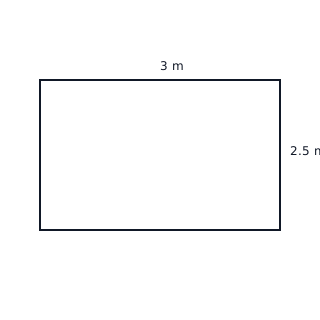
A rectangular patio has dimensions 3 m3 \text{ m} by 2.5 m2.5 \text{ m}. Calculate its area in cm2\text{cm}^2.

Rectangle representing a patio with labels 3m and 2.5m.

Solution:

  1. Find the area in m2\text{m}^2: Area=3×2.5=7.5 m2\text{Area} = 3 \times 2.5 = 7.5 \text{ m}^2
  2. Convert m2\text{m}^2 to cm2\text{cm}^2 by multiplying by 1002100^2 (which is 10,00010,000): 7.5×10,000=75,000 cm27.5 \times 10,000 = 75,000 \text{ cm}^2

Explanation:

To convert square meters to square centimeters, we multiply the value by the square of the conversion factor between meters and centimeters (1002100^2).

Problem 6:

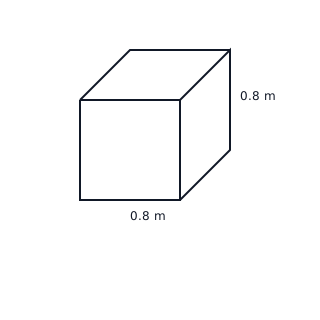
A storage container is in the shape of a cube with side length 0.8 m0.8 \text{ m}. Calculate its volume in cm3\text{cm}^3.

Cube showing side lengths of 0.8m.

Solution:

  1. Calculate the volume in m3\text{m}^3: Volume=0.83=0.512 m3\text{Volume} = 0.8^3 = 0.512 \text{ m}^3
  2. Convert m3\text{m}^3 to cm3\text{cm}^3 by multiplying by 1003100^3 (which is 1,000,0001,000,000): 0.512×1,000,000=512,000 cm30.512 \times 1,000,000 = 512,000 \text{ cm}^3

Explanation:

Volume conversion requires cubing the linear scale factor. Since 1 m=100 cm1 \text{ m} = 100 \text{ cm}, 1 m3=1,000,000 cm31 \text{ m}^3 = 1,000,000 \text{ cm}^3.