
Geometry - Symmetry and Transformations (Translation, Rotation, Reflection, Enlargement)
Review the key concepts, formulae, and examples before starting your quiz.
🔑Concepts
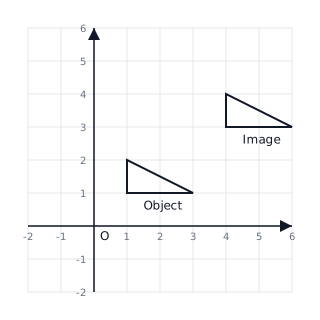
Translation involves sliding a shape a fixed distance in a specific direction without rotating or flipping it. It is described by a translation vector , where denotes the horizontal movement (right positive, left negative) and denotes the vertical movement (up positive, down negative).
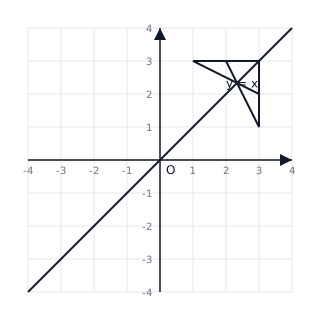
Reflection creates a mirror image of a shape across a line of reflection. Every point on the image is the same distance from the line as the corresponding point on the object. Key reflection lines include (y-axis), (x-axis), , and .
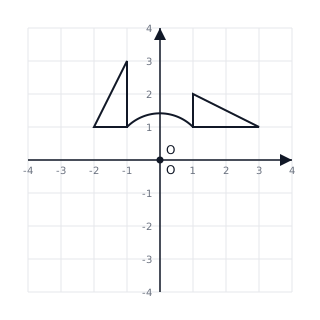
Rotation turns a shape around a fixed point called the center of rotation. A rotation is defined by the angle (e.g., , ), the direction (clockwise or anti-clockwise), and the coordinates of the center point.
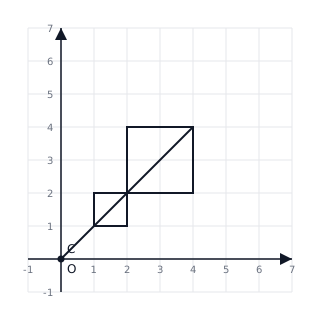
Enlargement changes the size of a shape but preserves its proportions and angles (similarity). It is defined by a center of enlargement and a scale factor . If , the shape grows; if , the shape shrinks.
📐Formulae
💡Examples
Problem 1:
Translate the point by the vector . Find the coordinates of the image .
Solution:
Explanation:
Add the -component of the vector to the -coordinate: . Add the -component to the -coordinate: .
Problem 2:
A square with side length 5 cm is enlarged by a scale factor of 3. What is the side length and area of the new square?
Solution:
Side length = 15 cm; Area = 225 cm²
Explanation:
The new side length is cm. The area of the new square is cm² (or original area ).
Problem 3:
Describe the single transformation that maps the point onto .
Solution:
Reflection in the line .
Explanation:
When the and coordinates are swapped, it indicates a reflection across the diagonal line where equals .
Problem 4:
What is the order of rotational symmetry for a regular hexagon?
Solution:
6
Explanation:
A regular hexagon can be rotated by (360/6) six times within a full circle and look identical each time.
Problem 5:
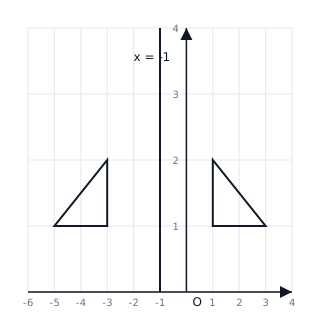
Shape is a triangle with vertices at , , and . Reflect shape in the line to form shape . List the coordinates of .
Solution:
The line of reflection is the vertical line . Distance of vertex from is units. The image will be 2 units to the left of : . So, . Distance of vertex from is units. The image will be 4 units to the left: . So, . Distance of vertex from is units. The image will be 2 units to the left: . So, . The coordinates of are , , and .
Explanation:
To reflect in a vertical line , the -coordinate remains the same, and the new -coordinate is . Here, .
Problem 6:
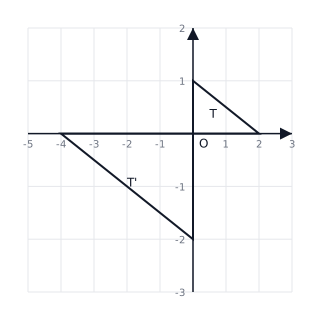
Triangle has vertices , , and . It is enlarged by a scale factor of with the center of enlargement at the origin . Find the coordinates of the image .
Solution:
Multiply each coordinate of the vertices of by the scale factor since the center is the origin. The vertices of are , , and .
Explanation:
A negative scale factor means the image is on the opposite side of the center of enlargement and is inverted. The size is increased by the absolute value .