
Review the key concepts, formulae, and examples before starting your quiz.
🔑Concepts
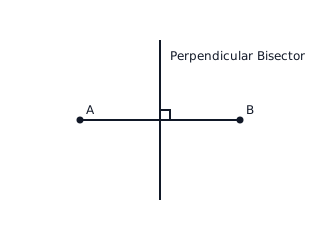
The perpendicular bisector of a line segment is the locus of all points that are equidistant from point and point . For any point on this line, .
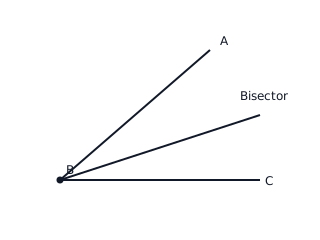
The angle bisector is the locus of all points that are equidistant from two intersecting lines. If a point lies on the bisector of , its perpendicular distance to is equal to its perpendicular distance to .
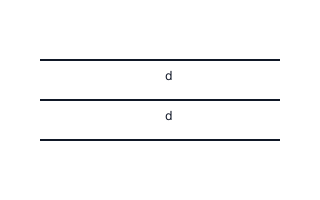
The locus of points at a constant distance from a straight line consists of two parallel lines, one on each side of the original line, at distance .
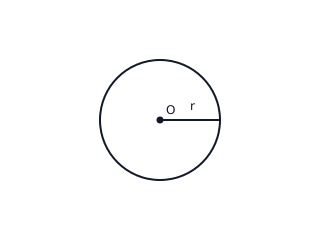
A locus can represent a region. For example, the region 'less than cm from point ' is the interior of a circle with radius centered at (excluding the boundary).
📐Formulae
Equidistant \ from \ points \ A \ and \ B: PA = PB
💡Examples
Problem 1:
Construct the locus of points that are equidistant from two points, P and Q, which are 6 cm apart.
Solution:
- Draw a line segment PQ of 6 cm. 2. Set the compass width to more than half of PQ (e.g., 4 cm). 3. Draw arcs above and below the line from point P. 4. Keeping the same compass width, draw arcs from point Q. 5. Draw a straight line through the two points where the arcs intersect.
Explanation:
This straight line is the perpendicular bisector. Every point on this line is the same distance from P as it is from Q.
Problem 2:
Draw the locus of points that are exactly 3 cm away from a fixed point C.
Solution:
- Mark point C on the paper. 2. Set the compass to a radius of 3 cm using a ruler. 3. Place the compass point on C and draw a full circle.
Explanation:
The locus of points at a fixed distance from a single point is always a circle with that fixed distance as the radius.
Problem 3:
A dog is tied to a 5m leash attached to a 10m long straight fence. Describe the locus of the area the dog can reach.
Solution:
The locus consists of a rectangle (parallel to the fence) and two semi-circles at the ends of the fence.
Explanation:
Since the dog is constrained by a leash (fixed distance) and a line (the fence), the boundary is 5m away from the line. At the corners/ends of the fence, the dog moves in a circular path, creating semi-circular boundaries.
Problem 4:
Construct the region of points that are closer to line than line in the rectangle , where cm and cm.
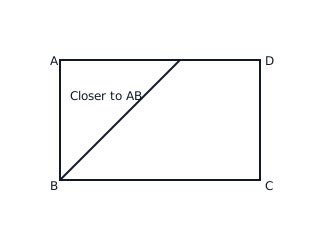
Solution:
- Identify that the locus of points equidistant from lines and is the angle bisector of .
- Draw the rectangle .
- Construct the bisector of (a line at since it is a rectangle).
- The region closer to is the area 'above' or 'inside' the bisector towards the side .
Explanation:
Points closer to one line than another are separated by the angle bisector of the two lines. In a rectangle, the angle is , so the bisector makes with each side.
Problem 5:
A goat is tethered to the corner of a rectangular shed of dimensions m by m. The rope is m long. Draw the locus of the area the goat can graze outside the shed.
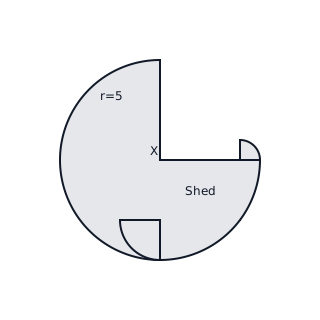
Solution:
- The goat can move in a arc (three-quarters of a circle) with radius m from corner .
- When the goat reaches the other corners of the shed, the rope 'bends'.
- Along the m side, m of rope remains. The goat can move in a arc of radius m from that corner.
- Along the m side, m of rope remains. The goat can move in a arc of radius m from that corner.
Explanation:
This is a composite locus. The primary locus is a large circular sector, and the secondary loci are smaller sectors formed where the rope is restricted by the shed's walls.