
Review the key concepts, formulae, and examples before starting your quiz.
🔑Concepts
Pythagoras' Theorem only applies to right-angled triangles. The longest side is called the hypotenuse and is always opposite the angle.
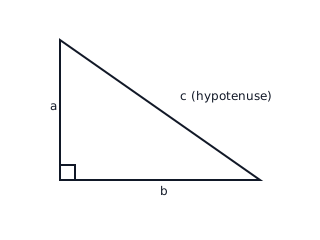
The relationship is stated as . This means the area of the square drawn on the hypotenuse is equal to the sum of the areas of the squares on the other two sides.
To find the hypotenuse , use the formula .
To find a shorter side (e.g., ), use the formula . Always subtract the square of the known shorter side from the square of the hypotenuse.
A Pythagorean Triple is a set of three integers that satisfy the theorem, such as or . Scaling these values (e.g., ) also results in a right-angled triangle.
📐Formulae
(where is the hypotenuse)
(finding the hypotenuse)
(finding a shorter side)
💡Examples
Problem 1:
A right-angled triangle has two shorter sides of length 5 cm and 12 cm. Calculate the length of the hypotenuse.
Solution:
cm
Explanation:
To find the hypotenuse, square both shorter sides, add them together, and then take the square root of the result.
Problem 2:
In a right-angled triangle, the hypotenuse is 10 cm and one side is 6 cm. Find the length of the third side.
Solution:
cm
Explanation:
When the hypotenuse and one side are known, subtract the square of the known side from the square of the hypotenuse, then take the square root.
Problem 3:
A ladder of length 5 m leans against a vertical wall. The foot of the ladder is 2 m away from the wall. Calculate how far up the wall the ladder reaches, giving your answer to 2 decimal places.
Solution:
m
Explanation:
The ladder acts as the hypotenuse (5m) and the distance from the wall is one side (2m). We solve for the height (the other side) and round to the required precision as per IGCSE standards.
Problem 4:
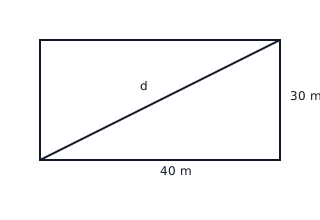
A rectangular field measures by . Calculate the length of the diagonal path across the field.
Solution:
Explanation:
The diagonal of a rectangle forms two right-angled triangles where the diagonal is the hypotenuse. We use Pythagoras' Theorem with and .
Problem 5:
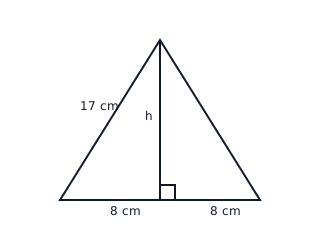
An isosceles triangle has a base of and two equal sides of . Calculate the perpendicular height of the triangle.
Solution:
Explanation:
In an isosceles triangle, the perpendicular height bisects the base. This creates two right-angled triangles with a base of () and a hypotenuse of .