
Review the key concepts, formulae, and examples before starting your quiz.
🔑Concepts
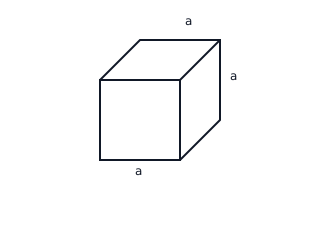
The volume of a 3D solid is the measure of the space occupied by it. For a Cube, all edges are of equal length . The volume is calculated as .
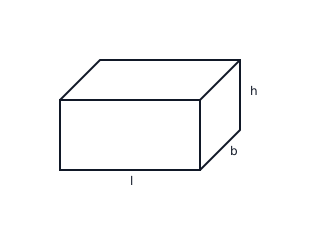
A Cuboid is a 3D shape with length , breadth , and height . Its volume is the product of these three dimensions: .
A Cylinder consists of two circular bases and a curved surface. The volume is the product of the area of the circular base and the height . Thus, .
Conversion of units is vital in volume calculations. Common conversions include: , , and .
📐Formulae
💡Examples
Problem 1:
Find the volume of a cylinder with a base radius of and a height of . (Use )
Solution:
- Identify given values: , .
- Use the formula: .
- Substitute the values: .
- Cancel out from numerator and denominator: .
- Calculate the final product: .
Explanation:
To find the cylinder's volume, we calculate the area of the circular base first using and then multiply it by the height. Substituting the radius and height into the formula gives the total space occupied in cubic centimeters.
Problem 2:
A cuboidal water tank is long, wide, and deep. Find its capacity in litres.
Solution:
- Calculate volume in cubic meters: .
- Convert to litres: Since .
- Capacity = .
Explanation:
We first find the volume of the tank by multiplying length, breadth, and depth. Since the question asks for capacity in litres, we use the conversion factor where cubic meter equals litres.
Problem 3:
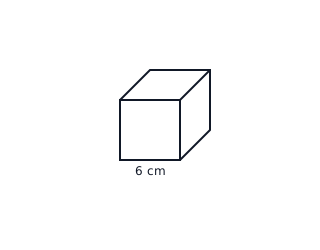
Calculate the volume of a cube whose total surface area is .
Solution:
- Let the side of the cube be .
- Total Surface Area of a cube .
- Given:
- Volume .
Explanation:
We first use the surface area formula to find the length of one side of the cube, then raise that side length to the power of 3 to find the volume.
Problem 4:
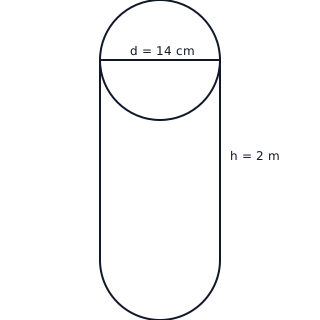
A cylindrical pillar has a diameter of and a height of . Find the volume of the pillar in . (Take )
Solution:
-
Identify the given values: Diameter Height
-
Calculate the radius:
-
Use the formula for volume of a cylinder:
Final Answer: The volume of the pillar is .
Explanation:
To find the volume, ensure all units are consistent. Since the diameter was in cm and height in m, we converted the height to cm (). Then, we used the radius (half the diameter) in the volume formula for a cylinder.