
Review the key concepts, formulae, and examples before starting your quiz.
🔑Concepts
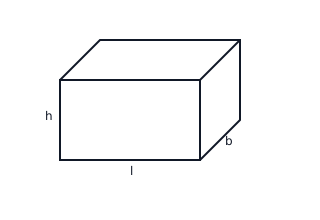
A cuboid is a three-dimensional box-shaped figure with six rectangular faces. Its Total Surface Area (TSA) is the sum of the areas of all six faces, while the Lateral Surface Area (LSA) excludes the top and bottom faces (area of four walls).
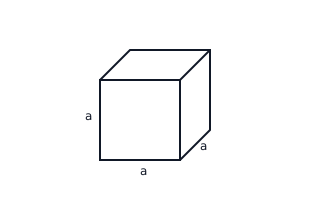
A cube is a special cuboid where all edges are equal in length (). Every face is a square of area . The TSA is and the LSA is .
A cylinder consists of two congruent circular bases and a curved surface. The Curved Surface Area (CSA) is equivalent to the area of a rectangle with length equal to the circumference and width equal to the height .
The Total Surface Area (TSA) of a cylinder includes the Curved Surface Area plus the areas of the two circular ends: .
📐Formulae
Total Surface Area of a Cuboid:
Lateral Surface Area (Area of 4 walls) of a Cuboid:
Total Surface Area of a Cube:
Lateral Surface Area of a Cube:
Curved Surface Area (CSA) of a Cylinder:
Total Surface Area (TSA) of a Cylinder: where is radius and is height
Area of one circular base of a Cylinder:
💡Examples
Problem 1:
A closed rectangular box has a length of , breadth of , and height of . Calculate the total surface area of the box.
Solution:
Given: , , . Using the formula for Total Surface Area (TSA) of a cuboid:
Explanation:
To find the TSA of a cuboid, we calculate the area of the three distinct pairs of rectangular faces and sum them up. The calculation shows the area of the top/bottom (), the sides (), and the front/back (), all multiplied by 2.
Problem 2:
Find the curved surface area and total surface area of a cylinder with a base radius of and a height of . (Take )
Solution:
Given: , .
- Curved Surface Area (CSA):
- Total Surface Area (TSA):
Explanation:
The CSA represents the side 'label' area of the cylinder. The TSA adds the area of the two circular lids () to the CSA. By using the distributive property formula , the calculation becomes more efficient.
Problem 3:
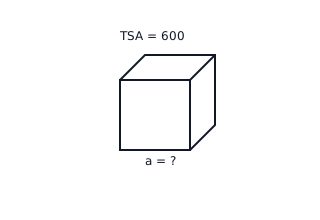
Find the length of the edge of a cube if its total surface area is .
Solution:
Let the edge of the cube be . Given, . We know, . Thus, the edge of the cube is .
Explanation:
To find the edge when the surface area is given, we equate the given value to the formula and solve for .
Problem 4:
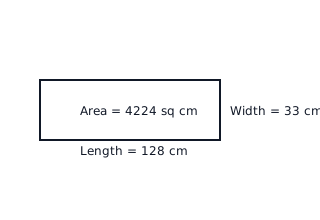
The lateral surface area of a hollow cylinder is . It is cut along its height and formed a rectangular sheet of width . Find the perimeter of the rectangular sheet.
Solution:
Let be the height of the cylinder and be its radius. When the cylinder is cut along its height, the width of the rectangular sheet equals the height of the cylinder, and the length of the sheet equals the circumference of the base. Width of sheet () = . Area of sheet = Lateral Surface Area of cylinder = . Length of sheet () Width () = Perimeter of the rectangular sheet = The perimeter of the sheet is .
Explanation:
When a cylinder is opened into a rectangle, the circumference of the circle becomes the length of the rectangle and the height of the cylinder becomes the width.