krit.club logo

Mensuration - Area of Trapezium and General Quadrilateral

Grade 8ICSE

Review the key concepts, formulae, and examples before starting your quiz.

🔑Concepts

•

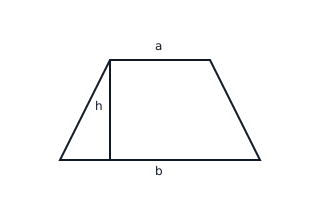
A trapezium is a quadrilateral with at least one pair of parallel sides. Its area is calculated as the product of half the sum of its parallel sides (aa and bb) and the perpendicular distance (hh) between them.

Trapezium with parallel sides a and b and height h
•

A general quadrilateral can be split into two triangles by drawing a diagonal. The area is the sum of the areas of these two triangles, which simplifies to 12×d×(h1+h2)\frac{1}{2} \times d \times (h_{1} + h_{2}), where dd is the diagonal and h1,h2h_{1}, h_{2} are the perpendicular offsets from the opposite vertices.
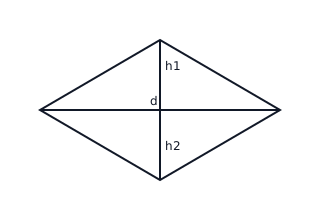
General quadrilateral divided by diagonal d with offsets h1 and h2
•

For a rhombus, since the diagonals are perpendicular bisectors of each other, the area is half the product of its diagonals: Area=12×d1×d2Area = \frac{1}{2} \times d_{1} \times d_{2}.

•

Area of a polygon can also be found by dividing it into known shapes like triangles and trapeziums and summing their individual areas.

📐Formulae

Area of a Trapezium=12×(sum of parallel sides)×heightArea\ of\ a\ Trapezium = \frac{1}{2} \times (sum\ of\ parallel\ sides) \times height

Area of a Trapezium=12×(a+b)×hArea\ of\ a\ Trapezium = \frac{1}{2} \times (a + b) \times h

Area of a General Quadrilateral=12×diagonal×(sum of perpendicular offsets)Area\ of\ a\ General\ Quadrilateral = \frac{1}{2} \times diagonal \times (sum\ of\ perpendicular\ offsets)

Area of a General Quadrilateral=12×d×(h1+h2)Area\ of\ a\ General\ Quadrilateral = \frac{1}{2} \times d \times (h_{1} + h_{2})

Area of a Rhombus=12×(product of diagonals)Area\ of\ a\ Rhombus = \frac{1}{2} \times (product\ of\ diagonals)

Area of a Rhombus=12×d1×d2Area\ of\ a\ Rhombus = \frac{1}{2} \times d_{1} \times d_{2}

💡Examples

Problem 1:

Find the area of a trapezium whose parallel sides are 14 cm14\text{ cm} and 10 cm10\text{ cm} and the distance between them is 6 cm6\text{ cm}.

Solution:

  1. Identify the given values: Parallel sides a=14 cma = 14\text{ cm}, b=10 cmb = 10\text{ cm}, and height h=6 cmh = 6\text{ cm}.
  2. Use the formula: Area=12×(a+b)×hArea = \frac{1}{2} \times (a + b) \times h
  3. Substitute the values: Area=12×(14+10)×6Area = \frac{1}{2} \times (14 + 10) \times 6
  4. Calculate the sum: Area=12×24×6Area = \frac{1}{2} \times 24 \times 6
  5. Simplify: Area=12×6=72 cm2Area = 12 \times 6 = 72\text{ cm}^{2}.

Explanation:

We use the standard trapezium formula by taking the average of the two parallel bases and multiplying it by the vertical height.

Problem 2:

Calculate the area of a quadrilateral ABCDABCD where the diagonal AC=12 cmAC = 12\text{ cm} and the perpendiculars (offsets) from vertices BB and DD on diagonal ACAC are 5 cm5\text{ cm} and 3 cm3\text{ cm} respectively.

Solution:

  1. Identify the given values: Diagonal d=12 cmd = 12\text{ cm}, offset h1=5 cmh_{1} = 5\text{ cm}, and offset h2=3 cmh_{2} = 3\text{ cm}.
  2. Use the formula for a general quadrilateral: Area=12×d×(h1+h2)Area = \frac{1}{2} \times d \times (h_{1} + h_{2})
  3. Substitute the values: Area=12×12×(5+3)Area = \frac{1}{2} \times 12 \times (5 + 3)
  4. Calculate the sum: Area=12×12×8Area = \frac{1}{2} \times 12 \times 8
  5. Simplify: Area=6×8=48 cm2Area = 6 \times 8 = 48\text{ cm}^{2}.

Explanation:

The quadrilateral is treated as two triangles with a common base (the diagonal). We sum the heights of these triangles and multiply by half the base length.

Problem 3:

The area of a trapezium is 440 cm2440\text{ cm}^2. The lengths of the parallel sides are 30 cm30\text{ cm} and 14 cm14\text{ cm}. Find the distance between the parallel sides.
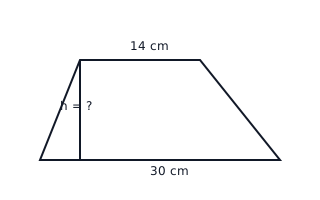
Trapezium with parallel sides 14 and 30 and unknown height

Solution:

Given: Area =440 cm2= 440\text{ cm}^2 Parallel sides a=30 cma = 30\text{ cm}, b=14 cmb = 14\text{ cm} Let the height be hh. Using the formula: Area=12×(a+b)×hArea = \frac{1}{2} \times (a + b) \times h 440=12×(30+14)×h440 = \frac{1}{2} \times (30 + 14) \times h 440=12×44×h440 = \frac{1}{2} \times 44 \times h 440=22×h440 = 22 \times h h=44022h = \frac{440}{22} h=20 cmh = 20\text{ cm} The distance between the parallel sides is 20 cm20\text{ cm}.

Explanation:

We substitute the known area and the lengths of the parallel sides into the trapezium area formula to solve for the missing height variable.

Problem 4:

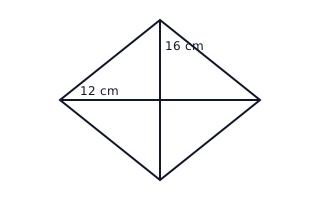
Find the area of a rhombus whose diagonals are of lengths 16 cm16\text{ cm} and 12 cm12\text{ cm}.

Rhombus showing diagonals of 16cm and 12cm

Solution:

Given: Diagonal d1=16 cmd_{1} = 16\text{ cm} Diagonal d2=12 cmd_{2} = 12\text{ cm} Using the formula: Area=12×d1×d2Area = \frac{1}{2} \times d_{1} \times d_{2} Area=12×16×12Area = \frac{1}{2} \times 16 \times 12 Area=8×12Area = 8 \times 12 Area=96 cm2Area = 96\text{ cm}^2 The area of the rhombus is 96 cm296\text{ cm}^2.

Explanation:

The area of a rhombus is calculated by taking half the product of its two diagonals.