
Review the key concepts, formulae, and examples before starting your quiz.
🔑Concepts
The Cartesian plane is formed by two perpendicular number lines: the horizontal -axis and the vertical -axis. Their point of intersection is the origin . Any point is represented by an ordered pair , where is the abscissa (distance from -axis) and is the ordinate (distance from -axis).
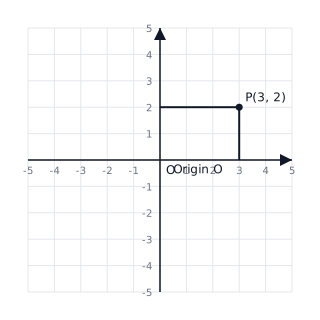
The axes divide the plane into four regions called quadrants. In Quadrant I, both and are positive . In Quadrant II, is negative and is positive . In Quadrant III, both are negative . In Quadrant IV, is positive and is negative . Points on the axes do not belong to any quadrant.
A linear equation in two variables, such as , can be represented as a straight line on the Cartesian plane. Every point that lies on this line satisfies the given equation.
Special cases of lines include vertical lines () which are parallel to the -axis, and horizontal lines () which are parallel to the -axis.
📐Formulae
General representation of a point:
Coordinates of the Origin:
Equation of the -axis:
Equation of the -axis:
General form of a linear equation:
💡Examples
Problem 1:
Identify the quadrant or axis for the following points without plotting them: , , , and .
Solution:
- For : Both and are positive , so it lies in Quadrant I.
- For : is negative and is positive , so it lies in Quadrant II.
- For : The -coordinate is . Any point with lies on the -axis.
- For : is positive and is negative , so it lies in Quadrant IV.
Explanation:
The location of a point is determined by the signs of its coordinates. If one coordinate is zero, the point lies on an axis rather than in a quadrant.
Problem 2:
Given the equation , find the coordinates of the points where the line crosses the -axis and the -axis.
Solution:
-
To find the -axis intersection (where ): So, the point is .
-
To find the -axis intersection (where ): So, the point is .
Explanation:
Intersection with the -axis always occurs when , and intersection with the -axis always occurs when . We substitute these values into the linear equation to solve for the unknown coordinate.
Problem 3:
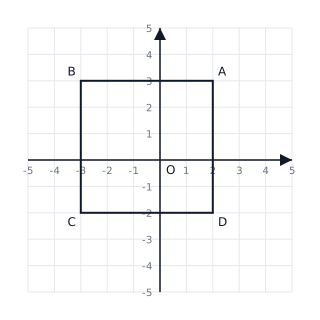
Plot the points , , , and on a Cartesian plane. Join them in order . Name the geometrical figure formed and calculate its area.
Solution:
- Plotting the points:
- is in Quadrant I.
- is in Quadrant II.
- is in Quadrant III.
- is in Quadrant IV.
-
Joining the points forms a rectangle .
-
Calculating dimensions:
- Length units.
- Breadth units.
- Since all sides are equal and angles are , the figure is a square. Area = sq. units.
Explanation:
By plotting the given coordinates and connecting them, we observe a closed quadrilateral. Since the horizontal distance (5 units) and vertical distance (5 units) between vertices are equal, the figure is a square.
Problem 4:
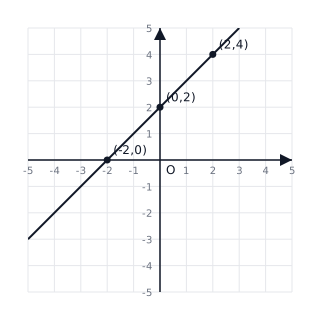
Draw the graph of the function by finding at least three points that satisfy the equation.
Solution:
- Create a table of values:
- If , . Point is .
- If , . Point is .
- If , . Point is .
- Plot the points , , and on the Cartesian plane.
- Draw a straight line passing through these points.
Explanation:
To graph a linear equation, we select arbitrary values for , calculate the corresponding values, plot the resulting ordered pairs, and join them with a straight line.