
Review the key concepts, formulae, and examples before starting your quiz.
🔑Concepts
The Cartesian Plane consists of two mutually perpendicular number lines: the horizontal line is called the -axis and the vertical line is called the -axis. Their intersection is the origin .
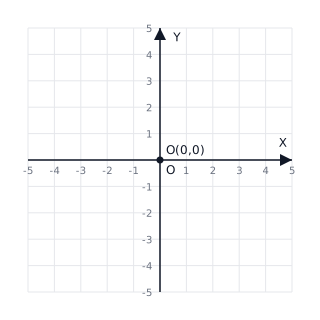
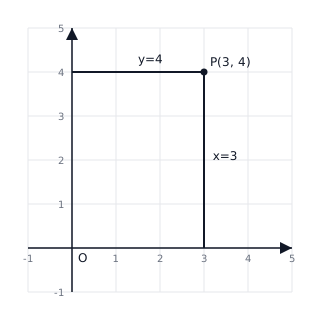
Every point in the plane is represented by an ordered pair . The -coordinate (abscissa) measures the distance from the -axis, and the -coordinate (ordinate) measures the distance from the -axis.
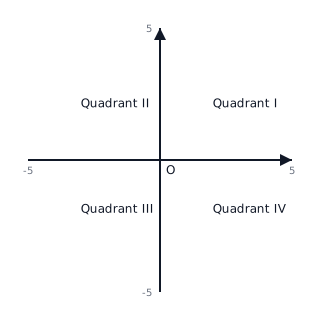
The axes divide the plane into four regions called Quadrants. Quadrant I (), Quadrant II (), Quadrant III (), and Quadrant IV ().
Points on the axes: If a point lies on the -axis, its -coordinate is always (e.g., ). If a point lies on the -axis, its -coordinate is always (e.g., ).
📐Formulae
Coordinates of the Origin:
General form of a point:
Equation of the x-axis:
Equation of the y-axis:
Linear relationship form: (where and are constants)
💡Examples
Problem 1:
Identify the location (Quadrant or Axis) of the following points: , , , , and .
Solution:
- Point : Both and , so it is in Quadrant I.
- Point : Here and , so it is in Quadrant II.
- Point : Both and , so it is in Quadrant III.
- Point : Here and , so it is in Quadrant IV.
- Point : Since the x-coordinate is , the point lies on the y-axis.
Explanation:
To determine the location, check the signs of the and coordinates. If a coordinate is , the point lies on an axis rather than in a quadrant.
Problem 2:
A point is units to the left of the y-axis and units above the x-axis. Find its coordinates.
Solution:
- '4 units to the left of the y-axis' means the x-coordinate (abscissa) is negative: .
- '6 units above the x-axis' means the y-coordinate (ordinate) is positive: .
- Combining these into an ordered pair , we get .
Explanation:
Direction matters: 'Left' and 'Down' indicate negative values; 'Right' and 'Up' indicate positive values relative to the origin.
Problem 3:
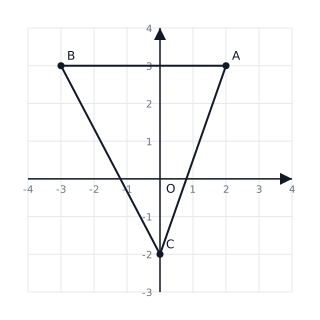
Plot the points , , and on the Cartesian plane and join them in order. What shape is formed if we also connect back to ?
Solution:
- Starting at the origin, move units right and units up to plot .
- Move units left and units up to plot .
- Locate on the -axis to plot .
- Joining to , to , and to forms a triangle.
Explanation:
By connecting three non-collinear points in a plane, a triangle is always formed. Here, the vertices are in different quadrants and on an axis.
Problem 4:
Draw a line passing through the points and . Does this line pass through the origin? What is the relation between the and coordinates for any point on this line?
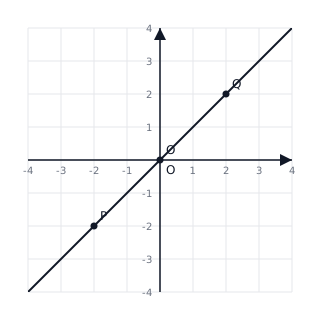
Solution:
- Plot in the third quadrant and in the first quadrant.
- Draw a straight line through these points.
- Observation: The line passes exactly through .
- For every point on this line, the -coordinate is equal to the -coordinate ().
Explanation:
The line represents the linear equation . Since the coordinates are equal at every plotted point, it must pass through the origin where .