
Review the key concepts, formulae, and examples before starting your quiz.
🔑Concepts
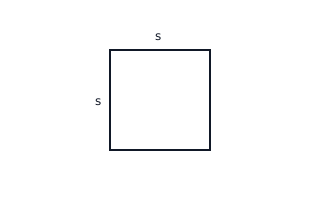
Perimeter is the total distance around the edge of a closed 2D shape. For a square, since all four sides are equal, the perimeter is . For a rectangle, it is .
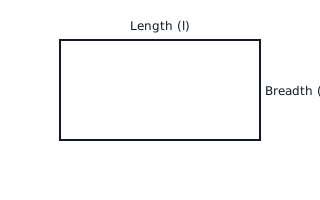
Area measures the surface covered by a 2D shape. It is expressed in square units like or . The area of a square is , and the area of a rectangle is .
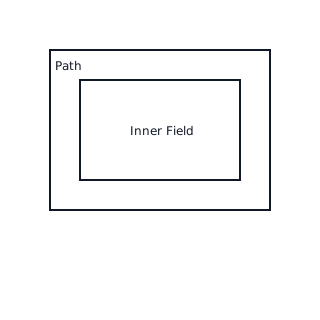
When a path is built around a rectangular field, the outer dimensions change. If a path of width is built outside, the new length becomes and the new breadth becomes .
Unit Conversion: and . This is crucial when calculating costs for surfacing or fencing.
📐Formulae
Perimeter of a Square = (where is the side)
Area of a Square =
Perimeter of a Rectangle = (where is length and is breadth)
Area of a Rectangle =
Side of a Square =
Side of a Square =
💡Examples
Problem 1:
A square park has a side length of . Find the total cost of fencing the park at a rate of per meter.
Solution:
Step 1: Identify the side of the square, . Step 2: Calculate the perimeter (boundary) for fencing. Step 3: Calculate the total cost. Final Answer: The total cost of fencing is .
Explanation:
To find the cost of fencing, we first need the total length of the boundary, which is the perimeter. Once the perimeter is found in meters, we multiply it by the cost per meter.
Problem 2:
The area of a rectangular hall is . If the length of the hall is , find its breadth and its perimeter.
Solution:
Step 1: Use the area formula to find the breadth (). Step 2: Use the length () and breadth () to find the perimeter. Final Answer: The breadth is and the perimeter is .
Explanation:
We start by rearranging the area formula to solve for the unknown breadth. Once both dimensions are known, we apply the perimeter formula for a rectangle.
Problem 3:
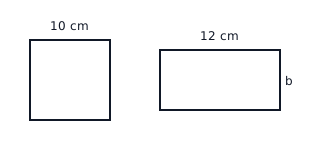
A wire in the shape of a square with side is bent into a rectangle of length . Find its breadth. Which shape encloses more area?
Solution:
Perimeter of Square = . Since the same wire is used for the rectangle, Perimeter of Rectangle = . Area of Square = . Area of Rectangle = . The square encloses more area.
Explanation:
Because the length of the wire remains constant, the perimeters are equal. We then compare the areas using the derived dimensions.
Problem 4:
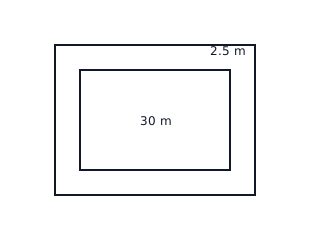
A rectangular garden is long and wide. A path wide is constructed outside the garden. Find the area of the path.
Solution:
Inner length = , Inner breadth = . Inner Area = . Outer length = . Outer breadth = . Outer Area = . Area of Path = Outer Area - Inner Area Area of Path = .
Explanation:
To find the area of the path, we subtract the area of the inner rectangle from the area of the outer rectangle formed by adding the path's width to all sides.