
Review the key concepts, formulae, and examples before starting your quiz.
🔑Concepts
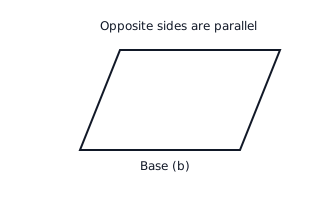
A parallelogram is a quadrilateral where opposite sides are parallel and equal in length. Any side of the parallelogram can be considered its base.
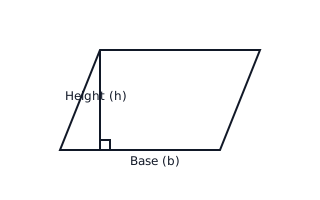
The height (or altitude) of a parallelogram is the perpendicular distance from the base to the opposite side. It must be at a angle to the base.
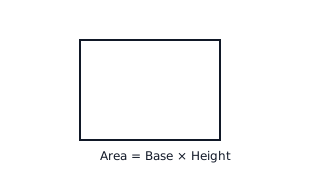
The area of a parallelogram is calculated as the product of its base () and its corresponding height (). If you cut a right-angled triangle from one side and move it to the other, the parallelogram becomes a rectangle of the same area.
If the area and one dimension (base or height) are known, the other dimension can be found by dividing the area by the known dimension.
📐Formulae
strength
💡Examples
Problem 1:
Find the area of a parallelogram whose base is and corresponding height is .
Solution:
Given:\nBase () = \nHeight () =
Using the formula:
Explanation:
To find the area, we simply identify the base and the perpendicular height from the problem and multiply them together. Ensure the units are square centimeters.
Problem 2:
The area of a parallelogram is and its height is . Find the length of its base.
Solution:
Given:\nArea = \nHeight () =
Using the formula for base:
Explanation:
When the area and height are known, we can find the missing base by dividing the total area by the given height.
Problem 3:
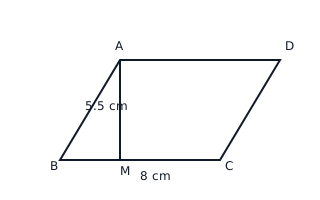
Find the area of the parallelogram where the base and the altitude drawn to the base is .
Solution:
Given: Base () = Height () =
Using the formula:
Therefore, the area of the parallelogram is .
Explanation:
Identify the base and the corresponding perpendicular height. Multiply the two values together to find the total surface area in square units.
Problem 4:
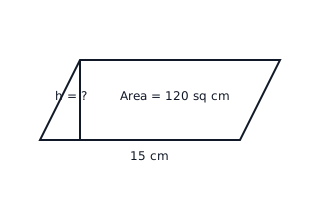
One side of a parallelogram is and the area is . Find the distance between the side and the opposite side.
Solution:
Given: Area = Base () = Distance between sides (Height ) = ?
Using the formula:
So, the height of the parallelogram is .
Explanation:
The distance between two parallel sides is the perpendicular height. To find the height, divide the given area by the base length.