
Review the key concepts, formulae, and examples before starting your quiz.
🔑Concepts
The area of a triangle is exactly half the area of the rectangle (or parallelogram) formed by its base and height. Any side of a triangle can be considered as the base.
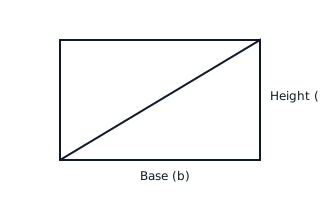
The height (altitude) is the perpendicular distance from the vertex to the opposite side (base). In an obtuse-angled triangle, the height may lie outside the triangle on the extension of the base.
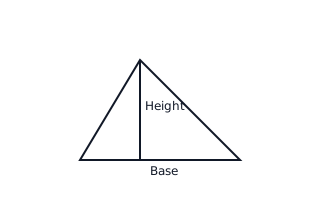
All triangles drawn between the same set of parallel lines and sharing the same base have equal areas, because their bases and heights are identical.
In a right-angled triangle, the two sides containing the right angle can be taken as the base and the height respectively.
📐Formulae
Area of a triangle =
Base of a triangle =
Height of a triangle =
💡Examples
Problem 1:
Find the area of a triangle whose base is and whose corresponding height is .
Solution:
- Identify the given values: base and height .
- Apply the formula:
- Substitute the values:
- Calculate: .\nTherefore, the area of the triangle is .
Explanation:
To find the area, we simply multiply the base by the height and then divide by . Since both measurements are in , the final result is in .
Problem 2:
The area of a triangle is . If its height is , find the length of its base.
Solution:
- Identify the given values: and .
- Use the modified formula for base:
- Substitute the values:
- Calculate: .\nTherefore, the base of the triangle is .
Explanation:
When the area and height are known, we can rearrange the area formula to solve for the base. Multiplying the area by and dividing by the height gives the required base length.
Problem 3:
Find the area of an isosceles right-angled triangle where the lengths of the two equal sides are each.
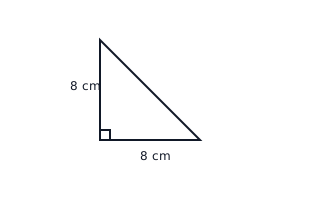
Solution:
Explanation:
In a right-angled triangle, the two sides meeting at the angle serve as the base and height. Since it is isosceles, both these sides are .
Problem 4:
In , the area is . If the base is , find the height dropped from vertex to the base .
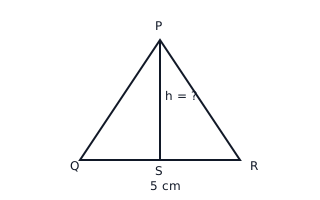
Solution:
Explanation:
To find the height when area and base are known, we rearrange the area formula to .