
Review the key concepts, formulae, and examples before starting your quiz.
🔑Concepts
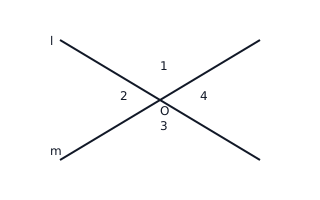
Intersecting Lines: Two lines and are called intersecting lines if they have a common point. This common point is called the point of intersection. When two lines intersect, they form four angles, and the vertically opposite angles are equal.
Transversal: A line that intersects two or more lines at distinct points is called a transversal. In the figure, line is a transversal to lines and . It creates 8 specific angles: Interior, Exterior, Corresponding, Alternate Interior, and Alternate Exterior angles.
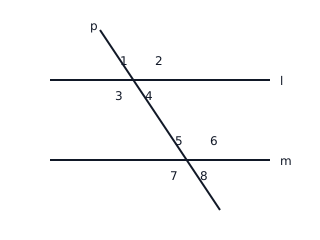
Parallel Lines: If two parallel lines are cut by a transversal, then: (i) each pair of corresponding angles are equal, (ii) each pair of alternate interior angles are equal, and (iii) each pair of interior angles on the same side of the transversal (co-interior) are supplementary (sum to ).
Checking for Parallelism: To prove two lines are parallel, we can check if any one of the following is true: (i) a pair of corresponding angles is equal, (ii) a pair of alternate interior angles is equal, or (iii) co-interior angles add up to .
📐Formulae
💡Examples
Problem 1:
In the given figure, line is parallel to line () and they are intersected by a transversal . If one of the alternate interior angles is , find the measure of its adjacent interior angle on the same side of the transversal.
Solution:
- Let the given alternate interior angle be .
- We know that for parallel lines, alternate interior angles are equal, but the question asks for the co-interior angle.
- Let the co-interior angle to be .
- According to the property of parallel lines, the sum of interior angles on the same side of the transversal is .
- Therefore, .
- .
- .
Explanation:
This problem uses the property that co-interior angles are supplementary when lines are parallel.
Problem 2:
Two lines intersect at a point . If one of the angles formed is and the angle vertically opposite to it is , find the value of .
Solution:
- Vertically opposite angles are equal when two lines intersect.
- We can set up the equation: .
- Subtract from both sides: .
- .
- Divide by : .
- .
Explanation:
The solution relies on the fundamental property that vertically opposite angles are always equal.
Problem 3:
In the given figure, line is parallel to (). Find the value of if the two interior angles on the same side of the transversal are and .
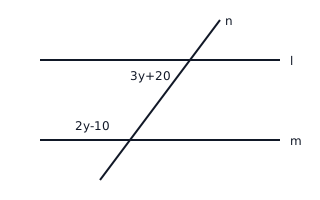
Solution:
Given , the sum of co-interior angles is .
Explanation:
Since the lines are parallel, the angles interior to the parallel lines and on the same side of the transversal must be supplementary. We set up an equation summing the two expressions to and solve for .
Problem 4:
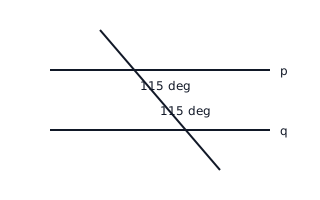
Determine if line is parallel to line if the alternate interior angles shown in the figure are and .
Solution:
In the figure, the two angles marked are alternate interior angles formed by transversal with lines and . Since the measure of both alternate interior angles is , they are equal. According to the property of parallel lines, if alternate interior angles are equal, the lines must be parallel. Therefore, .
Explanation:
We use the converse of the alternate interior angle property. Since the given pair of alternate interior angles are equal, it satisfies the condition for lines and to be parallel.