
Review the key concepts, formulae, and examples before starting your quiz.
🔑Concepts
A transversal is a line that intersects two or more lines at distinct points. When a transversal intersects two lines, eight angles are formed.
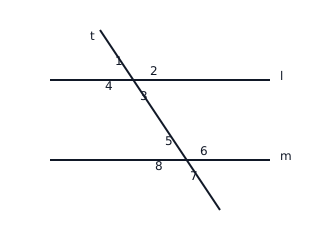
Interior and Exterior Angles: Angles lying between the two lines are called interior angles (), while those lying outside are called exterior angles ().
Corresponding Angles: These angles are in the same relative position at each intersection. If the lines are parallel, these angles are equal (e.g., , ).
Alternate Interior Angles: These angles are on opposite sides of the transversal and between the two lines. If lines are parallel, these angles are equal (e.g., , ).
Co-interior Angles: Also known as consecutive interior angles, they lie on the same side of the transversal. If the lines are parallel, these angles are supplementary ().
📐Formulae
If , then Corresponding Angles:
If , then Alternate Interior Angles:
If , then Alternate Exterior Angles:
If , then Co-interior Angles:
Linear Pair Equation: (angles on a straight line)
Vertically Opposite Angles: (angles opposite each other at a single vertex)
💡Examples
Problem 1:
In a figure, line is parallel to line () and they are intersected by a transversal . If one of the alternate interior angles is , find the value of its corresponding co-interior angle on the same side of the transversal.
Solution:
- Let the given alternate interior angle be .
- Let the alternate interior angle equal to be . Since , .
- Now, consider the co-interior angle to , let's call it .
- We know that for parallel lines, co-interior angles are supplementary: .
- Substitute the value: .
- Solve for : .
Explanation:
This problem uses two properties of parallel lines: first, that alternate interior angles are equal, and second, that co-interior angles sum to .
Problem 2:
Two parallel lines are cut by a transversal. If a pair of corresponding angles are represented by the expressions and , find the value of .
Solution:
- Since the lines are parallel, corresponding angles must be equal in measure.
- Set up the equation: .
- Subtract from both sides: .
- Add to both sides: .
- Therefore, .
Explanation:
The solution relies on the fundamental property that corresponding angles are equal when a transversal intersects parallel lines. We translate this geometric property into an algebraic equation to solve for the unknown variable.
Problem 3:
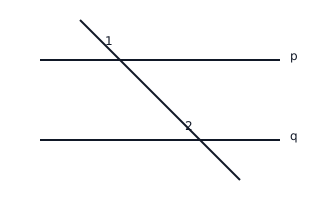
In the given figure, and is a transversal. If , find the measure of .
Solution:
Explanation:
Since , we use the property of alternate interior angles. First, we find the angle adjacent to using the linear pair property, then equate it to . Alternatively, and are co-exterior angles on the same side, which are also supplementary.
Problem 4:
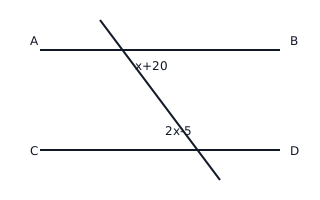
Given and a transversal intersects them. If a pair of co-interior angles are and , find the value of .
Solution:
Explanation:
When two parallel lines are intersected by a transversal, the sum of the interior angles on the same side of the transversal (co-interior angles) is always .