
Review the key concepts, formulae, and examples before starting your quiz.
🔑Concepts
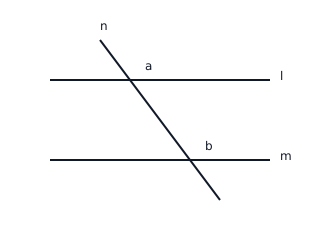
Corresponding Angles Criterion: Two lines are parallel if a transversal intersects them such that a pair of corresponding angles are equal. In the diagram, if , then line is parallel to line .
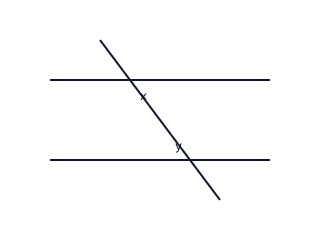
Alternate Interior Angles Criterion: If a transversal intersects two lines such that a pair of alternate interior angles are equal, the lines must be parallel.
Interior Angles on the Same Side (Co-interior): If a transversal intersects two lines such that the sum of the interior angles on the same side is (supplementary), then the lines are parallel.
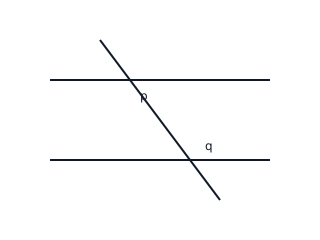
Lines parallel to the same line: If two lines are both parallel to a third line, then they are parallel to each other. If and , then .
📐Formulae
💡Examples
Problem 1:
In a figure, a transversal cuts two lines and . If a pair of consecutive interior angles are given as and , find the value of that would make line parallel to line , given that their sum must be is incorrect and they should be supplementary.
Solution:
Step 1: For lines and to be parallel, the sum of the consecutive interior angles must be . Step 2: Set up the equation: . Step 3: Combine like terms: . Step 4: Subtract from both sides: . Step 5: Divide by : .
Explanation:
We use the property that consecutive interior angles must be supplementary () for the lines to be parallel. Solving the linear equation gives the required value of .
Problem 2:
Line intersects lines and . If the alternate interior angles are and , what value of ensures ?
Solution:
Step 1: For lines and to be parallel, the alternate interior angles must be equal. Step 2: Set up the equation: . Step 3: Add to both sides: . Step 4: Divide by : .
Explanation:
According to the Converse of Alternate Interior Angles Theorem, if the alternate interior angles are equal, the lines are parallel. We equate the two given expressions and solve for the variable.
Problem 3:
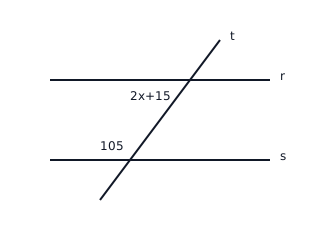
In the given figure, transversal intersects lines and . If the interior angles on the same side of the transversal are and , find the value of for which line is parallel to line .
Solution:
For , the sum of interior angles on the same side of the transversal must be .
Explanation:
We use the property that co-interior angles are supplementary for parallel lines. Setting their sum to 180 and solving the linear equation gives the required value of .
Problem 4:
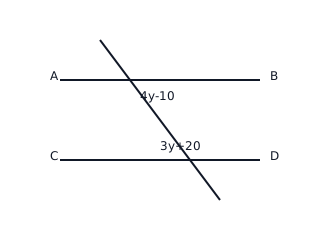
Check if line if the alternate interior angles formed by transversal are and where .
Solution:
Substitute into the angle expressions: Angle 1: Angle 2: Since the alternate interior angles are equal (), .
Explanation:
To check for parallelism, we calculate the numerical values of the alternate interior angles. If they are equal, the lines are parallel by the alternate interior angles converse theorem.