
Review the key concepts, formulae, and examples before starting your quiz.
🔑Concepts
Congruence of triangles means that two triangles are identical in shape and size. When , their corresponding parts (sides and angles) match exactly. This relationship is called Corresponding Parts of Congruent Triangles (CPCT).
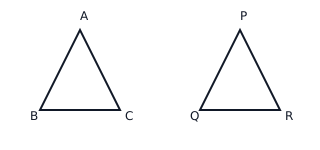
The SSS (Side-Side-Side) Criterion states that two triangles are congruent if all three sides of one triangle are equal to the corresponding three sides of the other triangle.
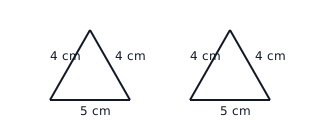
The SAS (Side-Angle-Side) Criterion requires two sides and the included angle (the angle between the sides) to be equal in both triangles.
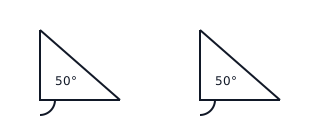
The ASA (Angle-Side-Angle) Criterion applies when two angles and the included side (the side between the angles) are equal.
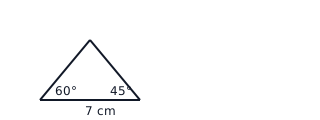
The RHS (Right angle-Hypotenuse-Side) Criterion is specific to right-angled triangles. It states that if the hypotenuse and one side of a right-angled triangle are equal to the hypotenuse and one side of another right-angled triangle, they are congruent.
📐Formulae
SSS Condition:
SAS Condition:
ASA Condition:
RHS Condition:
💡Examples
Problem 1:
In and , it is given that and . Prove that .
Solution:
In and :
- (Given)
- (Given)
- (Common side to both triangles) Therefore, by the SSS congruence criterion, .
Explanation:
We identified three pairs of corresponding sides that are equal. Since all three sides of match the three sides of , we use the Side-Side-Side (SSS) rule.
Problem 2:
In , is the perpendicular bisector of (where lies on ). Show that .
Solution:
In and :
- (Since bisects )
- (Since is perpendicular to )
- (Common side) Therefore, by the SAS congruence criterion, .
Explanation:
We have two sides and the angle included between them equal. Side , side is common, and the angle formed at is for both triangles. This satisfies the Side-Angle-Side (SAS) rule.
Problem 3:
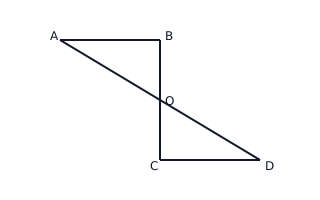
In the given figure, line segment is parallel to another line segment . is the midpoint of . Prove that .
Solution:
- In and :
- (Alternate interior angles, as and is the transversal).
- (Given that is the midpoint of ).
- (Vertically opposite angles).
- Therefore, by the ASA congruence criterion.
Explanation:
We use the properties of parallel lines and midpoints to identify two equal angles and one equal included side.
Problem 4:
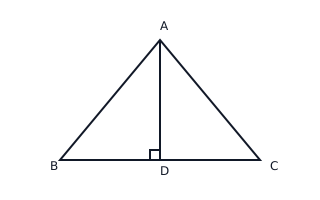
In , is the altitude to such that and . Show that .
Solution:
- In right-angled triangles and :
- (Given ).
- (Given Hypotenuse are equal).
- (Common side).
- Hence, by the RHS congruence criterion.
Explanation:
Since the triangles are right-angled and have equal hypotenuses and a common side, the RHS criterion is satisfied.