
Review the key concepts, formulae, and examples before starting your quiz.
🔑Concepts
Congruence of plane figures means that two objects are identical in shape and size. If you place one figure over the other, they cover each other exactly. The symbol used for congruence is .
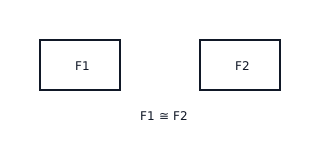
Congruence of line segments: Two line segments are congruent if they have the same length. For example, if and , then .

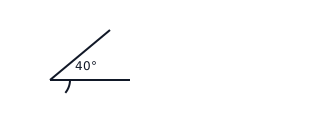
Congruence of angles: Two angles are congruent if they have the same measure. If and , then .
Congruence of Triangles: Two triangles are congruent if their corresponding sides and corresponding angles are equal. This is written as . The order of letters indicates the correspondence, e.g., .
📐Formulae
💡Examples
Problem 1:
If under the correspondence , list all the corresponding congruent parts of the triangles.
Solution:
Step 1: Identify the corresponding vertices from the given statement . The matches are , , and .\nStep 2: List the corresponding angles based on the vertex matches: \nStep 3: List the corresponding sides based on the pairs of vertices:
Explanation:
In congruence statements, the order of the letters tells us exactly which parts of one triangle correspond to which parts of the other.
Problem 2:
Two angles, and , are congruent. If the measure of and , find the value of .
Solution:
Step 1: Use the property of congruence for angles. Since , their measures must be equal.\nStep 2: Set up the equation: \nStep 3: Solve for :
Explanation:
Because the angles are congruent, their numerical degree values are identical, allowing us to solve for the unknown variable using basic algebra.
Problem 3:
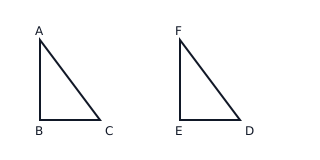
In the figure provided, check if given the correspondence . If , , and , find the lengths of , , and .
Solution:
Given . By the property of congruence, corresponding sides must be equal.
- corresponds to , so .
- corresponds to , so .
- corresponds to , so .
Explanation:
When two triangles are congruent, the parts that 'match' (correspond) are equal in measure. The naming tells us exactly which vertices match.
Problem 4:
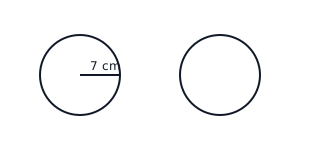
Two circles are congruent. If the radius of the first circle is , what is the diameter of the second circle?
Solution:
- Two circles are congruent if they have the same radius.
- Since the circles are congruent, .
- Diameter .
- .
Explanation:
Congruence in circles depends solely on the radius. If the radii are equal, the circles are identical in size.