
Review the key concepts, formulae, and examples before starting your quiz.
🔑Concepts
An input-output table shows a relationship between two sets of numbers. Each number that enters the 'function machine' (the input) is changed into a different number (the output) based on a specific, consistent rule.

The rule is the mathematical operation (addition, subtraction, multiplication, or division) that is applied to every input to get its corresponding output. For example, if the rule is , every input value must have added to it.
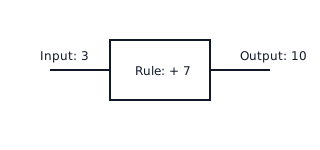
To find a missing value in a table, first identify the pattern by comparing the input and output pairs. Check if the output is getting larger (suggests addition or multiplication) or smaller (suggests subtraction or division) relative to the input.
The same rule must work for every single row in the table. If a rule works for the first row but not the second, it is not the correct rule for that function.
📐Formulae
💡Examples
Problem 1:
Look at the following table and find the rule and the missing output: Input (): | Output ():
Solution:
Step 1: Compare the first pair. . Possible rules are or . Step 2: Test both rules on the second pair. (Incorrect, the output is ). (Correct). Step 3: Verify with the third pair. (Correct). Step 4: Apply the rule to find the missing value. .
Explanation:
By checking multiple pairs, we confirmed that the rule is 'Multiply by '. Therefore, the missing output for the input is .
Problem 2:
Identify the rule for this function table: Input (): | Output (): .
Solution:
Step 1: Observe the change. The output is smaller than the input, so the rule involves subtraction or division. Step 2: Test subtraction for the first pair. . Step 3: Test the same rule for the next pairs. (Correct), (Correct), and (Correct).
Explanation:
Because subtracting from every input value consistently results in the correct output value, the rule is .
Problem 3:
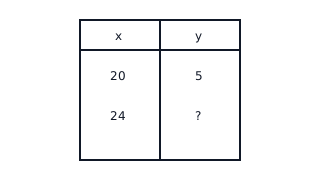
Determine the missing output value for the following function table:
Solution:
Explanation:
Compare the inputs and outputs: , , and . In each case, the output is smaller than the input. Dividing the input by gives the output (, ). Therefore, the rule is . Applying this to the last row, .
Problem 4:
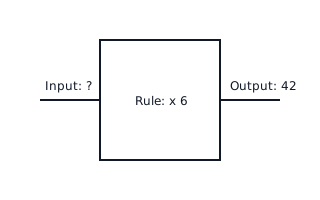
Identify the rule and find the missing input value for this table:
Solution:
Explanation:
Look at the relationship: , , and . The rule is . To find the missing input when the output is , we perform the inverse operation: .