
Review the key concepts, formulae, and examples before starting your quiz.
🔑Concepts
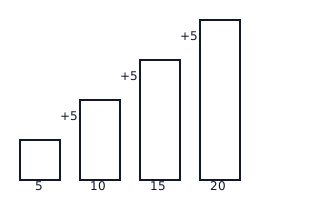
A number pattern is a sequence of numbers that follows a specific rule. For example, in an increasing pattern like , the rule is to add each time. We can visualize this using steps where each step increases by a fixed amount.
Input-Output tables show the relationship between two sets of numbers based on a function rule. If the rule is , every input number will decrease by to produce the output.

Patterns can also involve multiplication. In a geometric sequence, each term is found by multiplying the previous term by a constant number, such as where the rule is .
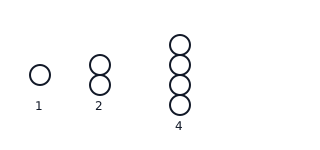
Identifying a missing term requires finding the common difference or common ratio between consecutive terms. For the sequence , we calculate , so the rule is to subtract .
📐Formulae
💡Examples
Problem 1:
Identify the rule and find the next two terms in the sequence:
Solution:
Step 1: Find the difference between the first two terms: . Step 2: Check if this works for the next pair: . The rule is 'Add '. Step 3: Add to the last known term: . Step 4: Add to that result: .
Explanation:
By subtracting consecutive terms, we determine the constant additive rule. We then apply this rule repeatedly to extend the sequence.
Problem 2:
Complete the Input-Output table if the rule is . Input values are .
Solution:
Step 1: For Input , calculate . Step 2: For Input , calculate . Step 3: For Input , calculate . The outputs are .
Explanation:
This example uses a multiplicative function rule. Each input is multiplied by the same constant () to find its corresponding output.
Problem 3:
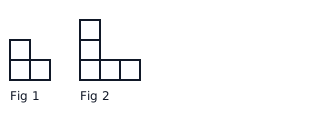
Observe the pattern of tiles shown below. If the pattern continues, how many tiles will be in the figure? Find the rule.
Solution:
Explanation:
By counting the squares in each figure, we see the sequence is . The difference between each term is . Adding to the last known term () gives us .
Problem 4:
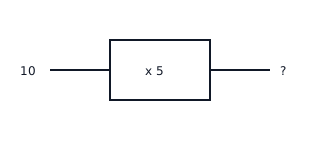
A function machine takes an input and produces an output . If for input the output is , and for input the output is , identify the rule and find the output for input .
Solution:
Explanation:
We compare the input to the output. Since is times , and is times , the relationship is a multiplication by . Applying this to gives .