
Review the key concepts, formulae, and examples before starting your quiz.
🔑Concepts
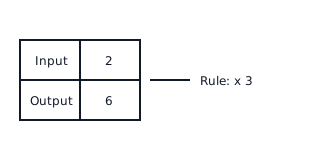
A function is like a machine that takes an input, applies a consistent rule (operation), and produces a specific output. The rule remains the same for every number in a sequence or pattern.

Pattern rules can be additive () or multiplicative (). We identify the rule by looking for a relationship that works for every pair of numbers provided in a set.
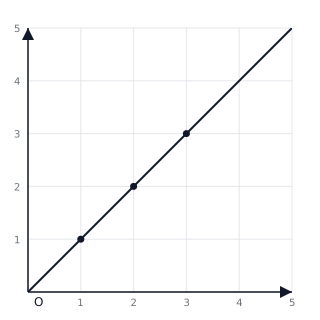
Functional relationships can be represented graphically. When the input () increases, the output () often increases in a straight line if the rule involves a constant addition or multiplication factor.
Inverse relationships exist where the rule might involve subtraction or division. For example, if the input is the total and the output is the remainder after sharing equally.
📐Formulae
💡Examples
Problem 1:
Look at the following pattern in a function table: Input (), Output (). What is the rule, and what would the output be if the input is ?
Solution:
Step 1: Find the difference between the first pair: . Test the rule on the second pair: . Test it on the third pair: . The rule is . Step 2: Apply the rule to the new input: .
Explanation:
To solve functional relationship problems, compare the input and output in each row to find a consistent operation. Once the rule is identified, apply it to the target number.
Problem 2:
A pattern of shapes uses toothpicks for square, toothpicks for squares, and toothpicks for squares. How many toothpicks are needed for squares?
Solution:
Step 1: Identify the relationship between the number of squares (Input) and toothpicks (Output). , , . Step 2: Determine the rule. Since and , the rule is . Step 3: Calculate for squares: toothpicks.
Explanation:
This is a growing pattern where the output is a multiple of the input. Identifying the multiplier allows us to predict much larger terms in the sequence.
Problem 3:
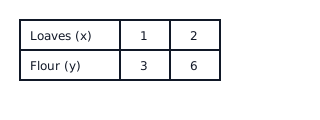
A baker uses cups of flour for every loaf of bread he makes. If he makes loaves, he uses cups, and for loaves, he uses cups. Identify the rule and determine how many cups of flour are needed for loaves.
Solution:
Explanation:
Looking at the relationship: , , . The output is always times the input. The rule is . Therefore, for loaves, we calculate .
Problem 4:
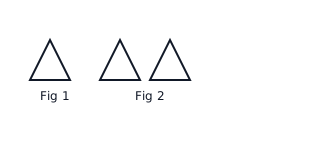
Observe the sequence of triangles. The first figure has sides, the second (two triangles side-by-side sharing no edges) has sides, and the third has sides. If this pattern continues, how many sides will the th figure have?
Solution:
Explanation:
Each figure adds one more triangle. Since each triangle has sides, we multiply the figure number (input) by to find the total sides (output). For the th figure, .