
Relations and Functions - Types of Relations: Reflexive, Symmetric, Transitive and Equivalence
Review the key concepts, formulae, and examples before starting your quiz.
🔑Concepts
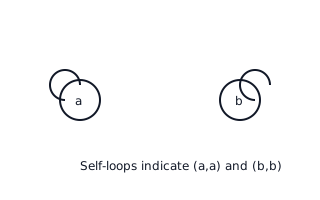
A relation on a set is Reflexive if every element of is related to itself. Formally, . Visually, in a directed graph representation, every node must have a self-loop.
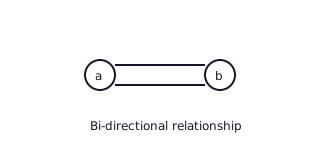
A relation is Symmetric if whenever , then must also be true. In a mapping diagram, this means any arrow from one set to another is matched by an arrow in the opposite direction.
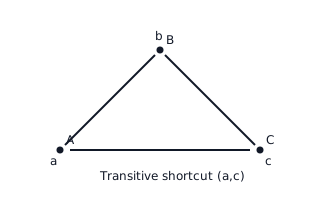
A relation is Transitive if and implies . It represents a 'shortcut' or a chain of relations.
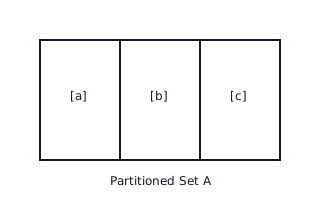
An Equivalence Relation is one that is simultaneously Reflexive, Symmetric, and Transitive. It partitions the set into disjoint subsets called Equivalence Classes.
📐Formulae
Reflexive condition:
Symmetric condition:
Transitive condition:
Number of relations on a set with elements:
Number of reflexive relations on a set with elements:
Equivalence class of :
💡Examples
Problem 1:
Let be the set of all triangles in a plane. Let be a relation in defined as (where denotes congruence). Prove that is an equivalence relation.
Solution:
- Reflexivity: Every triangle is congruent to itself (). Therefore, for all . is reflexive.
- Symmetry: If , then . By the property of congruence, . Therefore, . is symmetric.
- Transitivity: If and , then and . This implies . Therefore, . is transitive. Since is reflexive, symmetric, and transitive, it is an equivalence relation.
Explanation:
To prove a relation is an equivalence relation, we must verify all three fundamental properties (reflexive, symmetric, and transitive) using the given logical definition of the relation.
Problem 2:
Check if the relation on the set of integers defined by is an equivalence relation.
Solution:
- Reflexive: For any , . Since is divisible by , . Thus, is reflexive.
- Symmetric: Let . Then for some integer . Then . Since is an integer, is divisible by , so . Thus, is symmetric.
- Transitive: Let and . Then and for integers . Adding these: . Since is an integer, is divisible by , so . Thus, is transitive. Since all three hold, is an equivalence relation.
Explanation:
This demonstrates an equivalence relation over an infinite set (Integers). We use algebraic manipulation to show that if the condition holds for specific pairs, it must hold for the reflexive and transitive requirements.
Problem 3:
Show that the relation defined on the set of all lines in a plane by (parallelism) is an equivalence relation.

Solution:
- Reflexive: Every line is parallel to itself (). So, .
- Symmetric: If , then , thus .
- Transitive: If and , then and . This implies , so . Since is reflexive, symmetric, and transitive, it is an equivalence relation.
Explanation:
The relation of parallelism satisfies all three criteria. Note: we assume a line is parallel to itself in this context (reflexivity).
Problem 4:
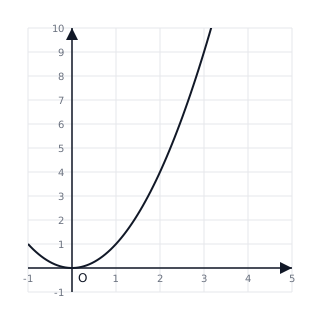
Check if the relation on the set of real numbers defined by is transitive.
Solution:
To check transitivity, we need to see if and implies . Consider a counter-example: Let , , . because (). because (). However, becomes (), which is False. Since and but , the relation is not transitive.
Explanation:
Transitivity fails because squaring numbers between 0 and 1 reduces their value, or squaring small numbers doesn't always maintain the chain of magnitude required by the relation.