krit.club logo

Relations and Functions - Inverse of a Function

Grade 12ICSE

Review the key concepts, formulae, and examples before starting your quiz.

🔑Concepts

•

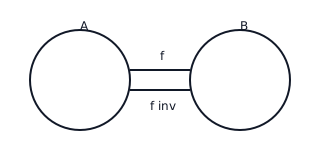
A function f:A→Bf: A \rightarrow B is invertible if and only if it is a bijective function, meaning it is both one-to-one (injective) and onto (surjective).

A flowchart showing the bidirectional mapping between elements in a bijective function.
•

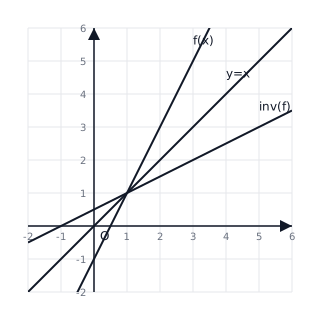
The graph of f−1f^{-1} is the reflection of the graph of ff in the line y=xy = x. If a point (a,b)(a, b) lies on the graph of ff, then the point (b,a)(b, a) must lie on the graph of f−1f^{-1}.

Graph showing f(x), its inverse, and the line of symmetry y=x.
•

The domain of ff becomes the range of f−1f^{-1}, and the range of ff becomes the domain of f−1f^{-1}. For f:A→Bf: A \rightarrow B, the inverse is f−1:B→Af^{-1}: B \rightarrow A.

Venn diagram mapping domain A to range B and back.
•

The identity property states that composing a function with its inverse results in the identity function: (f∘f−1)(x)=x(f \circ f^{-1})(x) = x and (f−1∘f)(x)=x(f^{-1} \circ f)(x) = x.

📐Formulae

f:A→B  ⟺  f−1:B→Af: A \rightarrow B \iff f^{-1}: B \rightarrow A

y=f(x)  ⟺  x=f−1(y)y = f(x) \iff x = f^{-1}(y)

(f∘f−1)(x)=I(x)=x(f \circ f^{-1})(x) = I(x) = x

(f−1∘f)(x)=I(x)=x(f^{-1} \circ f)(x) = I(x) = x

(g∘f)−1=f−1∘g−1(g \circ f)^{-1} = f^{-1} \circ g^{-1} (The Reversal Law)

💡Examples

Problem 1:

Let f:R−{75}→R−{35}f: \mathbb{R} - \{\frac{7}{5}\} \rightarrow \mathbb{R} - \{\frac{3}{5}\} be defined by f(x)=3x+45x−7f(x) = \frac{3x + 4}{5x - 7}. Find f−1(x)f^{-1}(x).

Solution:

Step 1: Set y=f(x)y = f(x). Hence, y=3x+45x−7y = \frac{3x + 4}{5x - 7}. \nStep 2: Solve for xx in terms of yy. \nMultiply both sides by (5x−7)(5x - 7): y(5x−7)=3x+4y(5x - 7) = 3x + 4 5xy−7y=3x+45xy - 7y = 3x + 4 \nStep 3: Collect all terms involving xx on one side: 5xy−3x=7y+45xy - 3x = 7y + 4 x(5y−3)=7y+4x(5y - 3) = 7y + 4 \nStep 4: Isolate xx: x=7y+45y−3x = \frac{7y + 4}{5y - 3} \nStep 5: Replace xx with f−1(y)f^{-1}(y): f−1(y)=7y+45y−3f^{-1}(y) = \frac{7y + 4}{5y - 3} \nReplacing yy with xx, we get: f−1(x)=7x+45x−3f^{-1}(x) = \frac{7x + 4}{5x - 3}.

Explanation:

To find the inverse, we express the independent variable xx as a function of the dependent variable yy. This algebraic manipulation swaps the roles of input and output.

Problem 2:

Show that the function f:R→Rf: \mathbb{R} \rightarrow \mathbb{R} defined by f(x)=4x+3f(x) = 4x + 3 is invertible and find its inverse.

Solution:

Step 1: Prove ff is one-to-one (Injective). \nLet f(x1)=f(x2)f(x_1) = f(x_2). 4x1+3=4x2+3  ⟹  4x1=4x2  ⟹  x1=x24x_1 + 3 = 4x_2 + 3 \implies 4x_1 = 4x_2 \implies x_1 = x_2. Thus, ff is injective. \nStep 2: Prove ff is onto (Surjective). \nLet y∈Ry \in \mathbb{R}. We seek xx such that y=4x+3y = 4x + 3. x=y−34x = \frac{y - 3}{4}. Since yy is any real number, xx is also a real number. Thus, ff is surjective. \nStep 3: Since ff is a bijection, f−1f^{-1} exists. \nFrom Step 2, x=f−1(y)=y−34x = f^{-1}(y) = \frac{y - 3}{4}. \nTherefore, f−1(x)=x−34f^{-1}(x) = \frac{x - 3}{4}.

Explanation:

A function is invertible only if it is a bijection. We first verify injectivity (one-to-one) and surjectivity (onto) before calculating the inverse expression by solving for xx.

Problem 3:

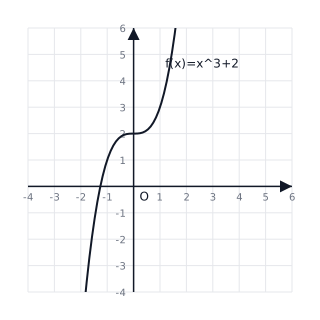
Given the function f:R→Rf: \mathbb{R} \rightarrow \mathbb{R} defined by f(x)=x3+2f(x) = x^3 + 2, determine if it is invertible and find its inverse f−1(x)f^{-1}(x).

Graph of the cubic function f(x) = x^3 + 2.

Solution:

  1. Check Injectivity: Let f(x1)=f(x2)f(x_1) = f(x_2). Then x13+2=x23+2  ⟹  x13=x23  ⟹  x1=x2x_1^3 + 2 = x_2^3 + 2 \implies x_1^3 = x_2^3 \implies x_1 = x_2. It is injective.
  2. Check Surjectivity: For any y∈Ry \in \mathbb{R}, y=x3+2  ⟹  x=y−23y = x^3 + 2 \implies x = \sqrt[3]{y - 2}. Since xx is a real number for all yy, it is surjective.
  3. Find Inverse: Swap xx and yy in y=x3+2y = x^3 + 2 to get x=y3+2x = y^3 + 2. Solve for yy: y3=x−2  ⟹  y=(x−2)1/3y^3 = x - 2 \implies y = (x - 2)^{1/3}. Therefore, f−1(x)=(x−2)1/3f^{-1}(x) = (x - 2)^{1/3}.

Explanation:

Since the function is a bijection (strictly increasing cubic), it has a unique inverse found by solving for the independent variable.

Problem 4:

Verify that the function f:[0,∞)→[1,∞)f: [0, \infty) \rightarrow [1, \infty) defined by f(x)=x2+1f(x) = x^2 + 1 is invertible and find f−1(x)f^{-1}(x). Sketch the graph of both the function and its inverse on the same coordinate plane.
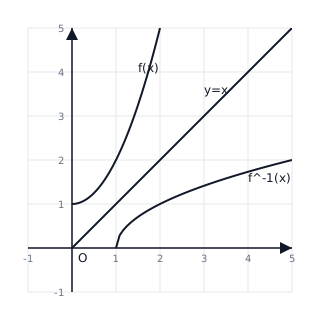
Graph showing f(x) = x^2 + 1 and its inverse f^-1(x) = sqrt(x-1) reflected across the line y = x.

Solution:

Step 1: To check if ff is invertible, it must be bijective (one-to-one and onto).

  • One-to-one: Let f(x1)=f(x2)f(x_1) = f(x_2). Then x12+1=x22+1  ⟹  x12=x22x_1^2 + 1 = x_2^2 + 1 \implies x_1^2 = x_2^2. Since x≥0x \geq 0, x1=x2x_1 = x_2. So ff is injective.
  • Onto: For any y∈[1,∞)y \in [1, \infty), let y=x2+1  ⟹  x=y−1y = x^2 + 1 \implies x = \sqrt{y-1}. Since y≥1y \geq 1, xx is a real number ≥0\geq 0. Thus ff is surjective.

Step 2: Find the inverse. y=x2+1y = x^2 + 1 x2=y−1x^2 = y - 1 x=y−1x = \sqrt{y - 1} (taking positive root since domain is x≥0x \geq 0)

Therefore, f−1(x)=x−1f^{-1}(x) = \sqrt{x - 1} for x∈[1,∞)x \in [1, \infty).

Explanation:

A function is invertible if it is a bijection. The graph of f−1(x)f^{-1}(x) is the reflection of f(x)f(x) about the line y=xy = x. For f(x)=x2+1f(x) = x^2 + 1, the domain is restricted to x≥0x \geq 0 to ensure the function is one-to-one.