
Review the key concepts, formulae, and examples before starting your quiz.
🔑Concepts
A function is called One-to-One (Injective) if distinct elements in the domain have distinct images in the codomain . Mathematically, for any , if , then . Visually, no two arrows from the domain point to the same element in the codomain.

A function is called Onto (Surjective) if every element in the codomain is the image of at least one element in the domain . This means the Range of is equal to the Codomain . For every , there exists such that .

A function is Bijective if it is both one-to-one and onto. This creates a perfect pairing between elements of the domain and the codomain. If , the total number of such bijections is .

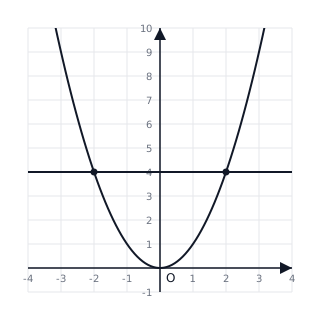
The Horizontal Line Test is used to determine injectivity from a graph. If any horizontal line intersects the graph of the function at more than one point, the function is not one-to-one.
📐Formulae
Injective Condition:
Surjective Condition: (Range equals Codomain)
Number of one-to-one functions from to (where ): if , and if
Number of bijective functions from to (where ):
Number of onto functions from to (where ):
💡Examples
Problem 1:
Check the injectivity and surjectivity of the function defined by .
Solution:
- Injectivity: Let . Then . Subtracting from both sides gives . Dividing by gives . Since implies , the function is injective (one-to-one).
- Surjectivity: Let be an arbitrary element in the codomain . We set and solve for : . For any real value of , will also be a real number. Since (the domain) exists for every (the codomain), the function is surjective (onto). \nConclusion: The function is bijective.
Explanation:
We use the standard algebraic definitions: for injectivity, we prove that equal outputs imply equal inputs; for surjectivity, we prove that any output can be produced by a valid input .
Problem 2:
Show that the function defined by is injective but not surjective.
Solution:
- Injectivity: Let . Since the domain is natural numbers (), and must be positive. Therefore, . The function is injective.
- Surjectivity: The codomain is . Consider an element in the codomain, say . If , then , which means . However, is not a natural number (). Since there are elements in the codomain (like ) that have no pre-image in the domain, the function is not surjective.
Explanation:
Injectivity holds because natural numbers are always positive, eliminating the negative root. Surjectivity fails because only perfect squares in the codomain have pre-images in the domain.
Problem 3:
Determine if the function defined by is a bijection.
Solution:
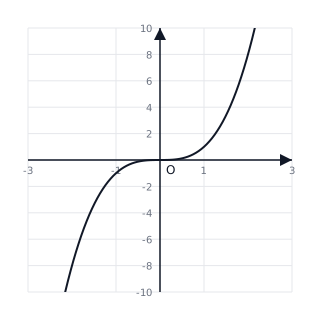
Injectivity: Let . Then . Taking the cube root of both sides, we get . Thus, is injective.
Surjectivity: Let . We seek such that . This implies . Since every real number has a unique real cube root, for every . Thus, the range is and is surjective.
Since is both injective and surjective, it is a bijection.
Explanation:
A cubic function is strictly increasing over the set of real numbers, ensuring each output is unique and every real value is eventually reached.
Problem 4:
Check the surjectivity of the function defined by . Is it injective?
Solution:
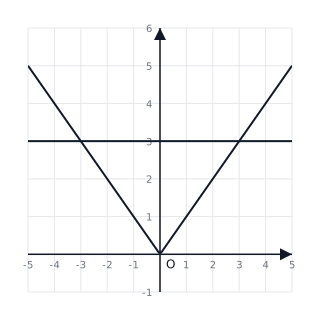
Injectivity: Let . For and , we have and . Since but , the function is not injective.
Surjectivity: The codomain is given as . For any , we can find such that . Thus, the range is , which equals the codomain. The function is surjective.
Explanation:
The absolute value function maps both positive and negative values to the same positive result, failing injectivity, but it covers all non-negative real numbers.