krit.club logo

Linear Programming - Graphical method of solving linear programming problems

Grade 12CBSE

Review the key concepts, formulae, and examples before starting your quiz.

🔑Concepts

•

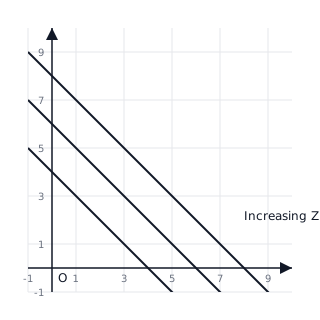
The objective function Z=ax+byZ = ax + by is the linear function that needs to be maximized or minimized. It represents a family of parallel lines on a graph, where the value of ZZ increases as the line moves further from the origin (for positive a,ba, b).

Graphical representation of objective function lines showing increasing Z values.
•

Linear constraints like ax+by≤cax + by \leq c or ax+by≥cax + by \geq c define half-planes. The intersection of all such half-planes, along with non-negativity constraints x≥0,y≥0x \geq 0, y \geq 0, forms the Feasible Region. This region is always a convex polygon.
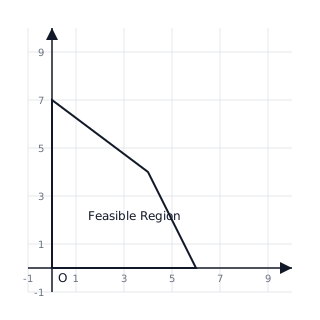
A convex polygon representing the feasible region in the first quadrant.
•

Corner Point Method: This fundamental theorem states that the optimal (maximum or minimum) value of the objective function occurs at one of the vertices (corner points) of the feasible region.

•

Bounded vs. Unbounded Regions: If the feasible region is bounded (a closed polygon), both maximum and minimum values exist. If it is unbounded, a maximum or minimum may not exist, requiring an extra check using the inequality ax+by>Zmaxax + by > Z_{max} or ax+by<Zminax + by < Z_{min}.

📐Formulae

Z=ax+byZ = ax + by

aix+biy≤cia_ix + b_iy \leq c_i

ajx+bjy≥cja_jx + b_jy \geq c_j

x≥0,y≥0x \geq 0, y \geq 0

💡Examples

Problem 1:

Solve the following linear programming problem graphically: Maximize Z=4x+yZ = 4x + y subject to the constraints: x+y≤50x + y \leq 50, 3x+y≤903x + y \leq 90, x≥0,y≥0x \geq 0, y \geq 0.

Solution:

  1. Convert inequalities to equations to find boundary lines: Line 1: x+y=50x + y = 50. Points: (0,50)(0, 50) and (50,0)(50, 0). Line 2: 3x+y=903x + y = 90. Points: (0,90)(0, 90) and (30,0)(30, 0).

  2. Find the feasible region: The region satisfies x+y≤50x + y \leq 50 (region below the line) and 3x+y≤903x + y \leq 90 (region below the line), restricted to the first quadrant (x≥0,y≥0x \geq 0, y \geq 0).

  3. Determine corner points of the feasible region: The intersection of x+y=50x + y = 50 and 3x+y=903x + y = 90: Subtracting the equations: (3x+y)−(x+y)=90−50  ⟹  2x=40  ⟹  x=20(3x + y) - (x + y) = 90 - 50 \implies 2x = 40 \implies x = 20. Then 20+y=50  ⟹  y=3020 + y = 50 \implies y = 30. Point: (20,30)(20, 30). Corner points are O(0,0)O(0, 0), A(30,0)A(30, 0), B(20,30)B(20, 30), and C(0,50)C(0, 50).

  4. Evaluate Z=4x+yZ = 4x + y at each corner point:

    • At O(0,0)O(0, 0): Z=4(0)+0=0Z = 4(0) + 0 = 0
    • At A(30,0)A(30, 0): Z=4(30)+0=120Z = 4(30) + 0 = 120
    • At B(20,30)B(20, 30): Z=4(20)+30=80+30=110Z = 4(20) + 30 = 80 + 30 = 110
    • At C(0,50)C(0, 50): Z=4(0)+50=50Z = 4(0) + 50 = 50

Maximum value of ZZ is 120 at point (30,0)(30, 0).

Explanation:

We first identify the feasible region by plotting the constraints on a graph. The shaded area where all conditions overlap is the feasible region. We then use the Corner Point Method, checking the value of the objective function at every vertex of this region to find the maximum.

Problem 2:

Minimize Z=200x+500yZ = 200x + 500y subject to x+2y≥10x + 2y \geq 10, 3x+4y≤243x + 4y \leq 24, x≥0,y≥0x \geq 0, y \geq 0.

Solution:

  1. Boundary lines: L1:x+2y=10  ⟹  (0,5),(10,0)L_1: x + 2y = 10 \implies (0, 5), (10, 0) L2:3x+4y=24  ⟹  (0,6),(8,0)L_2: 3x + 4y = 24 \implies (0, 6), (8, 0)

  2. Find intersection of L1L_1 and L2L_2: Multiply L1L_1 by 2: 2x+4y=202x + 4y = 20 Subtract from L2L_2: (3x+4y)−(2x+4y)=24−20  ⟹  x=4(3x + 4y) - (2x + 4y) = 24 - 20 \implies x = 4 Substitute x=4x=4 in L1L_1: 4+2y=10  ⟹  2y=6  ⟹  y=34 + 2y = 10 \implies 2y = 6 \implies y = 3. Point: (4,3)(4, 3).

  3. Corner points of feasible region: The region is bounded by points (0,5)(0, 5), (0,6)(0, 6), (4,3)(4, 3), and (8,0)(8, 0) is not possible because of the intersection directions. Checking valid region: Constraints: Above x+2y=10x + 2y = 10 and below 3x+4y=243x + 4y = 24. Corner points: A(0,5)A(0, 5), B(0,6)B(0, 6), C(4,3)C(4, 3). (Note: (8,0)(8,0) and (10,0)(10,0) check: 8+0≥108+0 \geq 10 is False, so (8,0)(8,0) is out. 3(10)+0≤243(10)+0 \leq 24 is False, so (10,0)(10,0) is out).

  4. Evaluate ZZ:

    • At A(0,5)A(0, 5): Z=200(0)+500(5)=2500Z = 200(0) + 500(5) = 2500
    • At B(0,6)B(0, 6): Z=200(0)+500(6)=3000Z = 200(0) + 500(6) = 3000
    • At C(4,3)C(4, 3): Z=200(4)+500(3)=800+1500=2300Z = 200(4) + 500(3) = 800 + 1500 = 2300

Minimum value is 2300 at (4,3)(4, 3).

Explanation:

Identify the intersection points of the lines and determine which corner points satisfy all inequalities. Calculating ZZ at these vertices reveals the minimum value.

Problem 3:

Maximize Z=3x+9yZ = 3x + 9y subject to constraints: x+3y≤60x + 3y \leq 60, x+y≥10x + y \geq 10, x≤yx \leq y, x≥0,y≥0x \geq 0, y \geq 0.

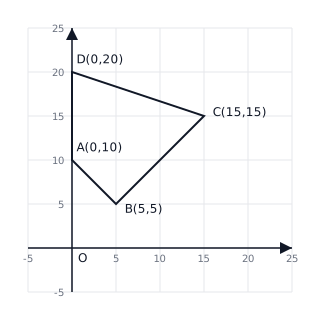
Graph showing the quadrilateral feasible region with vertices at (0,10), (5,5), (15,15), and (0,20).

Solution:

  1. Plot lines: L1:x+3y=60L_1: x + 3y = 60 (points (0,20), (60,0)), L2:x+y=10L_2: x + y = 10 (points (0,10), (10,0)), L3:x=yL_3: x = y.
  2. Identify Feasible Region vertices: A(0,10)A(0,10), B(5,5)B(5,5), C(15,15)C(15,15), D(0,20)D(0,20).
  3. Evaluate ZZ at vertices: At A(0,10),Z=3(0)+9(10)=90A(0,10), Z = 3(0) + 9(10) = 90 At B(5,5),Z=3(5)+9(5)=15+45=60B(5,5), Z = 3(5) + 9(5) = 15 + 45 = 60 At C(15,15),Z=3(15)+9(15)=45+135=180C(15,15), Z = 3(15) + 9(15) = 45 + 135 = 180 At D(0,20),Z=3(0)+9(20)=180D(0,20), Z = 3(0) + 9(20) = 180
  4. Since ZZ is 180 at both CC and DD, the maximum value is 180 and occurs at every point on the line segment CDCD.

Explanation:

The problem demonstrates a case of multiple optimal solutions because the objective function is parallel to one of the constraint boundaries (x+3y=60x + 3y = 60).

Problem 4:

Minimize Z=5x+10yZ = 5x + 10y subject to: x+2y≤120x + 2y \leq 120, x+y≥60x + y \geq 60, x−2y≥0x - 2y \geq 0, x,y≥0x, y \geq 0.

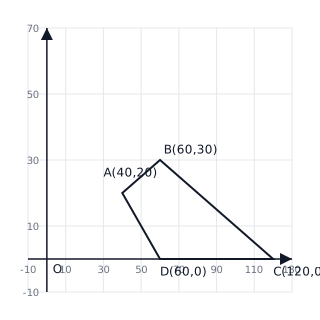
Graph of the feasible region for minimization problem with points (60,0), (120,0), (60,30), and (40,20).

Solution:

  1. Find corner points of feasible region by solving intersection of lines: L1:x+2y=120L_1: x + 2y = 120 L2:x+y=60L_2: x + y = 60 L3:x=2yL_3: x = 2y
  2. Corner points: A(40,20)A(40,20), B(60,30)B(60,30), C(120,0)C(120,0), D(60,0)D(60,0).
  3. Calculate ZZ: At A(40,20),Z=5(40)+10(20)=400A(40,20), Z = 5(40) + 10(20) = 400 At B(60,30),Z=5(60)+10(30)=600B(60,30), Z = 5(60) + 10(30) = 600 At C(120,0),Z=5(120)+10(0)=600C(120,0), Z = 5(120) + 10(0) = 600 At D(60,0),Z=5(60)+10(0)=300D(60,0), Z = 5(60) + 10(0) = 300
  4. Minimum value is 300 at point (60,0)(60,0).

Explanation:

We identify the intersection points of the boundary lines and use the Corner Point Method to evaluate the objective function.