
Review the key concepts, formulae, and examples before starting your quiz.
🔑Concepts
The Feasible Region is the common region determined by all constraints including non-negative constraints . This region represents the set of all possible points that satisfy the system of linear inequalities.
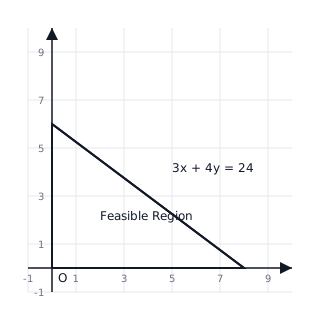
Corner Point Method: The optimal (maximum or minimum) value of the objective function must occur at one of the vertices (corner points) of the feasible region. If the region is bounded, both a maximum and a minimum value exist.
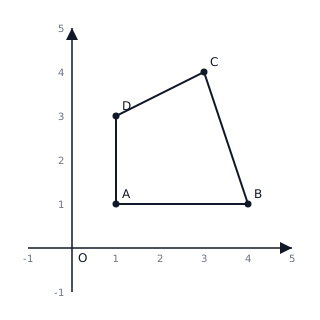
Bounded vs Unbounded Regions: A feasible region is bounded if it can be enclosed within a circle. If the region extends infinitely in any direction, it is unbounded. For unbounded regions, a maximum or minimum value might not exist.
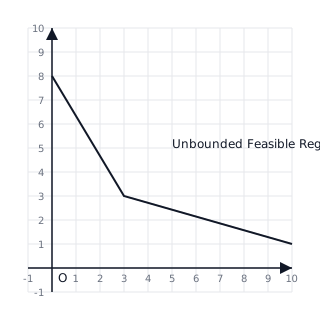
Multiple Optimal Solutions: If two adjacent corner points of the feasible region produce the same optimal value of , then every point on the line segment joining these two points is also an optimal solution.
📐Formulae
General Objective Function:
Standard Linear Constraint:
Non-negativity Constraints:
Condition for Multiple Optimal Solutions: If two corner points and give the same maximum/minimum value, then every point on the line segment joining them is also an optimal solution.
💡Examples
Problem 1:
Maximize subject to the constraints: , , .
Solution:
Step 1: Convert inequalities to equations to find boundary lines: and . Step 2: Find the intercepts for : and . Find the intercepts for : and . Step 3: Solve and simultaneously to find the intersection point: Subtracting from gives . Substituting into gives . The intersection is . Step 4: Identify the feasible region (bounded by the axes and these lines in the first quadrant). The corner points are , , , and . Step 5: Evaluate at each corner point:
- At
- At
- At
- At Step 6: The maximum value of is at the point .
Explanation:
We use the graphical method to find the intersection of the constraints. Since the region is bounded, we evaluate the objective function at all vertices of the shaded polygon to find the highest value.
Problem 2:
Minimize subject to: , , .
Solution:
Step 1: Boundary lines are (intercepts ) and (intercepts ). Step 2: Find intersection of and : Multiply by . Subtract from this: . Then . Intersection is . Step 3: The feasible region is unbounded and lies above the lines and . The corner points are , , and . Step 4: Evaluate :
- At
- At
- At Step 5: The minimum value is at . (Since the region is unbounded, we verify if has points in common with the feasible region; it does not, so 260 is the actual minimum).
Explanation:
This is a minimization problem with an unbounded feasible region extending away from the origin. The corner point with the smallest value is the candidate for the minimum.
Problem 3:
Minimize subject to constraints: , , .
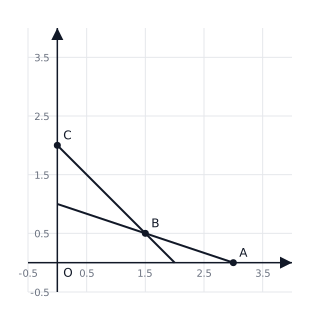
Solution:
- Plot lines (points (3,0), (0,1)) and (points (2,0), (0,2)).
- The intersection point of and is found by subtraction: .
- Corner points of the unbounded feasible region are , , and .
- Evaluate at each point:
- At :
- At :
- At :
- Minimum value is 7 at . Since the region is unbounded, we check if has points in common with the feasible region. It does not, so 7 is the minimum.
Explanation:
Identify the feasible region above the lines, find vertices, and apply the corner point method.
Problem 4:
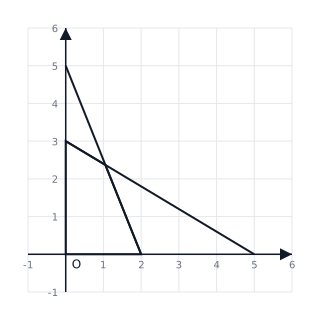
Maximize subject to , , .
Solution:
- Plot lines (intercepts (5,0), (0,3)) and (intercepts (2,0), (0,5)).
- Find intersection: and . Subtracting gives . Substituting gives .
- Corner points: , , , .
- Evaluate :
- At :
- At :
- At :
- At :
- Maximum value is at .
Explanation:
The feasible region is a bounded quadrilateral. The maximum value occurs at the intersection of the two constraint lines.