krit.club logo

Inverse Trigonometric Functions - Definition, range, domain, principal value branch

Grade 12CBSE

Review the key concepts, formulae, and examples before starting your quiz.

🔑Concepts

•

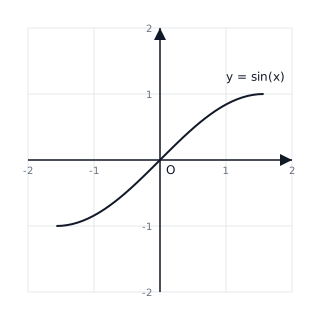
The inverse sine function, y=sin⁡−1xy = \sin^{-1} x, is defined by restricting the domain of the sine function to [−π2,π2][-\frac{\pi}{2}, \frac{\pi}{2}] to make it one-to-one and onto. Its domain is [−1,1][-1, 1] and its range (principal value branch) is [−π2,π2][-\frac{\pi}{2}, \frac{\pi}{2}].

Graph of sine function restricted to its principal domain.
•

The principal value of an inverse trigonometric function is the value of that function which lies in its specified principal value branch. For example, for cos⁡−1x\cos^{-1} x, the branch is [0,π][0, \pi]. Values outside this range are not considered principal values.
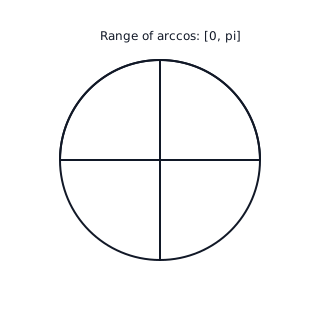
Unit circle showing the upper semi-circle representing the principal range of arccos.
•

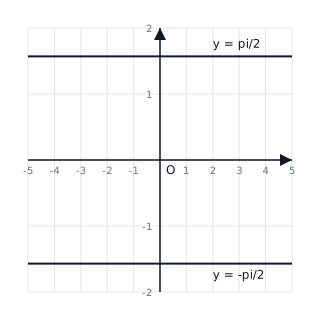
The domain of tan⁡−1x\tan^{-1} x and cot⁡−1x\cot^{-1} x is the set of all real numbers R\mathbb{R}. However, their ranges are different: (−π2,π2)(-\frac{\pi}{2}, \frac{\pi}{2}) for tan⁡−1x\tan^{-1} x and (0,π)(0, \pi) for cot⁡−1x\cot^{-1} x.

Horizontal asymptotes for the arctan function.
•

Functions like sec⁡−1x\sec^{-1} x and csc⁡−1x\csc^{-1} x have domains (−∞,−1]∪[1,∞)(-\infty, -1] \cup [1, \infty). Their principal value branches exclude points where the original functions are undefined (e.g., π2\frac{\pi}{2} for sec⁡\sec and 00 for csc⁡\csc).

📐Formulae

sin⁡−1:[−1,1]→[−π2,π2]\sin^{-1}: [-1, 1] \rightarrow [-\frac{\pi}{2}, \frac{\pi}{2}]

cos⁡−1:[−1,1]→[0,π]\cos^{-1}: [-1, 1] \rightarrow [0, \pi]

tan⁡−1:R→(−π2,π2)\tan^{-1}: \mathbb{R} \rightarrow (-\frac{\pi}{2}, \frac{\pi}{2})

cot⁡−1:R→(0,π)\cot^{-1}: \mathbb{R} \rightarrow (0, \pi)

sec⁡−1:R−(−1,1)→[0,π]−{π2}\sec^{-1}: \mathbb{R} - (-1, 1) \rightarrow [0, \pi] - \{\frac{\pi}{2}\}

csc⁡−1:R−(−1,1)→[−π2,π2]−{0}\csc^{-1}: \mathbb{R} - (-1, 1) \rightarrow [-\frac{\pi}{2}, \frac{\pi}{2}] - \{0\}

sin⁡−1(−x)=−sin⁡−1x,x∈[−1,1]\sin^{-1}(-x) = -\sin^{-1} x, x \in [-1, 1]

cos⁡−1(−x)=π−cos⁡−1x,x∈[−1,1]\cos^{-1}(-x) = \pi - \cos^{-1} x, x \in [-1, 1]

tan⁡−1(−x)=−tan⁡−1x,x∈R\tan^{-1}(-x) = -\tan^{-1} x, x \in \mathbb{R}

csc⁡−1(1x)=sin⁡−1x,∣x∣≤1,x≠0\csc^{-1}(\frac{1}{x}) = \sin^{-1} x, |x| \le 1, x \neq 0

💡Examples

Problem 1:

Find the principal value of cos⁡−1(−12)\cos^{-1}(-\frac{1}{2}).

Solution:

  1. Let y=cos⁡−1(−12)y = \cos^{-1}(-\frac{1}{2}). Then cos⁡y=−12\cos y = -\frac{1}{2}.
  2. We know that cos⁡(π3)=12\cos(\frac{\pi}{3}) = \frac{1}{2}.
  3. Since the range of the principal value branch of cos⁡−1\cos^{-1} is [0,π][0, \pi], we need a value in the second quadrant where cosine is negative.
  4. Using the identity cos⁡(π−θ)=−cos⁡θ\cos(\pi - \theta) = -\cos \theta, we get cos⁡(π−π3)=−cos⁡(π3)=−12\cos(\pi - \frac{\pi}{3}) = -\cos(\frac{\pi}{3}) = -\frac{1}{2}.
  5. Thus, cos⁡(2π3)=−12\cos(\frac{2\pi}{3}) = -\frac{1}{2}.
  6. Since 2π3∈[0,π]\frac{2\pi}{3} \in [0, \pi], the principal value is 2π3\frac{2\pi}{3}.

Explanation:

This problem uses the definition of the principal value branch for cosine, which requires the output angle to be between 00 and π\pi. Since the argument is negative, we use the second quadrant.

Problem 2:

Find the value of tan⁡−1(3)−sec⁡−1(−2)\tan^{-1}(\sqrt{3}) - \sec^{-1}(-2).

Solution:

  1. Let x=tan⁡−1(3)x = \tan^{-1}(\sqrt{3}). Since tan⁡(π3)=3\tan(\frac{\pi}{3}) = \sqrt{3} and π3∈(−π2,π2)\frac{\pi}{3} \in (-\frac{\pi}{2}, \frac{\pi}{2}), x=π3x = \frac{\pi}{3}.
  2. Let y=sec⁡−1(−2)y = \sec^{-1}(-2). Then sec⁡y=−2\sec y = -2, which means cos⁡y=−12\cos y = -\frac{1}{2}.
  3. From the principal branch of sec⁡−1\sec^{-1}, y∈[0,π]−{π2}y \in [0, \pi] - \{\frac{\pi}{2}\}.
  4. cos⁡y=−12  ⟹  y=π−π3=2π3\cos y = -\frac{1}{2} \implies y = \pi - \frac{\pi}{3} = \frac{2\pi}{3}.
  5. Now, tan⁡−1(3)−sec⁡−1(−2)=π3−2π3=−π3\tan^{-1}(\sqrt{3}) - \sec^{-1}(-2) = \frac{\pi}{3} - \frac{2\pi}{3} = -\frac{\pi}{3}.

Explanation:

To solve expressions with multiple inverse functions, calculate the principal value of each term individually according to their specific range restrictions, then perform the arithmetic.

Problem 3:

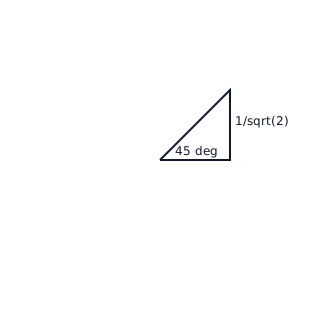
Find the principal value of sin⁡−1(12)\sin^{-1}(\frac{1}{\sqrt{2}}).

Right angled triangle showing 45 degree angle and corresponding sine ratio.

Solution:

Let sin⁡−1(12)=y\sin^{-1}(\frac{1}{\sqrt{2}}) = y. Then sin⁡y=12\sin y = \frac{1}{\sqrt{2}}. We know that sin⁡(π4)=12\sin(\frac{\pi}{4}) = \frac{1}{\sqrt{2}}. Since π4∈[−π2,π2]\frac{\pi}{4} \in [-\frac{\pi}{2}, \frac{\pi}{2}], the principal value is π4\frac{\pi}{4}.

Explanation:

To find the principal value, we look for an angle in the branch [−π2,π2][-\frac{\pi}{2}, \frac{\pi}{2}] whose sine value is 12\frac{1}{\sqrt{2}}.

Problem 4:

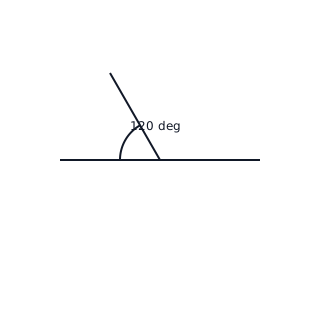
Calculate the value of cot⁡−1(−13)\cot^{-1}(-\frac{1}{\sqrt{3}}).

An angle of 120 degrees in the second quadrant representing the value 2pi/3.

Solution:

Let cot⁡−1(−13)=y\cot^{-1}(-\frac{1}{\sqrt{3}}) = y. Then cot⁡y=−13\cot y = -\frac{1}{\sqrt{3}}. We know cot⁡(π3)=13\cot(\frac{\pi}{3}) = \frac{1}{\sqrt{3}}. Since the range of cot⁡−1x\cot^{-1} x is (0,π)(0, \pi), we use the identity cot⁡(π−θ)=−cot⁡θ\cot(\pi - \theta) = -\cot \theta. Thus, y=π−π3=2π3y = \pi - \frac{\pi}{3} = \frac{2\pi}{3}.

Explanation:

Since the value is negative and the range of cot⁡−1\cot^{-1} is (0,π)(0, \pi), the angle must fall in the second quadrant.