
Review the key concepts, formulae, and examples before starting your quiz.
🔑Concepts
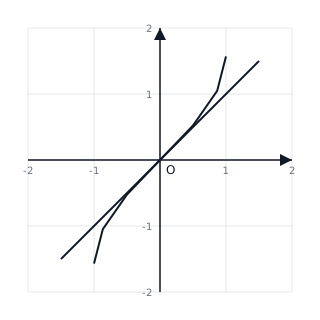
The inverse sine function is the inverse of the restricted sine function . Its domain is and its principal value branch (range) is . The graph shows the reflection of across the line .
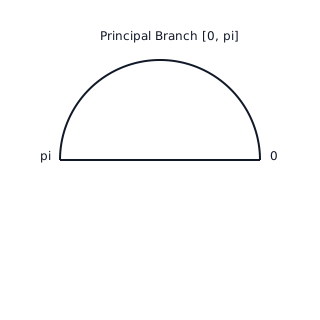
The principal value of an inverse trigonometric function is the value that lies in the defined range of the principal branch. For example, for , the result must be in the interval .
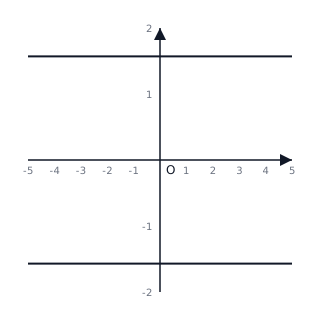
For the function , the domain is the set of all real numbers , and the range (principal branch) is the open interval . Horizontal asymptotes occur at and .
Negative arguments in inverse functions follow specific rules: (odd symmetry), whereas due to the range being restricted to .
📐Formulae
💡Examples
Problem 1:
Find the principal value of .
Solution:
Let . Then . We know that . Since , the principal value is .
Explanation:
The value must fall within the principal value branch of , which is .
Problem 2:
Find the principal value of .
Solution:
Let . Then . Since , we have . Since , the principal value is .
Explanation:
For negative arguments in , we use the property to ensure the result is within the range .
Problem 3:
Find the value of .
Solution:
- because and .
- . Since , .
- Value .
Explanation:
The problem is solved by calculating the principal values of each term individually and then performing subtraction.
Problem 4:
Evaluate the principal value of .
Solution:
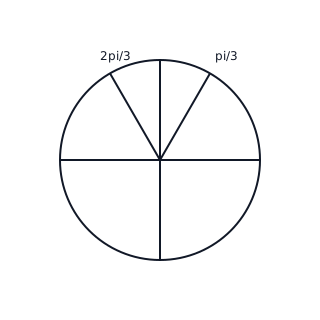
- Note that does not lie in the principal branch .
- We use the identity .
- .
- Now, .
- .
Explanation:
Since the input to the inverse sine function must be within its principal range to 'cancel' the sine, we reduce the angle using trigonometric identities until it falls within .
Problem 5:
Find the value of .
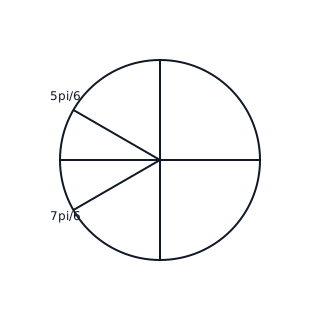
Solution:
- is outside the principal branch .
- Rewrite using the property .
- .
- lies in the interval .
- Therefore, .
Explanation:
To find the principal value, the angle must be mapped to the interval where the cosine function is one-to-one.