krit.club logo

Inverse Trigonometric Functions - Graphs of inverse trigonometric functions

Grade 12CBSE

Review the key concepts, formulae, and examples before starting your quiz.

πŸ”‘Concepts

β€’

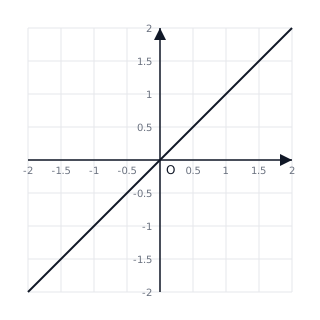
Definition and Bijectivity: Trigonometric functions are periodic and hence not one-to-one over their entire domain. To define inverse trigonometric functions, their domains are restricted to specific intervals (Principal Value Branches) where the functions are bijective. Visually, the graph of an inverse function is the reflection of the original function's graph across the line y=xy = x.

β€’

Graph of y=sinβ‘βˆ’1xy = \sin^{-1} x: The domain is [βˆ’1,1][-1, 1] and the principal value range is [βˆ’Ο€2,Ο€2][-\frac{\pi}{2}, \frac{\pi}{2}]. Visually, it is an 'S-shaped' curve passing through the origin (0,0)(0, 0). It is strictly increasing, starting from the point (βˆ’1,βˆ’Ο€2)(-1, -\frac{\pi}{2}) and ending at (1,Ο€2)(1, \frac{\pi}{2}).

β€’

Graph of y=cosβ‘βˆ’1xy = \cos^{-1} x: The domain is [βˆ’1,1][-1, 1] and the principal value range is [0,Ο€][0, \pi]. Visually, this is a strictly decreasing curve that starts at (βˆ’1,Ο€)(-1, \pi), crosses the y-axis at (0,Ο€2)(0, \frac{\pi}{2}), and ends at the point (1,0)(1, 0). Unlike the sine inverse, it lies entirely above or on the x-axis.

β€’

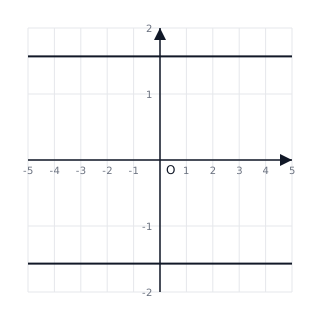
Graph of y=tanβ‘βˆ’1xy = \tan^{-1} x: The domain is the set of all real numbers R\mathbb{R}, and the principal value range is the open interval (βˆ’Ο€2,Ο€2)(-\frac{\pi}{2}, \frac{\pi}{2}). Visually, the graph features two horizontal asymptotes at y=Ο€2y = \frac{\pi}{2} and y=βˆ’Ο€2y = -\frac{\pi}{2}. The curve increases from left to right, passing through the origin and flattening out as it approaches the asymptotes.

β€’

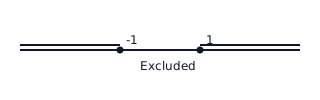
Graph of y=cosecβˆ’1xy = \text{cosec}^{-1} x and y=secβ‘βˆ’1xy = \sec^{-1} x: These functions have a domain of (βˆ’βˆž,βˆ’1]βˆͺ[1,∞)(-\infty, -1] \cup [1, \infty). Visually, there is a visible 'gap' in the graph between x=βˆ’1x = -1 and x=1x = 1. The graph of cosecβˆ’1x\text{cosec}^{-1} x has a horizontal asymptote at y=0y = 0, while secβ‘βˆ’1x\sec^{-1} x has one at y=Ο€2y = \frac{\pi}{2}.

β€’

Graph of y=cotβ‘βˆ’1xy = \cot^{-1} x: The domain is R\mathbb{R} and the range is (0,Ο€)(0, \pi). Visually, it is a strictly decreasing curve. It approaches the horizontal asymptote y=Ο€y = \pi as xβ†’βˆ’βˆžx \to -\infty and approaches y=0y = 0 as xβ†’βˆžx \to \infty.

β€’

Symmetry and Odd/Even properties: The graphs of sinβ‘βˆ’1x\sin^{-1} x, tanβ‘βˆ’1x\tan^{-1} x, and cosecβˆ’1x\text{cosec}^{-1} x are symmetric with respect to the origin (odd functions), meaning sinβ‘βˆ’1(βˆ’x)=βˆ’sinβ‘βˆ’1(x)\sin^{-1}(-x) = -\sin^{-1}(x). However, cosβ‘βˆ’1x\cos^{-1} x, secβ‘βˆ’1x\sec^{-1} x, and cotβ‘βˆ’1x\cot^{-1} x do not show origin symmetry; instead, their values follow the relation f(βˆ’x)=Ο€βˆ’f(x)f(-x) = \pi - f(x) due to their shifted ranges.

πŸ“Formulae

sinβ‘βˆ’1:[βˆ’1,1]β†’[βˆ’Ο€2,Ο€2]\sin^{-1}: [-1, 1] \to [-\frac{\pi}{2}, \frac{\pi}{2}]

cosβ‘βˆ’1:[βˆ’1,1]β†’[0,Ο€]\cos^{-1}: [-1, 1] \to [0, \pi]

tanβ‘βˆ’1:Rβ†’(βˆ’Ο€2,Ο€2)\tan^{-1}: \mathbb{R} \to (-\frac{\pi}{2}, \frac{\pi}{2})

cotβ‘βˆ’1:Rβ†’(0,Ο€)\cot^{-1}: \mathbb{R} \to (0, \pi)

secβ‘βˆ’1:Rβˆ’(βˆ’1,1)β†’[0,Ο€]βˆ’{Ο€2}\sec^{-1}: \mathbb{R} - (-1, 1) \to [0, \pi] - \{\frac{\pi}{2}\}

cosecβˆ’1:Rβˆ’(βˆ’1,1)β†’[βˆ’Ο€2,Ο€2]βˆ’{0}\text{cosec}^{-1}: \mathbb{R} - (-1, 1) \to [-\frac{\pi}{2}, \frac{\pi}{2}] - \{0\}

sinβ‘βˆ’1(βˆ’x)=βˆ’sinβ‘βˆ’1x,x∈[βˆ’1,1]\sin^{-1}(-x) = -\sin^{-1} x, x \in [-1, 1]

cosβ‘βˆ’1(βˆ’x)=Ο€βˆ’cosβ‘βˆ’1x,x∈[βˆ’1,1]\cos^{-1}(-x) = \pi - \cos^{-1} x, x \in [-1, 1]

tanβ‘βˆ’1(βˆ’x)=βˆ’tanβ‘βˆ’1x,x∈R\tan^{-1}(-x) = -\tan^{-1} x, x \in \mathbb{R}

πŸ’‘Examples

Problem 1:

Find the principal value of cosβ‘βˆ’1(βˆ’12)\cos^{-1}(-\frac{1}{2}).

Solution:

  1. Let y=cosβ‘βˆ’1(βˆ’12)y = \cos^{-1}(-\frac{1}{2}).
  2. This implies cos⁑y=βˆ’12\cos y = -\frac{1}{2}.
  3. We know that the principal value branch of cosβ‘βˆ’1\cos^{-1} is [0,Ο€][0, \pi].
  4. Since cos⁑π3=12\cos \frac{\pi}{3} = \frac{1}{2}, we use the identity cos⁑(Ο€βˆ’ΞΈ)=βˆ’cos⁑θ\cos(\pi - \theta) = -\cos \theta.
  5. cos⁑y=βˆ’cos⁑π3=cos⁑(Ο€βˆ’Ο€3)=cos⁑2Ο€3\cos y = -\cos \frac{\pi}{3} = \cos(\pi - \frac{\pi}{3}) = \cos \frac{2\pi}{3}.
  6. Since 2Ο€3∈[0,Ο€]\frac{2\pi}{3} \in [0, \pi], the principal value is 2Ο€3\frac{2\pi}{3}.

Explanation:

To find the principal value, we identify the angle in the restricted range [0,Ο€][0, \pi] whose cosine equals the given value. Because the value is negative, the angle must lie in the second quadrant.

Problem 2:

Find the domain of the function f(x)=sinβ‘βˆ’1(2xβˆ’3)f(x) = \sin^{-1}(2x - 3).

Solution:

  1. The domain of the basic function y=sinβ‘βˆ’1ty = \sin^{-1} t is βˆ’1≀t≀1-1 \leq t \leq 1.
  2. For f(x)=sinβ‘βˆ’1(2xβˆ’3)f(x) = \sin^{-1}(2x - 3), the argument (2xβˆ’3)(2x - 3) must lie within this range.
  3. Set up the inequality: βˆ’1≀2xβˆ’3≀1-1 \leq 2x - 3 \leq 1.
  4. Add 33 to all parts: 2≀2x≀42 \leq 2x \leq 4.
  5. Divide by 22: 1≀x≀21 \leq x \leq 2.
  6. Therefore, the domain is x∈[1,2]x \in [1, 2].

Explanation:

The domain of an inverse sine function is determined by ensuring the expression inside the function stays between βˆ’1-1 and 11, inclusive.

Graphs of inverse trigonometric functions Revision - Class 12 Maths CBSE