
Review the key concepts, formulae, and examples before starting your quiz.
🔑Concepts
A vector represents a displacement with both magnitude (length) and direction. In 2D, it is written as a column vector , where is the horizontal movement and is the vertical movement.
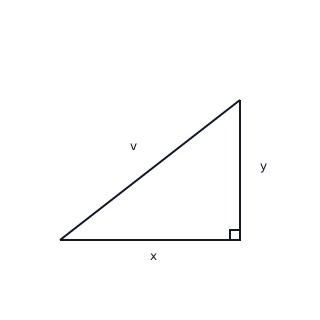
The magnitude (or modulus) of a vector , denoted by , is the length of the vector. It is calculated using Pythagoras' Theorem: .
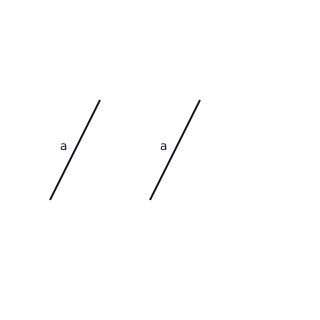
Vectors are equal if they have the same magnitude and the same direction, regardless of their starting positions. Parallel vectors are scalar multiples of each other, such as and .
A negative vector, denoted as , has the same magnitude as but acts in the exact opposite direction. If , then .
📐Formulae
Column Vector:
Magnitude (Modulus):
Vector from point to :
Distance between two points (Magnitude of ):
Scalar Product:
💡Examples
Problem 1:
Given the vector , calculate its magnitude .
Solution:
Explanation:
To find the magnitude, we use the Pythagorean formula on the and components. Note that squaring a negative number results in a positive value.
Problem 2:
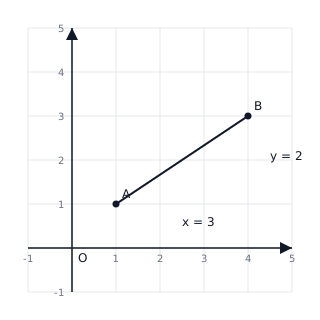
Point is and point is . Find the vector and its magnitude .
Solution:
. Magnitude:
Explanation:
First, subtract the coordinates of the starting point () from the coordinates of the end point () to find the column vector. Then apply the magnitude formula.
Problem 3:
If , find the magnitude of .
Solution:
. Magnitude:
Explanation:
Multiply each component of the vector by the scalar 3 first, then calculate the magnitude of the resulting vector.
Problem 4:
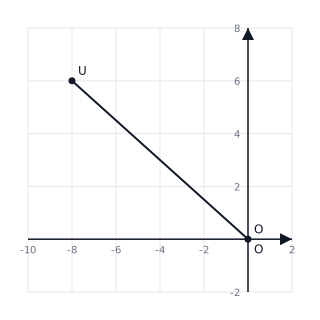
Given vector , calculate the magnitude .
Solution:
- Identify the components: and .
- Use the magnitude formula: .
- Substitute the values: .
- Calculate the squares: .
- .
Explanation:
The magnitude represents the straight-line distance from the start to the end of the vector. Since squaring a negative number results in a positive value, the direction (left/right) does not affect the length.
Problem 5:
Point is at and point is at . Find the column vector and its magnitude .
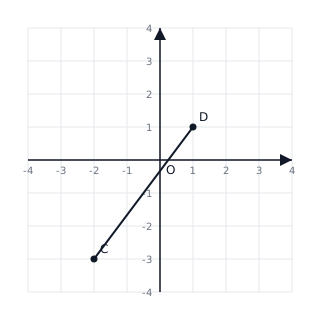
Solution:
- Find by subtracting coordinates of from : .
- Calculate the magnitude: .
- .
- .
Explanation:
To find the vector between two points, calculate the change in and change in . The magnitude is then found using the distance formula between these coordinates.