krit.club logo

Vectors and Transformations - Addition and subtraction of vectors

Grade 11A Level

Review the key concepts, formulae, and examples before starting your quiz.

🔑Concepts

•

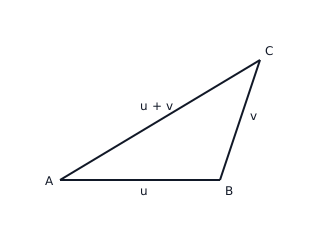
The Triangle Law of Addition states that if you follow vector AB⃗\vec{AB} and then vector BC⃗\vec{BC}, the resultant vector is the direct path from the start to the end, AC⃗\vec{AC}.

Diagram showing the Triangle Law of vector addition where vector AB (u) plus BC (v) equals vector AC (u+v).
•

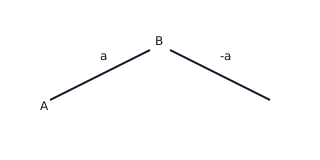
Negative vectors represent the same magnitude but the opposite direction. If AB⃗=a\vec{AB} = \mathbf{a}, then BA⃗=−a\vec{BA} = -\mathbf{a}. Subtraction of a vector is equivalent to adding its negative: a−b=a+(−b)\mathbf{a} - \mathbf{b} = \mathbf{a} + (-\mathbf{b}).

Comparison of vector a and vector -a showing opposite directions.
•

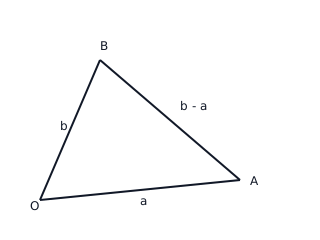
Vector subtraction can be visualized using the Parallelogram Law or by finding the vector between two points. AB⃗=OB⃗−OA⃗\vec{AB} = \vec{OB} - \vec{OA}, where OO is the origin.

Vector subtraction showing vector AB = b - a.
•

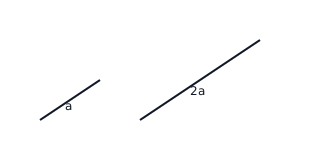
Scalar multiplication scales the length of the vector without changing its direction (if the scalar is positive). For a=(xy)\mathbf{a} = \begin{pmatrix} x \\ y \end{pmatrix}, ka=(kxky)k\mathbf{a} = \begin{pmatrix} kx \\ ky \end{pmatrix}.

Visualization of scalar multiplication showing a vector doubled in length.

📐Formulae

Addition of column vectors: (x1y1)+(x2y2)=(x1+x2y1+y2)\begin{pmatrix} x_1 \\ y_1 \end{pmatrix} + \begin{pmatrix} x_2 \\ y_2 \end{pmatrix} = \begin{pmatrix} x_1 + x_2 \\ y_1 + y_2 \end{pmatrix}

Subtraction of column vectors: (x1y1)−(x2y2)=(x1−x2y1−y2)\begin{pmatrix} x_1 \\ y_1 \end{pmatrix} - \begin{pmatrix} x_2 \\ y_2 \end{pmatrix} = \begin{pmatrix} x_1 - x_2 \\ y_1 - y_2 \end{pmatrix}

Triangle Law of Addition: AB⃗+BC⃗=AC⃗\vec{AB} + \vec{BC} = \vec{AC}

Vector between two points: PQ⃗=OQ⃗−OP⃗=q−p\vec{PQ} = \vec{OQ} - \vec{OP} = \mathbf{q} - \mathbf{p}

Scalar multiplication: k(xy)=(kxky)k \begin{pmatrix} x \\ y \end{pmatrix} = \begin{pmatrix} kx \\ ky \end{pmatrix}

💡Examples

Problem 1:

Given a=(4−2)\mathbf{a} = \begin{pmatrix} 4 \\ -2 \end{pmatrix} and b=(−15)\mathbf{b} = \begin{pmatrix} -1 \\ 5 \end{pmatrix}, calculate the resultant vector 3a−2b3\mathbf{a} - 2\mathbf{b}.

Solution:

3(4−2)−2(−15)=(12−6)−(−210)=(12−(−2)−6−10)=(14−16)3\begin{pmatrix} 4 \\ -2 \end{pmatrix} - 2\begin{pmatrix} -1 \\ 5 \end{pmatrix} = \begin{pmatrix} 12 \\ -6 \end{pmatrix} - \begin{pmatrix} -2 \\ 10 \end{pmatrix} = \begin{pmatrix} 12 - (-2) \\ -6 - 10 \end{pmatrix} = \begin{pmatrix} 14 \\ -16 \end{pmatrix}

Explanation:

First, multiply each vector by its respective scalar. Then, subtract the corresponding xx and yy components. Remember that subtracting a negative number results in addition.

Problem 2:

In triangle OABOAB, OA⃗=a\vec{OA} = \mathbf{a} and OB⃗=b\vec{OB} = \mathbf{b}. Point MM is the midpoint of ABAB. Find the vector OM⃗\vec{OM} in terms of a\mathbf{a} and b\mathbf{b}.

Solution:

  1. AB⃗=AO⃗+OB⃗=−a+b\vec{AB} = \vec{AO} + \vec{OB} = -\mathbf{a} + \mathbf{b}.
  2. AM⃗=12AB⃗=12(−a+b)\vec{AM} = \frac{1}{2}\vec{AB} = \frac{1}{2}(-\mathbf{a} + \mathbf{b}).
  3. OM⃗=OA⃗+AM⃗=a+12(−a+b)=a−12a+12b=12a+12b\vec{OM} = \vec{OA} + \vec{AM} = \mathbf{a} + \frac{1}{2}(-\mathbf{a} + \mathbf{b}) = \mathbf{a} - \frac{1}{2}\mathbf{a} + \frac{1}{2}\mathbf{b} = \frac{1}{2}\mathbf{a} + \frac{1}{2}\mathbf{b}.

Explanation:

To find OM⃗\vec{OM}, we find a path from OO to MM. We first find AB⃗\vec{AB} using the subtraction of position vectors. Since MM is the midpoint, AM⃗\vec{AM} is half of AB⃗\vec{AB}. Finally, we add OA⃗\vec{OA} and AM⃗\vec{AM} and simplify.

Problem 3:

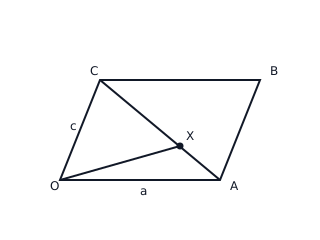
In the diagram, OABCOABC is a parallelogram. OA⃗=a\vec{OA} = \mathbf{a} and OC⃗=c\vec{OC} = \mathbf{c}. Point XX lies on ACAC such that AX:XC=1:2AX:XC = 1:2. Find OX⃗\vec{OX} in terms of a\mathbf{a} and c\mathbf{c}.

Parallelogram OABC with point X on diagonal AC.

Solution:

AC⃗=AO⃗+OC⃗=−a+c\vec{AC} = \vec{AO} + \vec{OC} = -\mathbf{a} + \mathbf{c} AX⃗=13AC⃗=13(−a+c)\vec{AX} = \frac{1}{3}\vec{AC} = \frac{1}{3}(-\mathbf{a} + \mathbf{c}) OX⃗=OA⃗+AX⃗=a+13(−a+c)\vec{OX} = \vec{OA} + \vec{AX} = \mathbf{a} + \frac{1}{3}(-\mathbf{a} + \mathbf{c}) OX⃗=a−13a+13c=23a+13c\vec{OX} = \mathbf{a} - \frac{1}{3}\mathbf{a} + \frac{1}{3}\mathbf{c} = \frac{2}{3}\mathbf{a} + \frac{1}{3}\mathbf{c}

Explanation:

We first find the vector for the diagonal ACAC. Since XX divides ACAC in a 1:2 ratio, AXAX is one-third of the total vector ACAC. Finally, we use the path O→A→XO \to A \to X to find the resultant vector.

Problem 4:

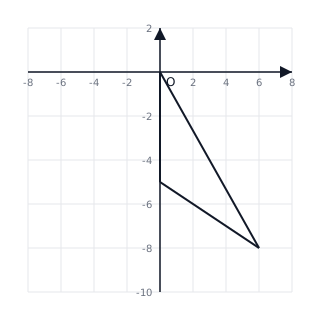
Given p=(3−4)\mathbf{p} = \begin{pmatrix} 3 \\ -4 \end{pmatrix} and q=(−21)\mathbf{q} = \begin{pmatrix} -2 \\ 1 \end{pmatrix}, find the magnitude of the vector 2p+3q2\mathbf{p} + 3\mathbf{q}.

Coordinate plot showing the addition of 2p and 3q to find the resultant vector (0, -5).

Solution:

2p=2(3−4)=(6−8)2\mathbf{p} = 2 \begin{pmatrix} 3 \\ -4 \end{pmatrix} = \begin{pmatrix} 6 \\ -8 \end{pmatrix} 3q=3(−21)=(−63)3\mathbf{q} = 3 \begin{pmatrix} -2 \\ 1 \end{pmatrix} = \begin{pmatrix} -6 \\ 3 \end{pmatrix} 2p+3q=(6+(−6)−8+3)=(0−5)2\mathbf{p} + 3\mathbf{q} = \begin{pmatrix} 6 + (-6) \\ -8 + 3 \end{pmatrix} = \begin{pmatrix} 0 \\ -5 \end{pmatrix} Magnitude=02+(−5)2=25=5\text{Magnitude} = \sqrt{0^2 + (-5)^2} = \sqrt{25} = 5

Explanation:

First, perform scalar multiplication on each vector. Then, add the resulting column vectors by summing their respective xx and yy components. Finally, use the Pythagorean theorem to find the magnitude.