
Vectors and Transformations - Transformations: Translation, Reflection, Rotation, Enlargement
Review the key concepts, formulae, and examples before starting your quiz.
🔑Concepts
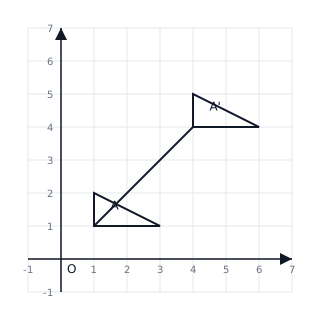
A Translation moves every point of a shape the same distance in a specified direction, defined by a column vector , where is the horizontal shift and is the vertical shift.
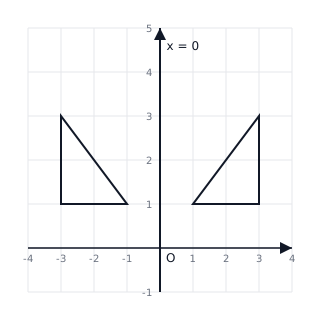
Reflection creates a mirror image of a shape across a line of reflection. Every point and its image are equidistant from this line.
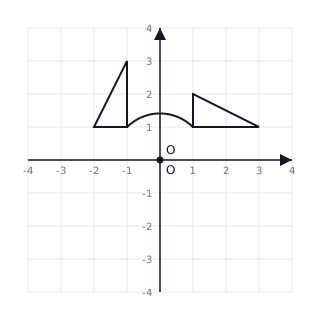
Rotation turns a shape about a fixed point called the center of rotation. It is defined by the center, the angle, and the direction (clockwise or anti-clockwise).
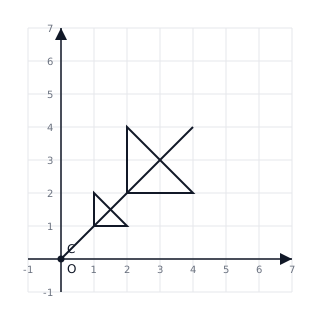
Enlargement changes the size of a shape by a scale factor from a center of enlargement. If the shape grows; if it shrinks; if it is inverted on the opposite side of the center.
📐Formulae
=
💡Examples
Problem 1:
Triangle A has vertices (1, 2), (3, 2), and (1, 5). Find the coordinates of the image after a translation by the vector .
Solution:
(1-3, 2+4) = (-2, 6); (3-3, 2+4) = (0, 6); (1-3, 5+4) = (-2, 9).
Explanation:
To translate a point, add the top value of the vector (x-shift) to the x-coordinate and the bottom value (y-shift) to the y-coordinate.
Problem 2:
A square with an area of 5 cm² is enlarged with a scale factor of 3. What is the area of the enlarged square?
Solution:
New Area = .
Explanation:
When a shape is enlarged by a scale factor , its area increases by .
Problem 3:
Describe fully the single transformation that maps Triangle T with vertices (2, 1), (4, 1), (4, 2) onto Triangle U with vertices (-2, -1), (-4, -1), (-4, -2).
Solution:
Rotation of about the origin .
Explanation:
Each point has been mapped to . This identifies a rotation. Since the distance from the origin remains proportional and the orientation is flipped both horizontally and vertically, the center is .
Problem 4:
Enlarge triangle ABC with vertices A(1,1), B(2,1), C(1,3) by scale factor -2, center of enlargement (0,0).
Solution:
A'(-2, -2), B'(-4, -2), C'(-2, -6).
Explanation:
Multiply each coordinate by the scale factor -2 because the center is the origin. The negative sign means the image is inverted and on the opposite side of the center.
Problem 5:
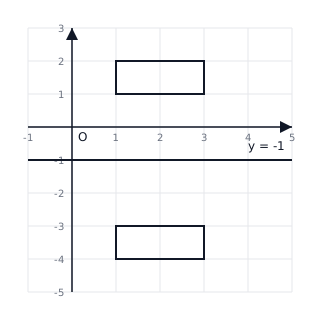
Reflect the rectangle with vertices , , , and in the line . State the coordinates of the image vertices.
Solution:
- Identify the mirror line .
- Calculate the vertical distance of each point from . Point is 2 units above the line ().
- Place the image point the same distance below the line: . Thus .
- Repeating for others: , , .
Explanation:
In a reflection across a horizontal line , the -coordinate remains unchanged, while the -coordinate changes such that the line is the midpoint between the original and the image .
Problem 6:
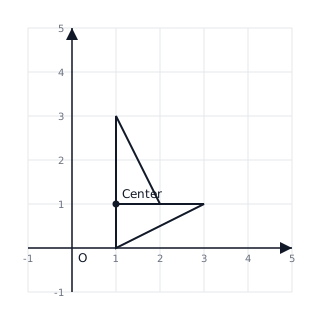
Rotate the shape with vertices , , and clockwise about the point .
Solution:
- The center of rotation is .
- Point is the center, so its image remains .
- Point is 1 unit to the right of the center. Rotating clockwise moves it 1 unit down from the center: .
- Point is 2 units above the center. Rotating clockwise moves it 2 units to the right of the center: . Image vertices: .
Explanation:
When rotating about a point other than the origin, subtract the center coordinates, apply the rotation rule, then add the center coordinates back.