
Review the key concepts, formulae, and examples before starting your quiz.
🔑Concepts
A cylinder is a solid with two parallel congruent circular bases and a curved surface. The volume is calculated by multiplying the base area by the height, while the total surface area includes the curved surface and two circular lids.
A cone is a solid with a circular base and a single vertex. The perpendicular height and the radius form a right-angled triangle with the slant height . The relationship is given by .
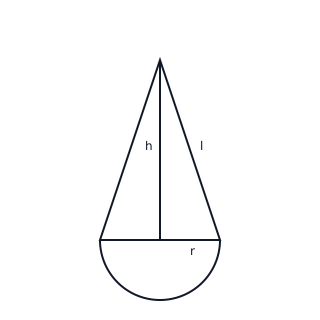
A sphere is a perfectly symmetrical 3D object where all points on the surface are at an equal distance (radius ) from the center. Its volume is and its surface area is .
A pyramid is a polyhedron formed by connecting a polygonal base and a point, called the apex. The volume is always one-third of the product of the base area and the perpendicular height.
For similar solids, if the ratio of corresponding lengths is , then the ratio of their surface areas is and the ratio of their volumes is .
📐Formulae
Cylinder Volume:
Cylinder Total Surface Area:
Cone Volume:
Cone Curved Surface Area: (where is slant height)
Sphere Volume:
Sphere Surface Area:
Pyramid Volume:
Slant height of a cone:
💡Examples
Problem 1:
A solid metal cone has a radius of 5 cm and a perpendicular height of 12 cm. Calculate its total surface area. (Take )
Solution:
cm. . Base Area = . cm².
Explanation:
First, find the slant height () using Pythagoras' theorem. Then, calculate the Curved Surface Area and the base area separately before adding them for the Total Surface Area.
Problem 2:
Two similar spheres have radii in the ratio 2:3. If the volume of the smaller sphere is cm³, find the volume of the larger sphere.
Solution:
Linear scale factor . Volume scale factor . Volume of larger sphere cm³.
Explanation:
Use the property that the ratio of volumes of similar solids is the cube of the ratio of their corresponding lengths.
Problem 3:
A hemisphere has a radius of 6 cm. Calculate its volume in terms of .
Solution:
cm³.
Explanation:
A hemisphere is half of a sphere. Use the sphere volume formula and divide by 2.
Problem 4:
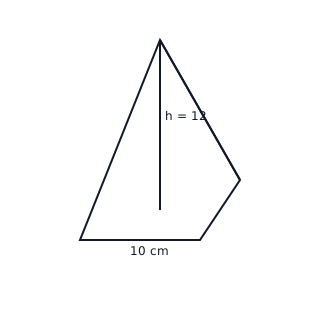
A square-based pyramid has a base side length of and a perpendicular height of . Calculate the volume of the pyramid.
Solution:
Explanation:
The volume of any pyramid is one-third of the base area times the vertical height. Here, the base is a square, so its area is . Multiplying by the height () and dividing by gives the final volume.
Problem 5:
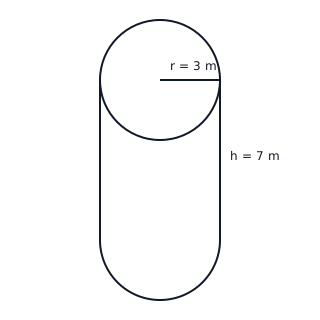
A cylindrical water tank has a radius of m and a height of m. Calculate the volume of the tank and its total surface area (including the top lid). Take .
Solution:
-
Volume ():
-
Total Surface Area ():
Explanation:
To find the volume, we use the formula for a cylinder which is the base area (circle) multiplied by the height. For the total surface area, we calculate the area of the curved surface () and add the areas of the two circular faces (top and bottom, ).