
Review the key concepts, formulae, and examples before starting your quiz.
🔑Concepts
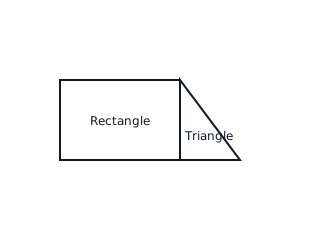
Compound 2D shapes are formed by combining two or more basic shapes such as rectangles, triangles, and circles. To find the total area, decompose the figure into these standard shapes and sum their individual areas.
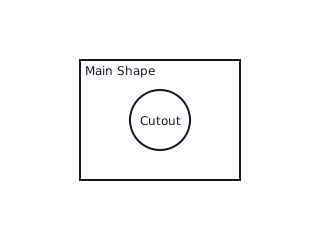
Subtractive areas occur when a portion of a shape is removed (e.g., a hole or a cutout). The total area is calculated as: .
Compound 3D solids involve joining 3D primitives like prisms, cylinders, or spheres. The total volume is the sum of the volumes of the parts: .
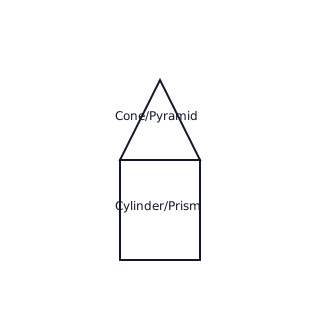
The Total Surface Area (TSA) of a compound solid only includes the visible external surfaces. Any faces where the two solids meet (the interface) must be subtracted from the sum of the individual surface areas.
📐Formulae
Area of a Trapezium:
Area of a Sector:
Arc Length:
Volume of a Cylinder:
Volume of a Cone:
Volume of a Sphere:
Surface Area of a Sphere:
Curved Surface Area of a Cone: (where is slant height)
💡Examples
Problem 1:
A compound 2D shape consists of a rectangle with dimensions 10cm by 6cm, with a semi-circle removed from one of the 6cm sides. Find the total area of the remaining shape.
Solution:
Area of Rectangle = . Radius of semi-circle = . Area of Semi-circle = . Total Area = .
Explanation:
This problem uses the subtraction method. We calculate the area of the full rectangle first, then identify the radius of the missing semi-circle (which is half the side length) and subtract it from the total.
Problem 2:
A solid toy is made by joining a cone to the flat face of a hemisphere. Both the cone and the hemisphere have a radius of 5cm. The slant height of the cone is 13cm. Calculate the total surface area of the toy.
Solution:
Curved Surface Area (CSA) of Cone = . CSA of Hemisphere = . Total Surface Area = .
Explanation:
When two solids are joined, the faces that touch (the circular bases) are no longer on the 'outside'. Therefore, the total surface area is the sum of the curved surface area of the cone and the curved surface area of the hemisphere only.
Problem 3:
A metal trough is 2m long. Its cross-section is a semi-circle with a diameter of 40cm. Find the volume of the trough in cubic centimeters ().
Solution:
Convert length to cm: . Radius . Area of cross-section (semi-circle) = . Volume = .
Explanation:
The trough is a prism with a semi-circular cross-section. We first ensure units are consistent (converting meters to centimeters), calculate the area of the semi-circle, and multiply by the length of the trough.
Problem 4:
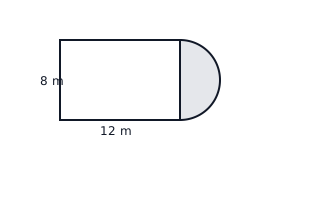
A swimming pool floor consists of a rectangle by and a semi-circle with a diameter of attached to one of the shorter sides. Calculate the total area of the pool floor to 1 decimal place.
Solution:
Explanation:
Divide the shape into a rectangle and a semi-circle. Sum the individual areas.
Problem 5:
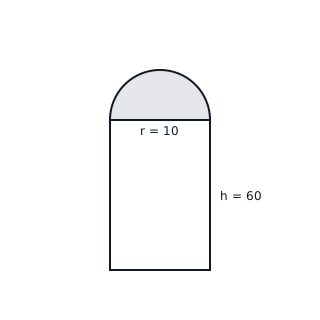
A heavy-duty bollard is made from a cylinder of height and radius , topped with a hemisphere of the same radius. Find the total volume of the bollard in terms of .
Solution:
Explanation:
Calculate the volume of the cylinder and the hemisphere separately, then add them. Note that the radius is common to both shapes.