
Review the key concepts, formulae, and examples before starting your quiz.
🔑Concepts
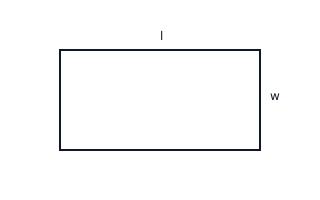
The perimeter of a 2D shape is the total distance around its boundary. For polygons, it is the sum of all side lengths. For a circle, it is called the circumference ().
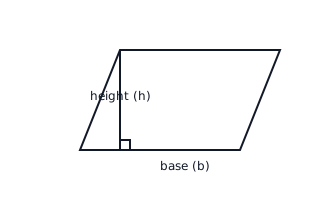
Area measures the surface inside a 2D shape. The area of a parallelogram is calculated using the base and the perpendicular height (). Note that the height must be at a right angle to the base.
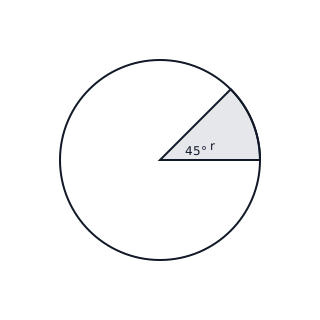
A sector is a portion of a circle defined by two radii and an arc. Its area is proportional to the central angle : .
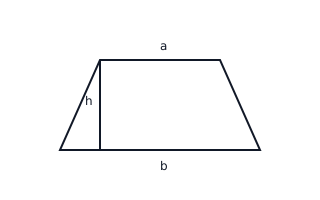
The area of a trapezium is found by taking the average of the parallel sides ( and ) and multiplying by the perpendicular height (): .
📐Formulae
💡Examples
Problem 1:
A sector of a circle has a radius of 6 cm and a central angle of 60°. Calculate the area of the sector and the length of the arc. (Use π = 3.142)
Solution:
Arc Length = (60/360) * 2 * 3.142 * 6 = 6.284 cm. Sector Area = (60/360) * 3.142 * 6^2 = 18.852 cm².
Explanation:
To find the arc length and sector area, we multiply the total circumference and total area of the circle by the fraction of the circle represented by the angle (60/360).
Problem 2:
A trapezium has parallel sides of length 8 cm and 12 cm. If the area of the trapezium is 50 cm², find its perpendicular height.
Solution:
50 = 1/2 * (8 + 12) * h => 50 = 1/2 * 20 * h => 50 = 10h => h = 5 cm.
Explanation:
Substitute the known values into the area of a trapezium formula: Area = 1/2(a+b)h. Solve the resulting linear equation for the unknown height (h).
Problem 3:
Calculate the area of a triangle where two sides are 7 cm and 10 cm, and the included angle between them is 30°.
Solution:
Area = 1/2 * 7 * 10 * sin(30°) = 1/2 * 70 * 0.5 = 17.5 cm².
Explanation:
When the perpendicular height is not given but an angle is, use the trigonometric area formula Area = 1/2 ab sin(C).
Problem 4:
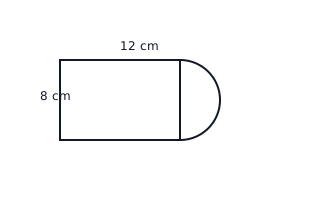
A compound shape is formed by a rectangle of length and width , with a semi-circle attached to one of the shorter sides. Find the total area of the shape. (Take )
Solution:
Explanation:
To find the area of a compound shape, divide it into basic shapes (a rectangle and a semi-circle), calculate their individual areas, and add them together. The diameter of the semi-circle matches the width of the rectangle.
Problem 5:
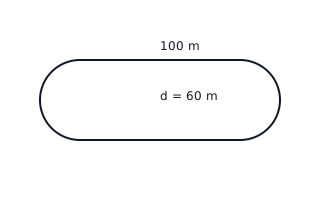
A running track consists of a rectangle with semi-circular ends. If the rectangle has a length of and the semi-circles have a diameter of , calculate the total perimeter of the track. (Take )
Solution:
Explanation:
The perimeter of the track consists of the two straight lengths of the rectangle and the two curved arcs. Since there are two semi-circles of the same diameter, they combine to form the circumference of one full circle.