
Review the key concepts, formulae, and examples before starting your quiz.
🔑Concepts
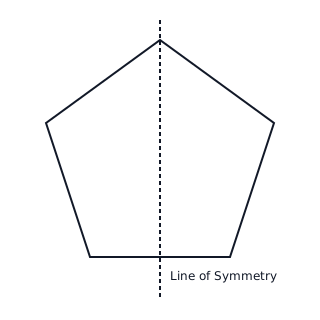
Line Symmetry (Reflectional Symmetry) occurs when a shape can be folded along a line so that the two halves match exactly. For a regular -sided polygon, there are always lines of symmetry.
Rotational Symmetry is the property a shape has when it looks the same after some rotation of less than . The 'Order of Rotational Symmetry' is the number of times the shape looks identical to its original position during a full turn.
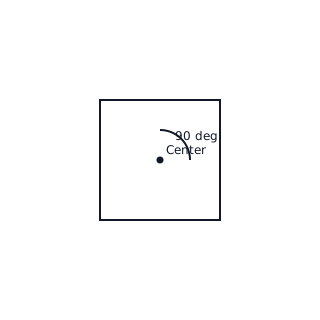
Point Symmetry occurs when every part of a figure has a matching part the same distance from a central point but in the opposite direction. It is equivalent to rotational symmetry of order 2 ( rotation).
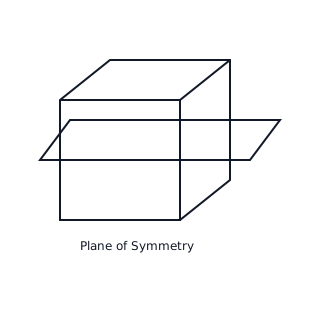
Planes of Symmetry in 3D shapes: A plane that divides a solid into two congruent halves that are mirror images of each other. A cube, for instance, has 9 planes of symmetry.
📐Formulae
💡Examples
Problem 1:
Identify the number of lines of symmetry and the order of rotational symmetry for a Rhombus.
Solution:
Lines of symmetry: 2; Order of rotational symmetry: 2.
Explanation:
A rhombus has two lines of symmetry, which are its diagonals. It looks the same twice (at 180° and 360°) during a full rotation, giving it an order of 2.
Problem 2:
A regular hexagon has a side length of 5 cm. State its number of lines of symmetry and the smallest angle it must be rotated by to look identical to its starting position.
Solution:
Lines: 6; Angle: 60°.
Explanation:
For any regular n-gon, there are n lines of symmetry. The angle of rotation is calculated as 360° divided by the order (n), so .
Problem 3:
How many planes of symmetry does a cuboid with dimensions 5cm x 5cm x 10cm have?
Solution:
5 planes of symmetry.
Explanation:
Because two sides are equal (square cross-section), it has: 2 planes passing through the diagonals of the square face, 2 planes bisecting the opposite sides of the square face, and 1 plane bisecting the 10cm length. Total = 5.
Problem 4:
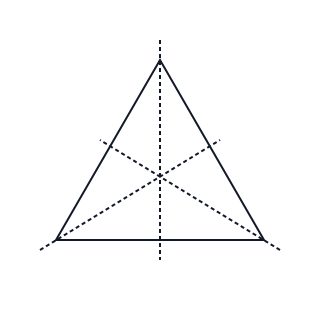
An equilateral triangle has all sides equal. Determine the number of lines of symmetry and the smallest angle of rotation required for the triangle to map onto itself.
Solution:
Explanation:
A regular polygon with sides has lines of symmetry and an order of rotational symmetry equal to . Since an equilateral triangle is a regular polygon with , it has 3 lines of symmetry and the angle of rotation is calculated by dividing by the order.
Problem 5:
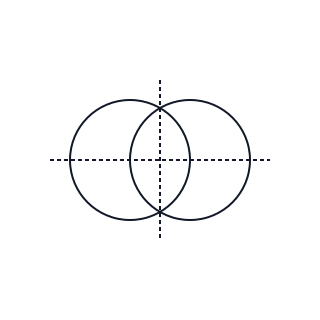
A shape is formed by two identical circles of radius 5 cm that intersect such that each passes through the center of the other. Identify the order of rotational symmetry and the number of lines of symmetry for the combined boundary.
Solution:
Explanation:
The shape (a vesica piscis) has two axes of symmetry: one horizontal line passing through both centers and one vertical line which is the perpendicular bisector of the line joining the centers. Rotating the shape about the midpoint of the line joining the centers returns the shape to its original appearance.