
Review the key concepts, formulae, and examples before starting your quiz.
🔑Concepts
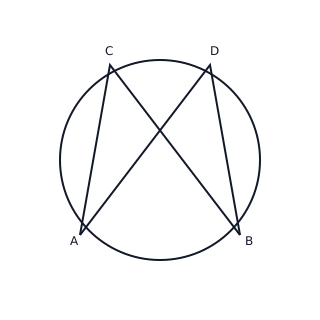
Angles in the same segment: Angles subtended by the same arc (or chord) at the circumference are equal. For example, because they both stand on arc AB.
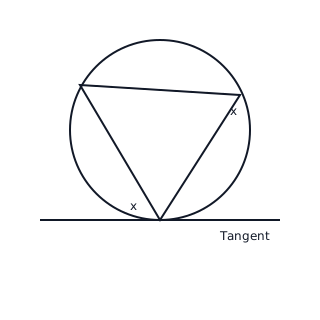
Alternate Segment Theorem: The angle between a tangent and a chord through the point of contact is equal to the angle subtended by the chord in the alternate segment.
Angle in a semi-circle: The angle subtended by a diameter at the circumference is always . This forms a right-angled triangle where the diameter is the hypotenuse.
Perpendicular from center: A line drawn from the center of a circle perpendicular to a chord bisects the chord. Conversely, the line joining the center to the midpoint of a chord is perpendicular to the chord.
📐Formulae
💡Examples
Problem 1:
In a circle with center O, point A and B lie on the circumference. If the angle , find the angle where C is a point on the major arc.
Solution:
Explanation:
According to the circle theorem 'Angle at the center is twice the angle at the circumference', . Therefore, .
Problem 2:
ABCD is a cyclic quadrilateral. If and , find the value of .
Solution:
Explanation:
In a cyclic quadrilateral, opposite angles sum to . The angle opposite to is . Therefore, .
Problem 3:
A tangent PT is drawn from an external point P to a circle with center O and radius 5cm. If the distance PO is 13cm, find the length of the tangent PT.
Solution:
Explanation:
The radius OT is perpendicular to the tangent PT at point T, forming a right-angled triangle . Using Pythagoras' theorem: .
Problem 4:
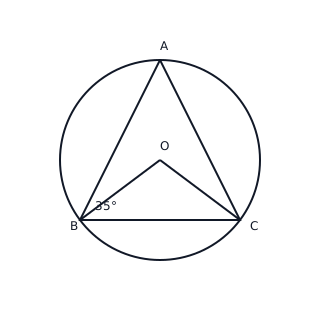
In the diagram, O is the center of the circle. Points A, B, and C lie on the circumference. If , calculate the size of .
Solution:
Explanation:
We first identify an isosceles triangle formed by two radii. By finding the angle at the center, we can apply the theorem that the angle at the center is twice the angle at the circumference.
Problem 5:
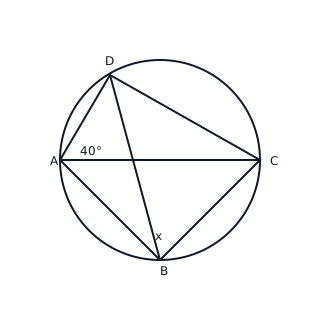
A cyclic quadrilateral ABCD is inscribed in a circle. Diagonal AC is a diameter. If and , find the value of .
Solution:
Explanation:
Identify the right angle created by the diameter. Calculate the third angle in triangle ADC, then use the 'angles in the same segment' theorem to relate it to angle x.