
Review the key concepts, formulae, and examples before starting your quiz.
🔑Concepts
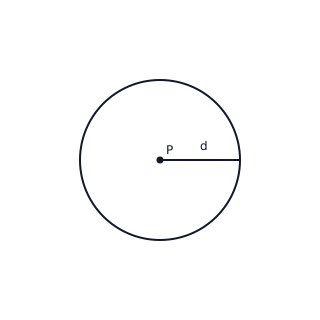
The locus of points at a constant distance from a fixed point is a circle. This is used when a condition specifies a distance 'from a point'.
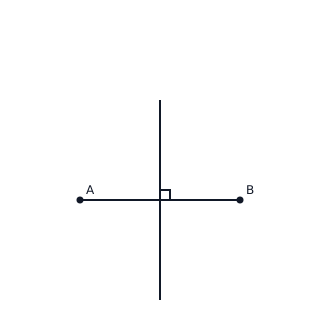
The perpendicular bisector of a line segment represents the locus of points equidistant from two fixed points and . This divides a region into 'closer to ' or 'closer to '.
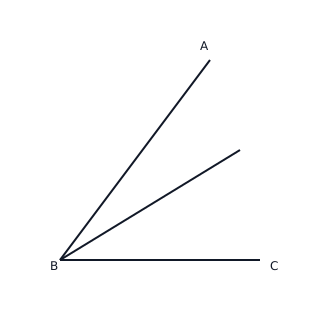
The angle bisector is the locus of points equidistant from two intersecting lines (e.g., sides of an angle ). This is used for problems involving 'equidistant from two fences' or 'two paths'.
The locus of points at a constant distance from a line segment consists of two parallel line segments and two semi-circles at the ends and . This is often called a 'stadium' or 'capsule' shape.
Scale drawings require converting actual measurements using a scale factor . When drawing, ensure all units are consistent (e.g., ). Always use a sharp pencil, a ruler, and a pair of compasses for construction.
📐Formulae
💡Examples
Problem 1:
A gardener wants to plant a tree that is: (1) More than 5m from a fixed post P, and (2) Closer to fence AB than to fence AC. Using a scale of 1cm : 1m, shade the region where the tree can be planted.
Solution:
- Draw a circle with center P and radius 5cm. The area outside this circle satisfies condition 1. 2. Construct the angle bisector of the angle at vertex A (where fences AB and AC meet). The region on the side of the bisector closer to AB satisfies condition 2. 3. Shade the intersection of the area outside the circle and the side of the bisector closer to AB.
Explanation:
Condition 1 defines a locus based on a fixed point, which is a circle. 'More than' means the exterior region. Condition 2 defines a locus equidistant from two intersecting lines, which is an angle bisector. The 'closer to' requirement indicates one side of that bisector.
Problem 2:
Construct a triangle ABC where AB = 8cm, AC = 6cm, and BC = 7cm. Then, construct the locus of points inside the triangle that are exactly 3cm from vertex A.
Solution:
- Draw line AB = 8cm. 2. Set compass to 6cm, draw an arc from A. 3. Set compass to 7cm, draw an arc from B. The intersection is point C. Join AC and BC. 4. To find the locus 3cm from A, set the compass to 3cm and draw an arc inside the triangle with the needle at point A.
Explanation:
This problem combines basic triangle construction using SSS (Side-Side-Side) criteria with the definition of a locus from a fixed point. The locus is a circular arc centered at A with a radius of 3cm.
Problem 3:
The scale of a map is 1:25,000. If the distance between two towns on the map is 4cm, calculate the actual distance in kilometers.
Solution:
- Actual distance in cm = cm. 2. Convert to meters: m. 3. Convert to km: km.
Explanation:
To convert map distance to real distance, multiply by the scale factor . Then, use the conversions and to reach the required units.
Problem 4:
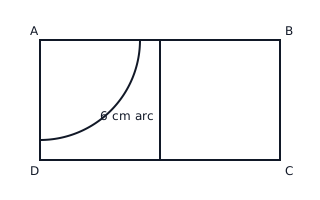
Construct a rectangle where and . Shade the region inside the rectangle that is closer to side than to side , and less than from vertex .
Solution:
- Draw the rectangle with dimensions .
- The locus of points equidistant from and is the perpendicular bisector of the sides and . This is a vertical line if is at and is at . Shading to the left of this line satisfies 'closer to '.
- The locus of points exactly from is an arc of a circle with center and radius .
- The final region is the intersection of the left half of the rectangle and the interior of the arc centered at .
Explanation:
To solve this, we combine the 'perpendicular bisector' logic (applied to parallel lines) with the 'circle' locus centered at a vertex. Only the overlapping area within the rectangle is shaded.
Problem 5:
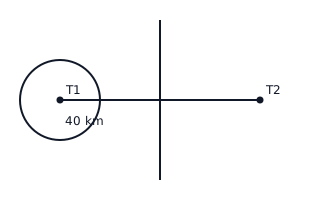
Two radio towers, and , are located apart. A receiver is located such that it is: (1) closer to than , and (2) at least from . Draw a sketch where and indicate the possible locations.
Solution:
- Mark points and at a distance of .
- Construct the perpendicular bisector of the line segment .
- Draw a circle around with a radius of ().
- Shade the region that is to the left of the bisector (closer to ) but outside the circle (at least from ).
Explanation:
The boundary for 'closer to' is the perpendicular bisector. The boundary for 'at least' is the circle itself, including all points on the circumference and everything outside of it.