
Review the key concepts, formulae, and examples before starting your quiz.
🔑Concepts
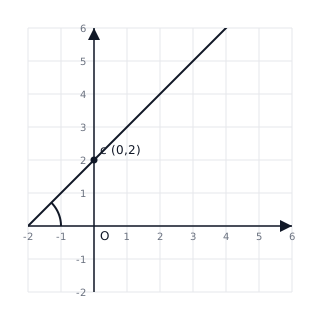
The Slope-Intercept form represents a line where is the gradient (tangent of the angle of inclination ) and is the y-intercept. This form is most useful for identifying the steepness and vertical shift of a line from the origin.
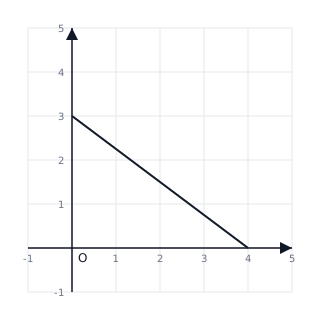
The Intercept Form describes a line passing through the points and . Here and are the x-intercept and y-intercept respectively.
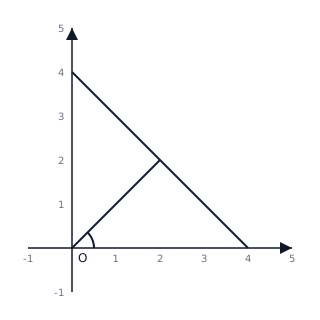
The Normal Form defines a line by the length of the perpendicular () from the origin to the line and the angle () that this perpendicular makes with the positive x-axis.
The General Equation can represent any straight line. The slope of this line is given by , the x-intercept is , and the y-intercept is .
📐Formulae
Slope:
Slope from two points:
Slope-Intercept Form:
Point-Slope Form:
Two-Point Form:
Normal Form:
General Equation:
Distance of a point from a line:
💡Examples
Problem 1:
Find the equation of the line passing through the point and perpendicular to the line .
Solution:
Step 1: Find the slope of the given line. The equation is . Rewriting in form: . Thus, . Step 2: Find the slope () of the perpendicular line. Since , we have . Step 3: Use the point-slope form with point and . .
Explanation:
To find the equation, we first determine the slope of the given line, then apply the perpendicularity condition () to find our required slope, and finally substitute the values into the point-slope formula.
Problem 2:
Reduce the equation into normal form and find the values of and .
Solution:
Step 1: Write the equation as . Here, and . Step 2: Calculate . Step 3: Divide the entire equation by 2. . Step 4: Compare with . We get , , and . Since both sine and cosine are positive, is in the first quadrant: or .
Explanation:
Normal form reduction requires dividing the general equation by to normalize the coefficients into trigonometric values (sine and cosine), while represents the perpendicular distance from the origin.
Problem 3:
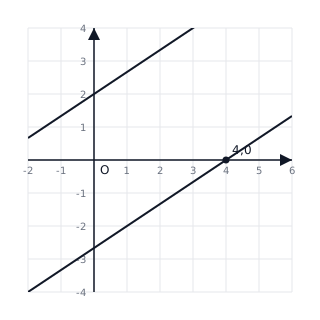
Find the equation of a line that makes an intercept of on the x-axis and is parallel to the line .
Solution:
- Find the slope of the given line . By rearranging into : So, .
- Parallel lines have equal slopes, so the required line also has .
- The x-intercept is given as , which means the line passes through .
- Using Point-Slope form:
Explanation:
Two lines are parallel if their slopes are equal. We extracted the slope from the general form of the first line and applied it to the given point (the x-intercept) to find the new equation.
Problem 4:
Find the equation of the line which passes through the point and the sum of its intercepts on the axes is .
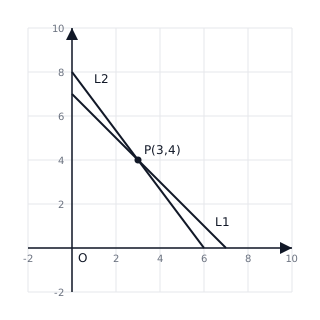
Solution:
Let the intercepts on the -axis and -axis be and respectively. According to the problem, . The equation of the line in intercept form is: Substituting : Since the line passes through : Thus, or . Case 1: If , then . The equation is , which simplifies to . Case 2: If , then . The equation is , which simplifies to .
Explanation:
We use the intercept form of a straight line equation. By expressing one intercept in terms of the other using the given sum, we substitute the coordinates of the given point to form a quadratic equation in 'a'. Solving this gives two possible lines that satisfy the condition.