
Review the key concepts, formulae, and examples before starting your quiz.
🔑Concepts
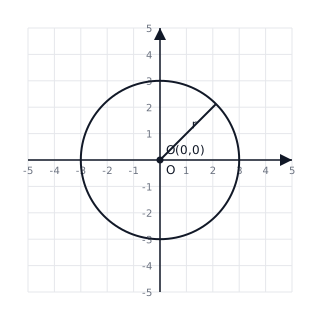
The circle is the locus of a point that moves such that its distance from a fixed point (center) is constant (radius). In standard form , the center is . If the center is at the origin, it simplifies to .
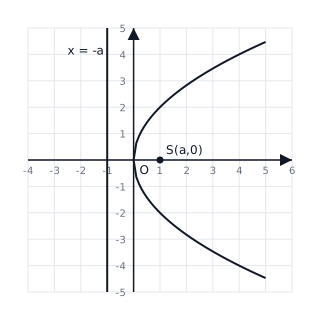
A parabola is the set of all points equidistant from a fixed point (focus) and a fixed line (directrix). For , the focus is and the directrix is .
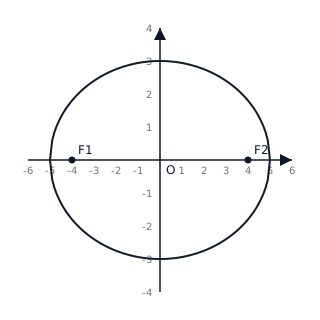
An ellipse is defined by . The eccentricity determines how 'flat' the ellipse is. The sum of distances from any point on the ellipse to the two foci is constant and equal to the major axis length .
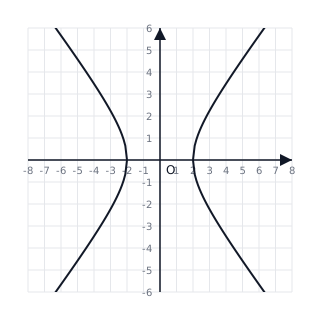
A hyperbola has two branches. The distance between the vertices is , and the eccentricity .
📐Formulae
Circle (Standard Form): , where is the center and is the radius.
Circle (General Form): , Center , Radius .
Parabola (Standard Form): , Focus , Directrix: , Length of Latus Rectum .
Ellipse (Standard Form): (), Eccentricity , Foci .
Hyperbola (Standard Form): , Eccentricity , Foci .
Length of Latus Rectum (Ellipse/Hyperbola): .
Condition for Tangency to Circle : The line is tangent if .
💡Examples
Problem 1:
Find the center and radius of the circle represented by the equation .
Solution:
- Compare the given equation with the general form .
- Identify coefficients: ; ; .
- Calculate Center : Center .
- Calculate Radius : .
Explanation:
To find the circle's properties, we identify the parameters from the general equation and apply the standard formulas for center and radius.
Problem 2:
Find the eccentricity and the coordinates of the foci for the ellipse .
Solution:
- Identify and : ; .
- Since , the major axis is along the -axis.
- Calculate eccentricity : .
- Calculate Foci : . Foci .
Explanation:
For an ellipse, we first determine the major axis by comparing and . Then we use the eccentricity formula for and find the focus distance from the center.
Problem 3:
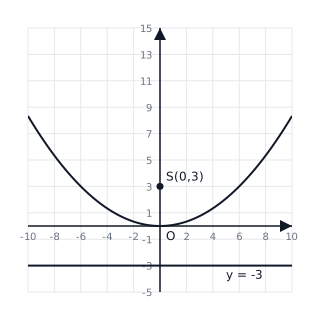
Find the equation of the parabola with vertex at and focus at . Also find the equation of its directrix.
Solution:
- Since the vertex is and the focus lies on the y-axis, the parabola opens upwards.
- The standard form is .
- Here, (distance from vertex to focus).
- Equation: .
- The directrix is a horizontal line at distance below the vertex: .
Explanation:
Because the focus has a non-zero y-coordinate and zero x-coordinate, the axis of symmetry is the y-axis. The value of 'a' is the y-coordinate of the focus.
Problem 4:
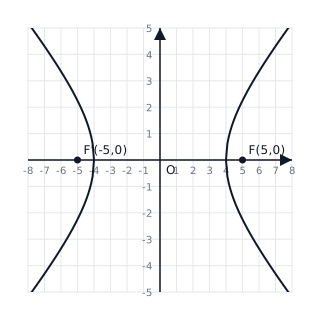
Find the eccentricity, length of the latus rectum, and foci of the hyperbola .
Solution:
- Divide by 144 to get standard form: .
- Here and .
- Eccentricity .
- Foci are .
- Length of Latus Rectum .
Explanation:
First convert the equation to the form to identify a and b. Then use the standard hyperbola formulas for eccentricity and focal coordinates.