
Review the key concepts, formulae, and examples before starting your quiz.
🔑Concepts
The perpendicular distance is the shortest path from a given point to a line . This distance is measured along a line passing through the point that is perpendicular to the given line.
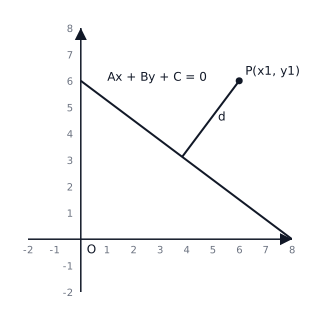
The distance of the origin from the line is simplified to the absolute value of the constant term divided by the square root of the sum of the squares of the coefficients of and .
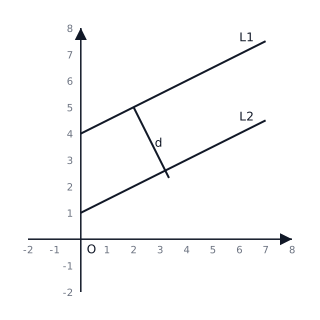
Parallel lines have the same slope. The distance between two parallel lines and is the constant difference normalized by the magnitude of the normal vector .
If a point lies on the line, the perpendicular distance is zero, as the coordinates of the point satisfy the equation .
📐Formulae
Distance of point from line :
Distance of the origin from line :
Distance between two parallel lines and :
Slope of the line :
💡Examples
Problem 1:
Find the perpendicular distance of the point from the line .
Solution:
Step 1: Identify the values from the point and the line equation. Here, , , , , and .
Step 2: Apply the distance formula:
Step 3: Substitute the values: units.
Explanation:
We use the standard distance formula by plugging in the coordinates of the point into the line's equation in the numerator and dividing by the magnitude of the line's normal vector in the denominator.
Problem 2:
Find the distance between the parallel lines and .
Solution:
Step 1: Identify the coefficients. Since the lines are parallel, and for both. The constants are and .
Step 2: Apply the formula for the distance between parallel lines:
Step 3: Substitute the values: units.
Explanation:
To find the distance between parallel lines, we calculate the absolute difference between their constant terms and divide by the square root of the sum of the squares of the and coefficients.
Problem 3:
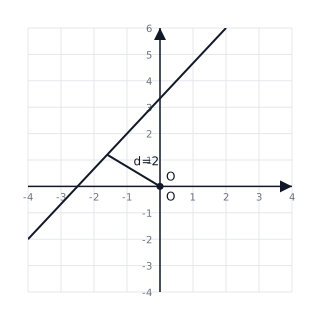
Find the distance of the origin from the line .
Solution:
Given the line , we have , , and . The origin is . Using the formula for distance from origin: Thus, the distance is units.
Explanation:
To find the distance from the origin, we substitute and into the numerator of the distance formula, leaving only the constant . We then divide by the square root of the sum of the squares of the coefficients of and .
Problem 4:
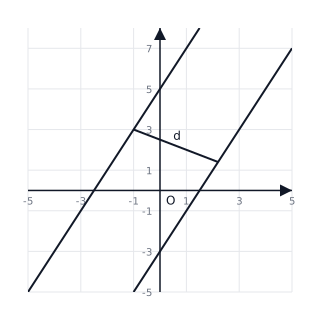
Find the distance between the parallel lines and .
Solution:
First, rewrite the equations in the form : Line 1: (where ) Line 2: (where ) Using the formula for distance between parallel lines: Rationalizing the denominator: Thus, the distance is units.
Explanation:
For parallel lines, we ensure the and coefficients are identical in both equations. Then, the distance is found by taking the absolute difference of the constants and dividing by the magnitude of the coefficient vector.