krit.club logo

Introduction to Three Dimensional Geometry - Section Formula

Grade 11CBSE

Review the key concepts, formulae, and examples before starting your quiz.

🔑Concepts

•

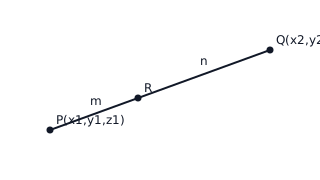
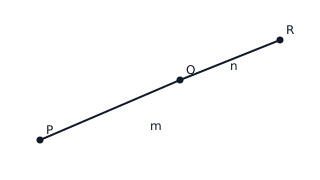
Internal Division: When a point R(x,y,z)R(x, y, z) lies on the line segment PQPQ and divides it in the ratio m:nm:n internally, its coordinates are determined by the weighted average of the coordinates of P(x1,y1,z1)P(x_1, y_1, z_1) and Q(x2,y2,z2)Q(x_2, y_2, z_2).

A line segment PQ divided internally by point R in the ratio m:n.
•

External Division: When a point RR lies on the extension of the line segment PQPQ such that PR:QR=m:nPR:QR = m:n, the point is said to divide the segment externally. The formula utilizes a subtraction component in the numerator and denominator.
Point R dividing line segment PQ externally.
•

Midpoint: This is a special case of internal division where the ratio m:nm:n is 1:11:1. The coordinates of the midpoint are the simple arithmetic means of the coordinates of the endpoints.
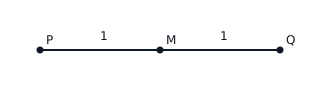
A line segment with a midpoint M showing equal ratios 1:1.
•

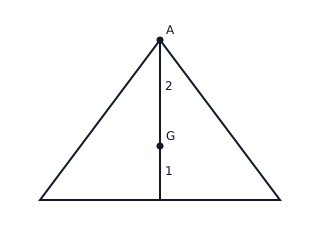
Centroid of a Triangle: The centroid GG of a triangle with vertices (x1,y1,z1)(x_1, y_1, z_1), (x2,y2,z2)(x_2, y_2, z_2), and (x3,y3,z3)(x_3, y_3, z_3) is the point of concurrency of its medians. It divides each median in the ratio 2:12:1.

Triangle ABC with centroid G dividing the median from A in ratio 2:1.

📐Formulae

Internal Division: R=(mx2+nx1m+n,my2+ny1m+n,mz2+nz1m+n)R = \left( \frac{mx_2 + nx_1}{m+n}, \frac{my_2 + ny_1}{m+n}, \frac{mz_2 + nz_1}{m+n} \right)

External Division: R=(mx2−nx1m−n,my2−ny1m−n,mz2−nz1m−n)R = \left( \frac{mx_2 - nx_1}{m-n}, \frac{my_2 - ny_1}{m-n}, \frac{mz_2 - nz_1}{m-n} \right)

Midpoint Formula: M=(x1+x22,y1+y22,z1+z22)M = \left( \frac{x_1 + x_2}{2}, \frac{y_1 + y_2}{2}, \frac{z_1 + z_2}{2} \right)

Centroid of a Triangle: G=(x1+x2+x33,y1+y2+y33,z1+z2+z33)G = \left( \frac{x_1 + x_2 + x_3}{3}, \frac{y_1 + y_2 + y_3}{3}, \frac{z_1 + z_2 + z_3}{3} \right)

Section Formula using k:1k:1 ratio: R=(kx2+x1k+1,ky2+y1k+1,kz2+z1k+1)R = \left( \frac{kx_2 + x_1}{k+1}, \frac{ky_2 + y_1}{k+1}, \frac{kz_2 + z_1}{k+1} \right)

💡Examples

Problem 1:

Find the coordinates of the point which divides the line segment joining the points A(1,−2,3)A(1, -2, 3) and B(3,4,−5)B(3, 4, -5) in the ratio 2:32:3 internally.

Solution:

Given: A(x1,y1,z1)=(1,−2,3)A(x_1, y_1, z_1) = (1, -2, 3), B(x2,y2,z2)=(3,4,−5)B(x_2, y_2, z_2) = (3, 4, -5), m=2m = 2, and n=3n = 3. Using the internal section formula: x=mx2+nx1m+n=2(3)+3(1)2+3=6+35=95x = \frac{m x_2 + n x_1}{m+n} = \frac{2(3) + 3(1)}{2+3} = \frac{6+3}{5} = \frac{9}{5} y=my2+ny1m+n=2(4)+3(−2)2+3=8−65=25y = \frac{m y_2 + n y_1}{m+n} = \frac{2(4) + 3(-2)}{2+3} = \frac{8-6}{5} = \frac{2}{5} z=mz2+nz1m+n=2(−5)+3(3)2+3=−10+95=−15z = \frac{m z_2 + n z_1}{m+n} = \frac{2(-5) + 3(3)}{2+3} = \frac{-10+9}{5} = -\frac{1}{5} Therefore, the coordinates are (95,25,−15)(\frac{9}{5}, \frac{2}{5}, -\frac{1}{5}).

Explanation:

We apply the internal division formula by substituting the coordinates of the given points and the values of the ratio mm and nn into the respective xx, yy, and zz components.

Problem 2:

Find the ratio in which the YZYZ-plane divides the line segment formed by joining the points (−2,4,7)(-2, 4, 7) and (3,−5,8)(3, -5, 8).

Solution:

Let the YZYZ-plane divide the line segment joining A(−2,4,7)A(-2, 4, 7) and B(3,−5,8)B(3, -5, 8) in the ratio k:1k:1 at point PP. On the YZYZ-plane, the xx-coordinate of any point is always zero. The xx-coordinate of point PP is given by: x=k(3)+1(−2)k+1x = \frac{k(3) + 1(-2)}{k+1} Since x=0x = 0 on the YZYZ-plane: 0=3k−2k+10 = \frac{3k - 2}{k+1} 3k−2=03k - 2 = 0 3k=2  ⟹  k=233k = 2 \implies k = \frac{2}{3} Thus, the ratio is 2:32:3 internally.

Explanation:

To find the ratio, we use the property that the xx-coordinate is zero on the YZYZ-plane. We assume the ratio is k:1k:1, set the xx-component of the section formula to zero, and solve for kk.

Problem 3:

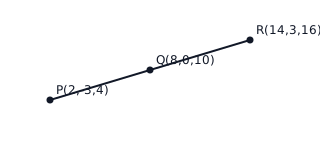
Find the coordinates of the point RR which divides the line segment joining P(2,−3,4)P(2, -3, 4) and Q(8,0,10)Q(8, 0, 10) externally in the ratio 2:12:1.

Diagram showing external division of segment PQ by R.

Solution:

Given: P(x1,y1,z1)=(2,−3,4)P(x_1, y_1, z_1) = (2, -3, 4), Q(x2,y2,z2)=(8,0,10)Q(x_2, y_2, z_2) = (8, 0, 10) and m:n=2:1m:n = 2:1. Using the external division formula: x=mx2−nx1m−n=2(8)−1(2)2−1=16−21=14x = \frac{mx_2 - nx_1}{m-n} = \frac{2(8) - 1(2)}{2-1} = \frac{16 - 2}{1} = 14 y=my2−ny1m−n=2(0)−1(−3)2−1=0+31=3y = \frac{my_2 - ny_1}{m-n} = \frac{2(0) - 1(-3)}{2-1} = \frac{0 + 3}{1} = 3 z=mz2−nz1m−n=2(10)−1(4)2−1=20−41=16z = \frac{mz_2 - nz_1}{m-n} = \frac{2(10) - 1(4)}{2-1} = \frac{20 - 4}{1} = 16 Thus, the coordinates of RR are (14,3,16)(14, 3, 16).

Explanation:

Since the division is external, the point RR lies outside the segment PQPQ. We apply the section formula for external division with m=2m=2 and n=1n=1.

Problem 4:

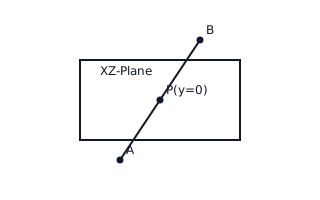
Find the ratio in which the XZXZ-plane divides the line segment joining the points A(−2,3,5)A(-2, 3, 5) and B(1,−4,6)B(1, -4, 6).

Line segment AB passing through the XZ-plane at point P.

Solution:

Let the XZXZ-plane divide ABAB in the ratio k:1k:1 at point PP. In the XZXZ-plane, the yy-coordinate of any point is zero. Using the section formula for the yy-coordinate: y=ky2+y1k+1=0y = \frac{ky_2 + y_1}{k+1} = 0 k(−4)+3k+1=0\frac{k(-4) + 3}{k+1} = 0 −4k+3=0-4k + 3 = 0 4k=3  ⟹  k=344k = 3 \implies k = \frac{3}{4} Therefore, the ratio is 3:43:4 internally.

Explanation:

To find the ratio where a plane divides a segment, identify which coordinate is zero on that plane. For the XZXZ-plane, y=0y=0. Solve for kk using the section formula.