
Review the key concepts, formulae, and examples before starting your quiz.
🔑Concepts
The 3D coordinate system is formed by three mutually perpendicular axes: , , and . Any point in space is uniquely identified by an ordered triplet , which represents the signed distances from the , , and planes respectively.
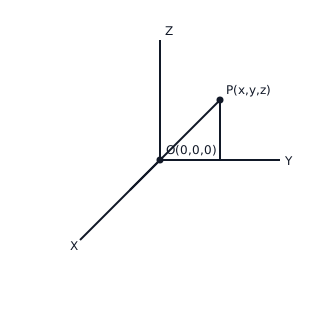
The distance formula in 3D is an extension of the 2D Pythagorean distance. For points and , the distance is the square root of the sum of the squares of the differences of their corresponding coordinates.
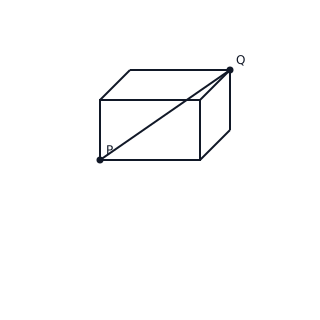
Geometric properties such as isosceles, equilateral, or right-angled triangles can be verified by calculating the lengths of the sides using the distance formula. For instance, a triangle is isosceles if at least two side lengths are equal.
A point lies on the -plane if its -coordinate is zero (), on the -plane if , and on the -plane if .
📐Formulae
Distance between and :
Distance of point from the origin :
Condition for collinearity of : (or any permutation where the sum of two segments equals the third)
Condition for Right-angled triangle: (Pythagoras Theorem)
💡Examples
Problem 1:
Find the distance between the points and .
Solution:
Step 1: Identify the coordinates: and .\nStep 2: Apply the 3D distance formula: .\nStep 3: Substitute the values: .\nStep 4: Simplify: .\nStep 5: Final simplification: units.
Explanation:
The distance is found by substituting the coordinates into the 3D distance formula, which calculates the length of the vector connecting the two points in space.
Problem 2:
Show that the points , and are collinear.
Solution:
Step 1: Calculate distance .\nStep 2: Calculate distance .\nStep 3: Calculate distance .\nStep 4: Check if . We have , which matches the value of .
Explanation:
To prove collinearity, we calculate the distances between all three pairs of points. If the sum of the two shorter distances equals the longest distance, the points lie on a single straight line.
Problem 3:
Verify if the points , and form an isosceles right-angled triangle.
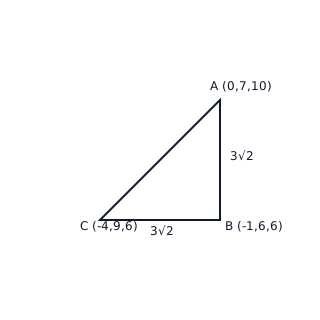
Solution:
-
Calculate side : units.
-
Calculate side : units.
-
Calculate side : units.
Since , the triangle is isosceles. Also, and . Since , the triangle is right-angled at .
Explanation:
We use the distance formula to find all three side lengths. Comparing the lengths reveals that two sides are equal (isosceles) and the square of the longest side equals the sum of squares of the other two (Pythagorean theorem).
Problem 4:
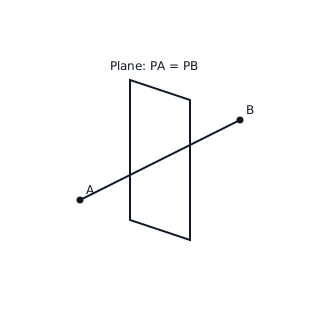
Find the equation of the set of points such that its distance from the point is equal to its distance from the point .
Solution:
Let be the point. Given . So, . Expanding the squares: Cancelling from both sides: Rearranging terms:
Explanation:
This problem describes the locus of points equidistant from two fixed points, which is the perpendicular bisector plane of the segment AB. We equate the squares of the distances to remove the square roots.