
Introduction to Three Dimensional Geometry - Coordinate Axes and Coordinate Planes in Three Dimensional Space
Review the key concepts, formulae, and examples before starting your quiz.
🔑Concepts
In three-dimensional geometry, we use three mutually perpendicular lines passing through a common point (the origin). These lines are called the , , and axes. The position of any point is given by an ordered triplet . The space is divided into 8 regions called octants.
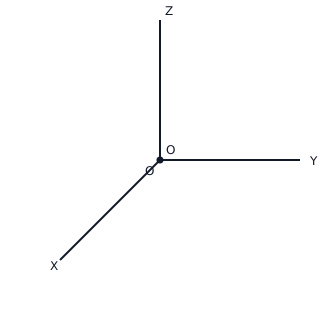
The three pairs of axes define three coordinate planes: the -plane (where ), the -plane (where ), and the -plane (where ). Every point in space lies in relation to these planes.
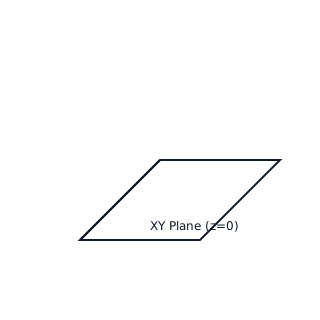
The signs of the coordinates determine the octant. For example, in the first octant (I), all coordinates are positive . In the fifth octant (V), and are positive while is negative .
The distance of a point from the -plane is , from the -plane is , and from the -plane is .
📐Formulae
Coordinates of the origin: contrast to 2D
Equation of the -plane:
Equation of the -plane:
Equation of the -plane:
Equation of the -axis:
Equation of the -axis:
Equation of the -axis:
Distance of a point from the origin :
Distance between two points and :
💡Examples
Problem 1:
Determine the octant in which the following points lie: (i) and (ii) .
Solution:
For point (i) , we have (positive), (negative), and (positive). This corresponds to Octant IV (). For point (ii) , we have (negative), (positive), and (negative). This corresponds to Octant VI ().
Explanation:
To identify the octant, check the signs of the and coordinates. There are 8 combinations: (+,+,+) is I, (-,+,+) is II, (-,-,+) is III, (+,-,+) is IV. Adding a negative maps to V, VI, VII, VIII respectively.
Problem 2:
A point is at a distance of units from the -axis and lies on the -axis. What are its coordinates?
Solution:
Since the point lies on the -axis, its and coordinates must be zero. Thus, the point is of the form . The distance from the -axis to a point is given by . Here, , which means . Therefore, the coordinates are or .
Explanation:
We use the property that points on the -axis have and , and then apply the geometric definition of distance from an axis.
Problem 3:
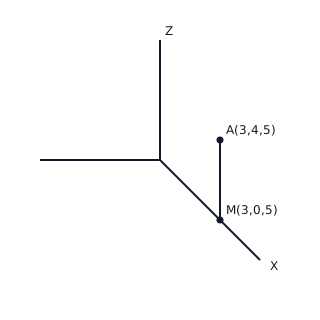
Find the coordinates of the foot of the perpendicular drawn from the point to the -plane.
Solution:
- Any point on the -plane has its -coordinate equal to .
- The perpendicular from to the -plane keeps the and coordinates same but reduces the distance from the plane to zero.
- Therefore, the foot of the perpendicular is .
Explanation:
In 3D space, projecting a point onto a coordinate plane involves setting the coordinate corresponding to the 'missing' axis in the plane's name to zero.
Problem 4:
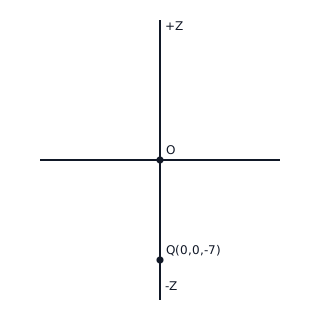
A point lies on the -axis. If its distance from the point is units and it lies in the negative direction of the -axis, what are its coordinates?
Solution:
- Any point on the -axis has coordinates in the form .
- The distance from the origin is given as units, so .
- Since the point lies in the negative direction of the -axis, .
- Thus, the coordinates are .
Explanation:
Points on an axis have two of their coordinates as zero. The sign is determined by the direction (positive or negative) along that axis.