
krit.club logo

Mensuration - Conversion of solids from one shape to another

Grade 10ICSE

Review the key concepts, formulae, and examples before starting your quiz.

🔑Concepts

•

The fundamental principle of conversion of solids is that when a solid is melted or recast into another shape, its volume remains constant. If one shape is converted into 'n' identical smaller shapes, then: VolumeOriginal=n×VolumeSmallVolume_{Original} = n \times Volume_{Small}
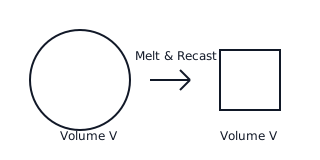
Diagram showing a sphere being converted into a cube with the text 'Volume remains same'.
•

In problems involving 'emptying' or 'filling', such as water flowing through a pipe into a tank, the volume of water flows per unit time is calculated as: Volume=Area of cross-section×Speed of flow×TimeVolume = Area \text{ of cross-section} \times \text{Speed of flow} \times \text{Time}

•

When a solid is dipped into a container full of liquid, the volume of the liquid displaced is exactly equal to the volume of the submerged part of the solid.

•

If a solid is recast into a new shape, properties like Surface Area usually change, even though the Volume stays the same. Always solve for the unknown dimension (like height or radius) using the volume equality first.

📐Formulae

VolumetextofCube=a3Volume \\text{ of Cube} = a^3

VolumetextofCuboid=ltimesbtimeshVolume \\text{ of Cuboid} = l \\times b \\times h

VolumetextofCylinder=pir2hVolume \\text{ of Cylinder} = \\pi r^2 h

VolumetextofCone=frac13pir2hVolume \\text{ of Cone} = \\frac{1}{3} \\pi r^2 h

VolumetextofSphere=frac43pir3Volume \\text{ of Sphere} = \\frac{4}{3} \\pi r^3

VolumetextofHemisphere=frac23pir3Volume \\text{ of Hemisphere} = \\frac{2}{3} \\pi r^3

VolumetextofHollowCylinder=pi(R2−r2)hVolume \\text{ of Hollow Cylinder} = \\pi (R^2 - r^2)h

SlanttextheightofCone(l)=sqrtr2+h2Slant \\text{ height of Cone } (l) = \\sqrt{r^2 + h^2}

💡Examples

Problem 1:

A metallic sphere of radius 4.24.2 cm is melted and recast into the shape of a cylinder of radius 66 cm. Find the height of the cylinder.

Solution:

  1. Let r=4.2r = 4.2 cm be the radius of the sphere and R=6R = 6 cm be the radius of the cylinder. Let hh be the height of the cylinder. 2. Since the sphere is melted and recast, Volumetextofsphere=VolumetextofcylinderVolume \\text{ of sphere} = Volume \\text{ of cylinder}. 3. Formula: frac43pir3=piR2h\\frac{4}{3} \\pi r^3 = \\pi R^2 h. 4. Substitute values and cancel pi\\pi: frac43times(4.2)3=62timesh\\frac{4}{3} \\times (4.2)^3 = 6^2 \\times h. 5. frac4times4.2times4.2times4.23=36h\\frac{4 \\times 4.2 \\times 4.2 \\times 4.2}{3} = 36h. 6. 4times1.4times17.64=36hRightarrow5.6times17.64=36h4 \\times 1.4 \\times 17.64 = 36h \\Rightarrow 5.6 \\times 17.64 = 36h. 7. 98.784=36hRightarrowh=frac98.78436=2.74498.784 = 36h \\Rightarrow h = \\frac{98.784}{36} = 2.744 cm.

Explanation:

The principle used is the conservation of volume. By equating the volume of the original sphere to the volume of the new cylinder, we can solve for the unknown height hh of the cylinder.

Problem 2:

How many silver coins, 1.751.75 cm in diameter and of thickness 22 mm, must be melted to form a cuboid of dimensions 5.55.5 cm times10\\times 10 cm times3.5\\times 3.5 cm?

Solution:

  1. Cuboid dimensions: l=5.5l = 5.5 cm, b=10b = 10 cm, h=3.5h = 3.5 cm. Volume=5.5times10times3.5=192.5textcm3Volume = 5.5 \\times 10 \\times 3.5 = 192.5 \\text{ cm}^3. 2. Coin dimensions (Cylinder): Radius r=frac1.752=0.875r = \\frac{1.75}{2} = 0.875 cm, Thickness h′=2textmm=0.2h' = 2 \\text{ mm} = 0.2 cm. 3. Volume of one coin: V=pir2h′=frac227times(0.875)2times0.2V = \\pi r^2 h' = \\frac{22}{7} \\times (0.875)^2 \\times 0.2. 4. Let nn be the number of coins. ntimesVolumetextofonecoin=Volumetextofcuboidn \\times Volume \\text{ of one coin} = Volume \\text{ of cuboid}. 5. ntimesfrac227timesfrac78timesfrac78timesfrac15=192.5n \\times \\frac{22}{7} \\times \\frac{7}{8} \\times \\frac{7}{8} \\times \\frac{1}{5} = 192.5. 6. ntimesfrac11times732times5=192.5Rightarrowntimesfrac77160=192.5n \\times \\frac{11 \\times 7}{32 \\times 5} = 192.5 \\Rightarrow n \\times \\frac{77}{160} = 192.5. 7. n=frac192.5times16077=2.5times160=400n = \\frac{192.5 \\times 160}{77} = 2.5 \\times 160 = 400.

Explanation:

To find the number of coins, we divide the total volume of the resulting cuboid by the volume of a single cylindrical coin. All units were converted to centimeters before solving.

Problem 3:

A solid metallic right circular cone of height 2424 cm and radius of base 66 cm is melted and recast into a sphere. Find the radius of the sphere.
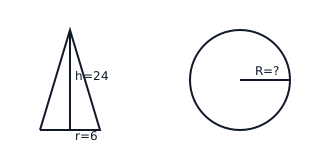
A cone with height 24 and radius 6 next to a sphere of unknown radius R.

Solution:

Volume of Cone=13πrc2hcVolume \text{ of Cone} = \frac{1}{3} \pi r_c^2 h_c Volume of Cone=13×π×62×24Volume \text{ of Cone} = \frac{1}{3} \times \pi \times 6^2 \times 24 Volume of Cone=288π cm3Volume \text{ of Cone} = 288\pi \text{ cm}^3 Let the radius of the sphere be RR. Volume of Sphere=43πR3Volume \text{ of Sphere} = \frac{4}{3} \pi R^3 Since the cone is recast into a sphere: 43πR3=288π\frac{4}{3} \pi R^3 = 288\pi R3=288×34R^3 = \frac{288 \times 3}{4} R3=72×3=216R^3 = 72 \times 3 = 216 R=2163=6 cmR = \sqrt[3]{216} = 6 \text{ cm}

Explanation:

The volume of the original cone must equal the volume of the new sphere. By equating the two volume formulae, we can cancel out π\pi and solve for the unknown radius RR.

Problem 4:

A cylindrical copper rod of diameter 11 cm and length 88 cm is drawn into a wire of length 1818 m of uniform thickness (cylindrical). Find the thickness (diameter) of the wire.
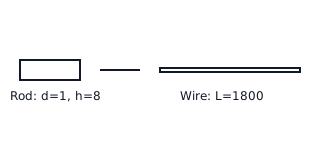
Short thick cylinder (rod) being stretched into a long thin cylinder (wire).

Solution:

Convert all units to cm: Length of wire L=18 m=1800 cmL = 18 \text{ m} = 1800 \text{ cm}. Radius of rod r=12=0.5 cmr = \frac{1}{2} = 0.5 \text{ cm}. Volume of Rod=πr2h=π×(0.5)2×8=2π cm3Volume \text{ of Rod} = \pi r^2 h = \pi \times (0.5)^2 \times 8 = 2\pi \text{ cm}^3 Let the radius of the wire be RR. Volume of Wire=πR2L=π×R2×1800Volume \text{ of Wire} = \pi R^2 L = \pi \times R^2 \times 1800 Since volume remains the same: 1800πR2=2π1800\pi R^2 = 2\pi R2=21800=1900R^2 = \frac{2}{1800} = \frac{1}{900} R=130 cmR = \frac{1}{30} \text{ cm} Thickness(Diameter)=2R=2×130=115 cm≈0.067 cmThickness (Diameter) = 2R = 2 \times \frac{1}{30} = \frac{1}{15} \text{ cm} \approx 0.067 \text{ cm}

Explanation:

A wire is simply a very long and thin cylinder. The volume of the copper remains constant as it is stretched from a rod into a wire. Ensure all units are consistent (cm) before calculating.