
Review the key concepts, formulae, and examples before starting your quiz.
🔑Concepts
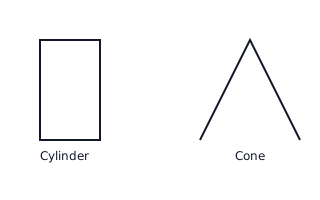
The Right Circular Cylinder consists of two congruent circular bases and a curved surface. The radius is the distance from the center to the edge of the base, and height is the perpendicular distance between the bases.
A Right Circular Cone is formed by a circular base and a slanted surface meeting at a point called the vertex. The slant height is the distance from the vertex to any point on the circumference of the base, forming a right-angled triangle with radius and vertical height .
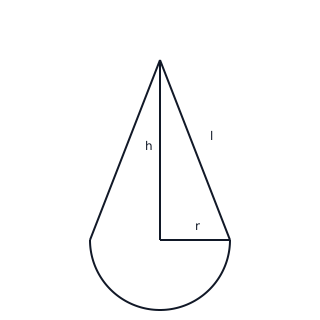
A Sphere is a perfectly round geometrical object in three-dimensional space. Every point on its surface is equidistant from its center. A Hemisphere is exactly half of a sphere.
When a solid is melted and recast into another shape, the volume remains constant. This principle is used to find dimensions or the number of objects formed.
📐Formulae
Cylinder Volume:
Cylinder Curved Surface Area (CSA):
Cylinder Total Surface Area (TSA):
Cone Slant Height:
Cone Volume:
Cone Curved Surface Area (CSA):
Cone Total Surface Area (TSA):
Sphere Surface Area:
Sphere Volume:
Hemisphere Curved Surface Area (CSA):
Hemisphere Total Surface Area (TSA):
Hemisphere Volume:
Hollow Cylinder Volume:
💡Examples
Problem 1:
A metallic sphere of radius is melted and then recast into small cones, each of radius and height . Find the number of cones formed.
Solution:
- Volume of the sphere = \
- Volume of one small cone = \
- Let the number of cones be . By the principle of conservation of volume: \
- \
- \
Explanation:
When a solid is melted and recast, the total volume remains the same. We calculate the volume of the large sphere and divide it by the volume of a single small cone to find the total number of cones.
Problem 2:
A solid is in the form of a cylinder with hemispherical ends. The total height of the solid is and the diameter of the cylinder is . Find the total surface area and the volume of the solid.
Solution:
- Radius of cylinder and hemispheres \
- Height of the cylinder \
- Volume = Volume of cylinder + Volume of hemisphere
\ - Total Surface Area (TSA) = CSA of cylinder + CSA of hemisphere
Explanation:
For composite solids, the height of the central cylinder is found by subtracting the radii of the two hemispherical ends from the total height. The surface area includes only the curved parts because the flat circular faces are joined together internally.
Problem 3:
A cylindrical bucket, high and with radius of base , is filled with sand. This bucket is emptied on the ground and a conical heap of sand is formed. If the height of the conical heap is , find the radius and slant height of the heap.
Solution:
- Volume of sand in the cylindrical bucket:
- Volume of the conical heap:
- Equating the volumes ():
- Slant height of the heap:
Explanation:
The volume of sand remains the same when transferred from the cylinder to the cone. We solve for the unknown radius using the volume equality and then use the Pythagorean theorem for slant height.
Problem 4:
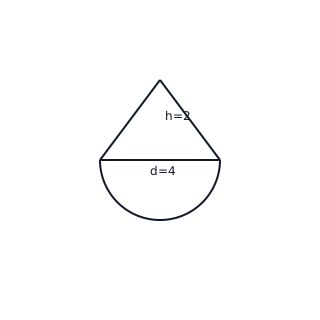
A solid toy is in the form of a hemisphere surmounted by a right circular cone. The height of the cone is and the diameter of the base is . Determine the volume of the toy.
Solution:
- Dimensions: Radius of hemisphere and cone Height of cone
- Volume of the toy = Volume of cone + Volume of hemisphere
- Taking :
Explanation:
The toy is a composite solid. Its total volume is the sum of the volumes of its individual geometric components (cone and hemisphere) sharing the same base radius.