
Review the key concepts, formulae, and examples before starting your quiz.
🔑Concepts
When two solids are joined together, the total volume of the resulting combination is the sum of the volumes of the individual components. For example, a cylinder capped with a hemisphere has .
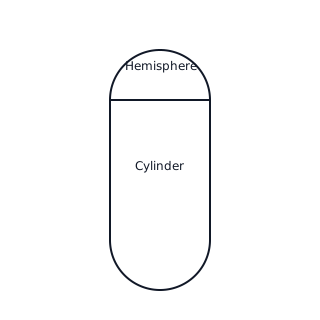
In combined solids, the Total Surface Area (TSA) is NOT always the sum of the individual TSAs. If two surfaces are joined, those surfaces are no longer 'visible' or 'exposed'. The visible surface area is the sum of the Curved Surface Areas (CSA) of the parts.
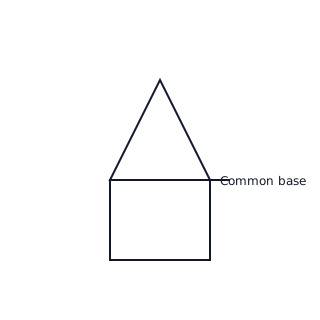
Recasting of Solids: When a solid is melted and recast into another shape, the volume remains constant. This principle is expressed as , where is the number of new solids formed.
Hollow Solids: For objects like pipes or hollow spheres, the volume of the material is found by subtracting the internal volume from the external volume: .
📐Formulae
Volume of Cylinder:
Curved Surface Area of Cylinder:
Total Surface Area of Cylinder:
Volume of Cone:
Curved Surface Area of Cone: where
Total Surface Area of Cone:
Volume of Sphere:
Surface Area of Sphere:
Volume of Hemisphere:
Curved Surface Area of Hemisphere:
Total Surface Area of Hemisphere:
Volume of material in a hollow cylinder:
💡Examples
Problem 1:
A toy is in the form of a cone of radius mounted on a hemisphere of the same radius. The total height of the toy is . Find the total surface area of the toy. (Use )
Solution:
- Radius of cone and hemisphere, .
- Total height of toy = . Height of cone, .
- Calculate slant height of the cone: .
- Surface Area of toy = CSA of cone + CSA of hemisphere.
- Surface Area = .
- Substituting values: .
Explanation:
To find the surface area of a combined solid, we only sum the areas of the visible surfaces. The base of the cone and the base of the hemisphere are joined, so they are not part of the external surface. We use the total height to find the vertical height of the cone first, then find the slant height for the CSA calculation.
Problem 2:
A solid metallic sphere of radius is melted and recast into a number of smaller cones, each of radius and height . Find the number of cones formed.
Solution:
- Volume of the metallic sphere .
- Volume of one small cone .
- Let be the number of cones. By conservation of volume: .
- .
- Canceling and from both sides: .
- .
- Since , we get .
Explanation:
When melting one solid to form others, the total volume remains the same. We set up an equation where the volume of the large sphere equals times the volume of a single small cone. It is usually easier to keep as a symbol and cancel it out later to simplify calculations.
Problem 3:
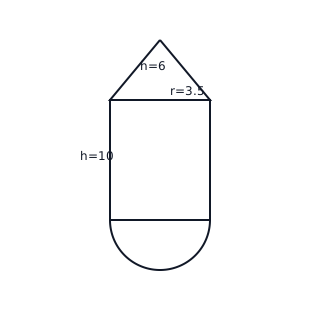
A solid is in the form of a right circular cylinder with a hemisphere at one end and a cone at the other end. The radius of the common base is . The height of the cylindrical part is and the height of the conical part is . Find the total volume of the solid.
Solution:
- Identify individual components:
- Radius () for all parts =
- Height of cylinder () =
- Height of cone () =
- Calculate individual volumes:
- Total Volume:
Explanation:
To find the volume of a combined solid, we sum the volumes of its constituent geometric parts: the cone, the cylinder, and the hemisphere.
Problem 4:
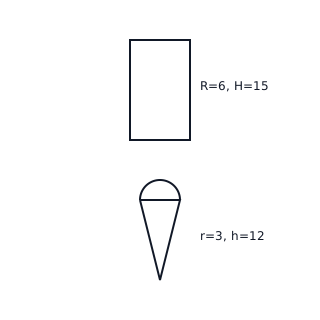
A cylindrical container of radius and height is full of ice cream. This ice cream is to be filled into cones of height and radius , having a hemispherical shape on the top. Find the number of such cones which can be filled.
Solution:
- Volume of ice cream in cylinder:
- Volume of one ice cream cone (Cone + Hemisphere):
- Number of cones ():
Explanation:
Since the total volume of ice cream remains the same when transferred, we divide the volume of the cylinder by the volume of a single combined ice cream cone shape.