krit.club logo

Geometry - Similarity (of triangles, polygons)

Grade 10ICSE

Review the key concepts, formulae, and examples before starting your quiz.

🔑Concepts

•

Two polygons are similar if their corresponding angles are equal and their corresponding sides are in the same ratio. For triangles, similarity can be established using AAA (Angle-Angle-Angle), SAS (Side-Angle-Side), or SSS (Side-Side-Side) criteria.
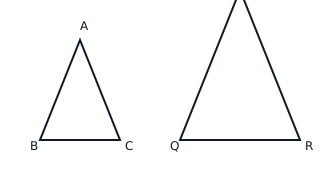
Two similar triangles ABC and PQR with different sizes but identical shape.
•

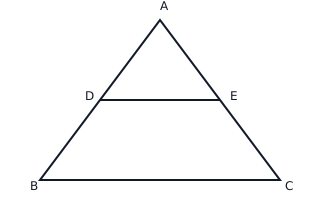
Basic Proportionality Theorem (Thales's Theorem): If a line is drawn parallel to one side of a triangle to intersect the other two sides in distinct points, the other two sides are divided in the same ratio. In △ABC\triangle ABC, if DE∥BCDE \parallel BC, then ADDB=AEEC\frac{AD}{DB} = \frac{AE}{EC}.

Triangle ABC with a line DE parallel to BC intersecting sides AB and AC.
•

The ratio of the areas of two similar triangles is equal to the square of the ratio of their corresponding sides. If △ABC∼△PQR\triangle ABC \sim \triangle PQR, then Area(△ABC)Area(△PQR)=(ABPQ)2=k2\frac{\text{Area}(\triangle ABC)}{\text{Area}(\triangle PQR)} = \left(\frac{AB}{PQ}\right)^2 = k^2.

•

Map and Model Scales: In maps or models, the scale factor kk represents the ratio of linear dimensions. The ratio of areas is k2k^2 and the ratio of volumes is k3k^3.

📐Formulae

Scale Factor (kk): k=Length of ModelLength of Objectk = \frac{\text{Length of Model}}{\text{Length of Object}}

Basic Proportionality: ADDB=AEEC\frac{AD}{DB} = \frac{AE}{EC} (where DE∥BCDE \parallel BC)

Ratio of Sides: ABPQ=BCQR=ACPR=k\frac{AB}{PQ} = \frac{BC}{QR} = \frac{AC}{PR} = k

Ratio of Perimeters: Perimeter(△ABC)Perimeter(△PQR)=k\frac{\text{Perimeter}(\triangle ABC)}{\text{Perimeter}(\triangle PQR)} = k

Ratio of Areas: Area(△ABC)Area(△PQR)=k2\frac{\text{Area}(\triangle ABC)}{\text{Area}(\triangle PQR)} = k^2

Ratio of Volumes: Volume1Volume2=k3\frac{\text{Volume}_1}{\text{Volume}_2} = k^3

💡Examples

Problem 1:

In △ABC\triangle ABC, DE∥BCDE \parallel BC with DD on ABAB and EE on ACAC. If AD=3 cmAD = 3 \text{ cm}, DB=5 cmDB = 5 \text{ cm}, and AE=4.5 cmAE = 4.5 \text{ cm}, find the length of ACAC.

Solution:

  1. Since DE∥BCDE \parallel BC, by the Basic Proportionality Theorem, we have: ADDB=AEEC\frac{AD}{DB} = \frac{AE}{EC}
  2. Substitute the given values: 35=4.5EC\frac{3}{5} = \frac{4.5}{EC}
  3. Solve for ECEC: 3×EC=5×4.53 \times EC = 5 \times 4.5 3×EC=22.53 \times EC = 22.5 EC=22.53=7.5 cmEC = \frac{22.5}{3} = 7.5 \text{ cm}
  4. Find ACAC by adding the segments: AC=AE+EC=4.5+7.5=12 cmAC = AE + EC = 4.5 + 7.5 = 12 \text{ cm}

Explanation:

We use the Basic Proportionality Theorem which states that a line parallel to one side of a triangle divides the other two sides proportionally. After finding the lower segment ECEC, we add it to the upper segment AEAE to get the total length of side ACAC.

Problem 2:

The areas of two similar triangles △PQR\triangle PQR and △XYZ\triangle XYZ are 64 cm264 \text{ cm}^2 and 121 cm2121 \text{ cm}^2 respectively. If QR=12 cmQR = 12 \text{ cm}, find the length of YZYZ.

Solution:

  1. We know that for similar triangles: Area(△PQR)Area(△XYZ)=(QRYZ)2\frac{\text{Area}(\triangle PQR)}{\text{Area}(\triangle XYZ)} = \left(\frac{QR}{YZ}\right)^2
  2. Substitute the known values: 64121=(12YZ)2\frac{64}{121} = \left(\frac{12}{YZ}\right)^2
  3. Take the square root of both sides: 64121=12YZ\sqrt{\frac{64}{121}} = \frac{12}{YZ} 811=12YZ\frac{8}{11} = \frac{12}{YZ}
  4. Solve for YZYZ using cross-multiplication: 8×YZ=12×118 \times YZ = 12 \times 11 8×YZ=1328 \times YZ = 132 YZ=1328=16.5 cmYZ = \frac{132}{8} = 16.5 \text{ cm}

Explanation:

This problem applies the property that the ratio of the areas of similar triangles is equal to the square of the ratio of their corresponding sides. By taking the square root of the area ratio, we find the linear scale factor and use it to calculate the missing side length.

Problem 3:

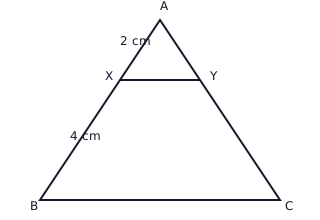
In the given figure, XY∥BCXY \parallel BC. If AX=2 cmAX = 2\text{ cm}, XB=4 cmXB = 4\text{ cm} and the area of △AXY=5 cm2\triangle AXY = 5\text{ cm}^2, find the area of trapezium XYCBXYCB.

Triangle ABC with XY parallel to BC, showing segments AX=2 and XB=4.

Solution:

  1. In △AXY\triangle AXY and △ABC\triangle ABC: ∠A=∠A\angle A = \angle A (Common) ∠AXY=∠ABC\angle AXY = \angle ABC (Corresponding angles as XY∥BCXY \parallel BC) Therefore, △AXY∼△ABC\triangle AXY \sim \triangle ABC by AA similarity.

  2. Find the scale factor kk of the sides: AB=AX+XB=2+4=6 cmAB = AX + XB = 2 + 4 = 6\text{ cm} k=AXAB=26=13k = \frac{AX}{AB} = \frac{2}{6} = \frac{1}{3}

  3. Use the area ratio property: Area(△AXY)Area(△ABC)=k2=(13)2=19\frac{\text{Area}(\triangle AXY)}{\text{Area}(\triangle ABC)} = k^2 = \left(\frac{1}{3}\right)^2 = \frac{1}{9} 5Area(△ABC)=19\frac{5}{\text{Area}(\triangle ABC)} = \frac{1}{9} Area(△ABC)=5×9=45 cm2\text{Area}(\triangle ABC) = 5 \times 9 = 45\text{ cm}^2

  4. Calculate the area of the trapezium: Area(XYCB)=Area(△ABC)−Area(△AXY)\text{Area}(XYCB) = \text{Area}(\triangle ABC) - \text{Area}(\triangle AXY) Area(XYCB)=45−5=40 cm2\text{Area}(XYCB) = 45 - 5 = 40\text{ cm}^2

Explanation:

Since the line segment is parallel to the base, the smaller triangle at the top is similar to the whole triangle. The ratio of their areas is the square of the ratio of their corresponding side lengths. The area of the trapezium is the difference between the large and small triangle areas.

Problem 4:

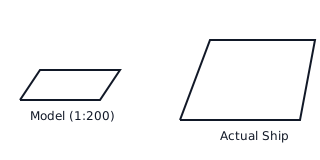
A model of a ship is made to a scale of 1:2001:200. If the area of the deck of the model is 0.5 m20.5\text{ m}^2 and the volume of the model is 0.02 m30.02\text{ m}^3, find: (i) The actual area of the deck in m2\text{m}^2. (ii) The actual volume of the ship in m3\text{m}^3.

Visual comparison of a small model ship and a large actual ship to illustrate scale factor.

Solution:

Given scale factor k=1200k = \frac{1}{200}.

(i) For Area: Area of ModelActual Area=k2\frac{\text{Area of Model}}{\text{Actual Area}} = k^2 0.5Actual Area=(1200)2=140000\frac{0.5}{\text{Actual Area}} = \left(\frac{1}{200}\right)^2 = \frac{1}{40000} Actual Area=0.5×40000=20000 m2\text{Actual Area} = 0.5 \times 40000 = 20000\text{ m}^2

(ii) For Volume: Volume of ModelActual Volume=k3\frac{\text{Volume of Model}}{\text{Actual Volume}} = k^3 0.02Actual Volume=(1200)3=18000000\frac{0.02}{\text{Actual Volume}} = \left(\frac{1}{200}\right)^3 = \frac{1}{8000000} Actual Volume=0.02×8000000=160000 m3\text{Actual Volume} = 0.02 \times 8000000 = 160000\text{ m}^3

Explanation:

Scaling applies to all dimensions. Linear dimensions scale by kk, area by k2k^2, and volume by k3k^3. Here, the ship is the object and the model is the image.