
Review the key concepts, formulae, and examples before starting your quiz.
🔑Concepts
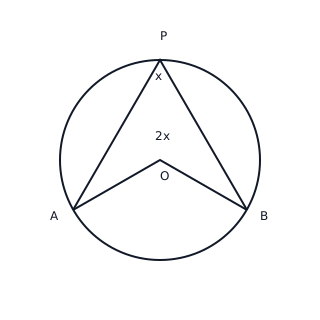
The angle subtended by an arc at the center is double the angle subtended by it at any point on the remaining part of the circle. This implies that all angles subtended by the same arc in the same segment are equal.
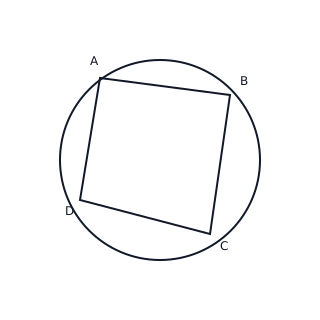
In a cyclic quadrilateral, the sum of opposite angles is . Furthermore, the exterior angle of a cyclic quadrilateral is equal to the interior opposite angle.
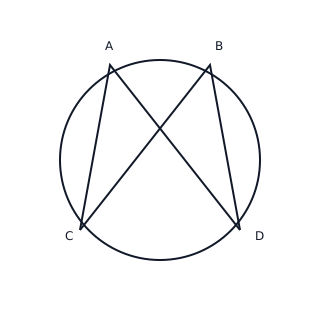
Angles in the same segment of a circle are equal. This is a direct consequence of the central angle theorem.
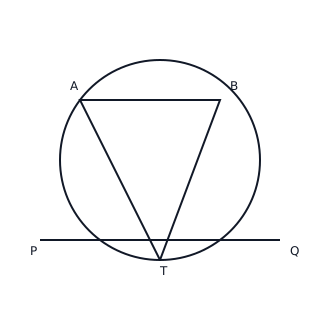
The angle between a tangent and a chord through the point of contact is equal to the angle subtended by the chord in the alternate segment.
📐Formulae
Angle at Center:
Cyclic Quadrilateral:
Intersecting Chords (Internal):
Intersecting Secants (External): (where is the external intersection point)
Tangent-Secant Theorem: (where is a tangent and is a secant)
Length of tangent from point at distance from center with radius :
💡Examples
Problem 1:
In a circle with center , chord is equal to the radius of the circle. Find the angle subtended by this chord at a point on the major arc.
Solution:
- Let the radius of the circle be . Given chord .
- In , (radii) and (given).
- Therefore, is an equilateral triangle.
- This implies the angle at the center .
- By the property that the angle at the center is double the angle at the circumference: .
- .
Explanation:
We first identify the triangle formed by the radii and the chord. Since all sides are equal, we find the central angle, then apply the theorem relating central angles to angles at the circumference.
Problem 2:
From an external point , a tangent and a secant are drawn to a circle. If and , find the length of .
Solution:
- Use the Tangent-Secant Theorem: .
- Substitute the known values: .
- .
- .
- Since lies on the secant line such that , we have:
- .
- .
Explanation:
The Tangent-Secant theorem relates the length of the tangent segment to the product of the entire secant segment and its external portion. Solving for the full secant length allows us to subtract the external part to find the chord length.
Problem 3:
In the given figure, is the center of the circle. If , find where is a point on the circumference in the major segment.
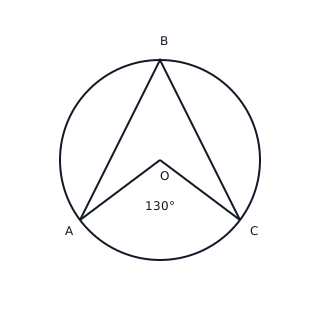
Solution:
Explanation:
According to the property that the angle subtended by an arc at the center of a circle is double the angle subtended by it at any point on the remaining part of the circle, the angle at the circumference is half of the central angle .
Problem 4:
In the figure, two chords and of a circle intersect at an internal point . If , and , find the length of .
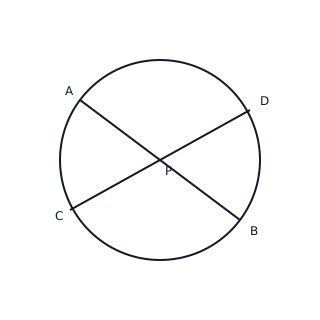
Solution:
By the Intersecting Chords Theorem:
Explanation:
When two chords of a circle intersect internally, the product of the lengths of the segments of one chord is equal to the product of the lengths of the segments of the other chord.