
Review the key concepts, formulae, and examples before starting your quiz.
🔑Concepts
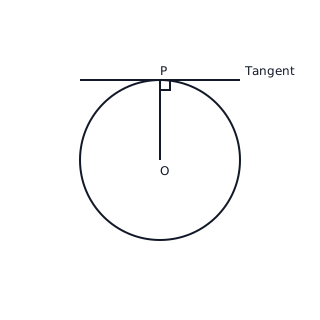
The tangent at any point on a circle is perpendicular to the radius through the point of contact. This fundamental property allows us to construct tangents by drawing a perpendicular to the radius at the point where it meets the circumference.
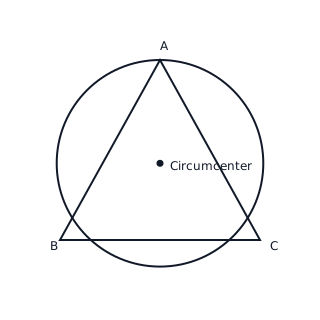
The circumcircle of a triangle is constructed by finding the intersection of the perpendicular bisectors of any two sides. This point is the circumcenter (), which is equidistant from all three vertices () of the triangle.
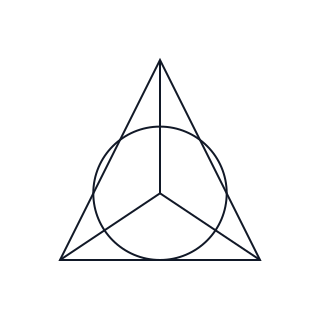
The incircle of a triangle is the largest circle that can fit inside the triangle, touching all three sides. It is constructed by finding the intersection of the internal angle bisectors of the triangle.
To construct a tangent to a circle from an external point, we join the point to the center, bisect this line segment, and draw a second circle with the midpoint as center and radius equal to half the segment length.
📐Formulae
Angle between Radius and Tangent:
Length of Tangents from External Point:
Tangent-Secant Theorem: (where is the tangent and is a secant line)
Inradius () of a triangle:
Circumradius () of a triangle: (where are side lengths)
Semi-perimeter:
💡Examples
Problem 1:
Construct a triangle with , , and . Construct the incircle of this triangle.
Solution:
- Draw the base .
- Use a compass to draw an arc of from and an arc of from . The intersection point is . Join and .
- Construct the angle bisector of by drawing an arc and then two intersecting arcs from the points where the first arc cuts and .
- Similarly, construct the angle bisector of .
- The point where these two bisectors intersect is the incenter .
- From , draw a perpendicular to the side . Let the foot of the perpendicular be .
- With as center and as radius, draw the circle that touches all three sides.
Explanation:
The incenter is the equidistant point from all sides of the triangle. By bisecting the angles, we locate this point. The perpendicular distance to a side serves as the radius.
Problem 2:
Draw a circle of radius . From a point at a distance of from the center , construct two tangents to the circle. Measure the length of the tangents.
Solution:
- Draw a circle with center and radius .
- Mark a point such that .
- Construct the perpendicular bisector of : Draw arcs from and with radius greater than to find midpoint .
- With as center and (or ) as radius, draw a dotted circle.
- Let the dotted circle intersect the original circle at points and .
- Join and . These are the required tangents.
- Calculation: .
Explanation:
This construction utilizes the property that the angle in a semi-circle is . The dotted circle ensures that is a right angle, making a tangent.
Problem 3:
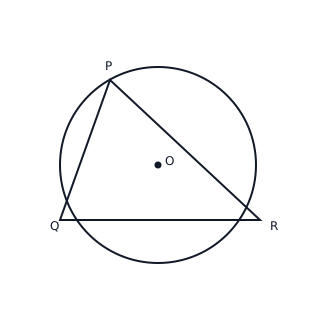
Construct a triangle where cm, cm, and cm. Construct the circumcircle of triangle .
Solution:
- Draw a line cm.
- With as center and radius cm, draw an arc. With as center and radius cm, draw another arc to intersect at .
- Join and to form .
- Draw the perpendicular bisectors of and .
- Let the intersection of these bisectors be (the circumcenter).
- With as center and as radius, draw the circle passing through and .
Explanation:
The circumcenter is the point where the perpendicular bisectors of the sides meet. This point is equidistant from all vertices, making .
Problem 4:
Construct a circle of radius cm. Take a point on the circle and construct a tangent to the circle at point without using the center.
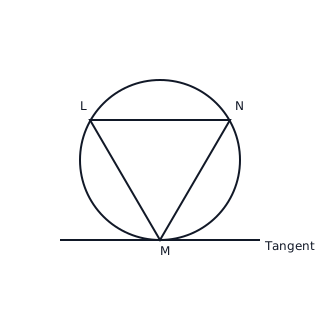
Solution:
- Draw a circle of radius cm and mark point on the circumference.
- Draw any chord and take a third point on the major arc .
- Join and to form in the alternate segment.
- At point , construct an angle equal to (angles in alternate segments).
- The line forming this angle with chord is the required tangent.
Explanation:
According to the Alternate Segment Theorem, the angle between a tangent and a chord through the point of contact is equal to the angle in the alternate segment.